Yes. They do.
(Source for all photos in this post)
Yes. The purebred dog in that last identification query is a Labrador.
And you may have seen a dog like this one on this blog before.
Remember, Ch. Zelstone?

Zelstone was born in 1880, and he became a very important sire in the old wavy and flat-coated retriever breed from which both golden retrievers and modern flat-coats descend. Tracer, his son and full brother to Ch. Moonstone, was bred into the strain of yellow wavy-coated retrievers at Guisachan. Moonstone, when bred back to his mother produced a red-gold puppy, which meant that Zelstone carried the recessive red color.
Zelstone’s ancestry ran right through Henry Farquharson’s kennels— and he was mostly of St. John’s water dog ancestry. Farquharson was a major importer of dogs from Newfoundland, and although most of his dogs were of the larger type, he evidently had some of the smaller St. John’s type. It is likely that some of these were long-haired dogs. Lambert de Boillieu, a trader working Labrador during the 1850’s, mentions that long-haired dogs were of no use to the fishermen and hunters of Newfoundland and Labrador, and they were eager to have them sent off to Britain:
The dogs sent to England, with rough shaggy coats, are useless on the coast; the true-bred and serviceable dog having smooth, short hair, very close and compact to the body. I sent to England a fine specimen of these, but unfortunately the vessel which bore it had the misfortune to be wrecked on the north coast of Ireland, and all hands were lost (243-244).
The long-haired dogs likely comprised the vast majority of the dogs imported to Britain, where they were used to found the wavy-coated retriever. It is often said that the long-coats on these dogs derived from crossing the smooth-coated St. John’s water dog with the setter. However, this doesn’t theory hold up with much scrutiny. If one breeds a dog that is homozygous for the smooth-coat to a dog that is homozygous for the long-coat, you will get smooth-coated puppies. The vast majority of retrievers derived from St. John’s water dogs or “Labradors” in the British Isles during the nineteenth century were long-coated and were called “wavy-coated retrievers.” These dogs were sometimes crossed with setters or collies, but as a rule, they were almost always long-coated.
The Rev. Thomas Pearce (“Idstone”) wrote inThe Dog (1872) that smooth-coated retrievers that were of this St. John’s water dog ancestry were quite rare in England, but it was possible to get puppies with both coats in litters. The smooths were always associated with imports from Newfoundland, but they were good workers:
The flat and shaggy, and the smooth-coated—I mean as short in the hair as a Mastiff—are sometimes found in one litter, and one of the best I ever saw was thus bred from Mr. Drax’s keeper’s old “Dinah” (imported), the father being also from Labrador. “Jack” acknowledged no owner but Mr. Drax, and died in his service at Charborough Park. During the time he was in the squire’s service he must have carried more game than any team, or half-a-dozen teams, could draw, since every year he went the circuit of Mr. Drax’s manors and estates, and the two were as much heralds of each other in Kent, Dorset, or Yorkshire, as Wells and “Fisherman” when a Queen’s Plate was to be run for. Beaters gave him a wide berth, for he was not to be induced to give up game to them, and woe betide any of the number, whom he knew by their dress—a white gaberdine with a red cross in it—if they approached to familiarity, or intercepted him whilst he tracked his game liked a Bloodhound, and stooped to his line amongst the underwood, or tried to knock over crippled game after he had viewed it and was racing it down.
He was just like his rough brother ” Tom ” —or, in fact, like “Snow,” in all but length of coat . As they,” Snow” and “Tom,” came out of the lake when we were shooting teal and widgeon, drenched with half-frozen water, I have frequently been struck with the family likeness.
But the smooth-coated dog has a lighter eye—a pale hazel with an intensely black pupil, occasionally very like what is known as a “china” or “wall-eye.” Be that how it may, they are the best of all breeds for boating; they can stand all weathers, and though men unused to them call them butchers’ dogs [a common complaint was that St. John’s water dogs with smooth coats looked like bulldogs], I think them handsome, and I know that they are sensible, and that the punt and shore men, living by adroit use of the long stauncheon gun and “flat,” look upon them as a part of their household, and in some cases—to quote the words of one old sporting farmer, to a duke who wanted to buy his horse— “no man has money enough to buy them” (pg. 128-129).
Idstone believed that the setter was the primary ancestor of the wavy-coated retriever, but we now know that during the early days of this kind of retriever in the nineteenth century that they were primarily of St. John’s water dog ancestry.
The famous depiction of Paris and Melody from an edition “Stonehenge’s” Dogs of the British Islands. Paris was said to have been a pure “Labrador” or “St. John’s water dog.” He also had long hair. Melody was a setter cross, and she looks more like a setter than even the modern flat-coated retriever, which had some Irish setter crossed in at a later date to make them even more refined.

The modern flat-coated retriever also has more or less the setter’s coat, which lacks the very, very dense undercoat that is associated with golden and Labrador retrievers. Because of this coat type in modern flat-coats, it is much more likely that the wavy-coated retrievers were primarily of St. John’s water dog ancestry– with only occasional outcrosses to setters.
When Stonehenge provided a depiction of a St. John’s Newfoundland or Labrador dog in an edition of The Dog in Health and Disease (1879), he chose to use an image of a long-haired one.

Now, the long-haired dogs would be instrumental in establishing the old wavy-coated retriever, which eventually became the golden retriever and the modern flat-coat. These were the dominant retrievers in the British Isles through the late nineteenth century and early twentieth century. The founding president of the Kennel Club, Sewallis Shirley, was a major patron of this retriever, and he and Dr. Bond Moore, who often called his dogs “Labradors,” were instrumental in establishing the old wavy/flat-coated retriever as defined breed. These were all long-haired dogs, but because there were only two varieties of retriever, the curly and the wavy, there was some interbreeding between those two types. Smooth-coated retrievers were very uncommon at this time, which also strongly suggests that the founding population of St. John’s water dogs that were used to found the wavy-coated retrievers were of the shaggy-type that Lambert de Boilieu mentioned. If the founding dogs were smooth-coated as the later St. John’s water dogs were, then most of the retrievers that were derived from these dogs would have been smooths. But the bulk of the evidence shows that the British retriever in the nineteenth century was almost universally long-haired.

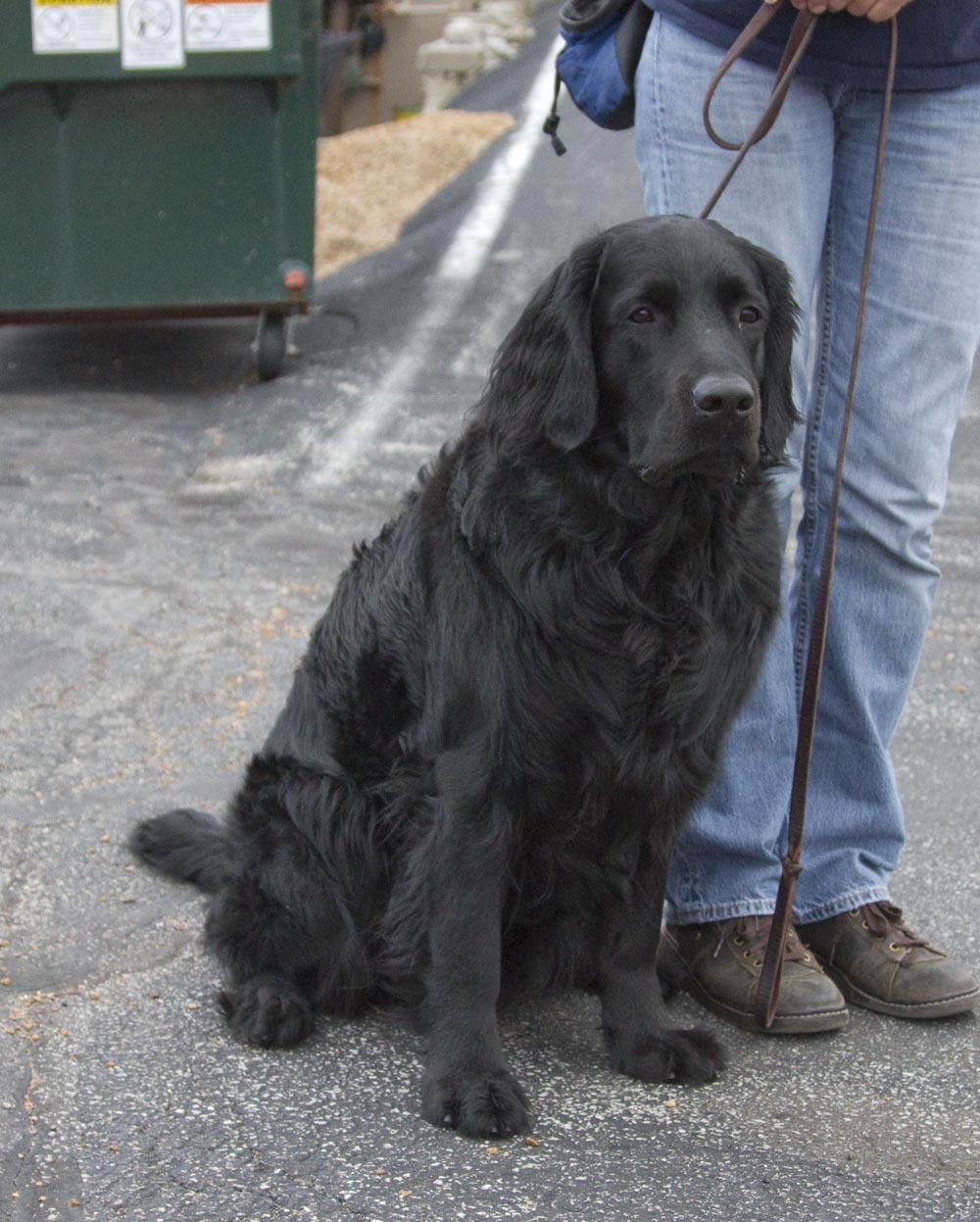
A modern long-haired Labrador retriever in profile. Its resemblance to the old wavy-coated retriever is uncanny.
One needs to understand that the dog that these texts call a “Labrador” isn’t necessarily the same as the breed called the “Labrador retriever.” The modern Labrador retriever traces to the 1880’s, when the line of smooth-coated retrievers that was kept by the Dukes of Buccleuch was combined with that of the Earls of Malmesbury. This was the only British retriever to be selected for the dominant smooth coat. Modern Labrador retriever are almost universally smooth-coated dogs.
However, very rarely, a long-coated puppy is born. These dogs are extremely rare– much rarer than Labradors with tan poins or brindling.
The exact origin of these modern long-haired Labradors isn’t exactly clear.
They could have always been hidden within the smooth-coated St. John’s water dog bloodlines that eventually gave us the Labrador retriever, but if this were so, it probably would be more common in the breed than it is today. I think a much more likely source for this coat is cross-breeding. Labrador, golden, and flat-coated retrievers were considered varieties of a single breed, and interbreeding the varieties was very common. When the Labrador retriever needed fresh blood, it was occasionally bred to wavy or flat-coated retrievers, which may have included dogs we would call golden retrievers. The Dukes of Buccleuch and the Earls of Malmesbury tried to keep their dogs from being bred to long-haired retrievers, which is one reason why they were so eager to import more smooths from Newfoundland. However, other breeders certainly did outcross.
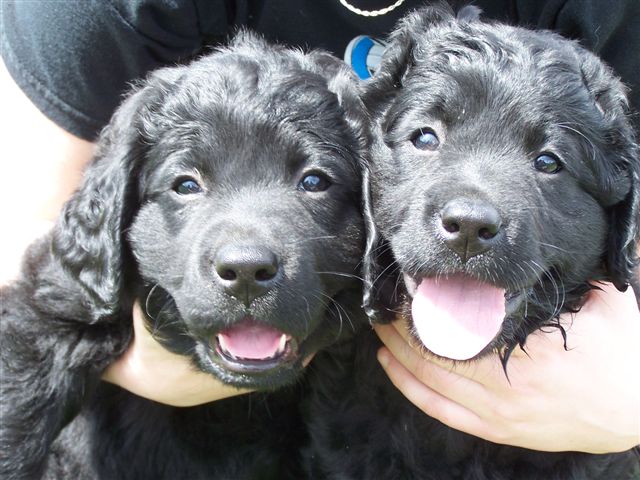
Long-haired Labrador retriever puppies.
Long-haired Labrador retrievers are a sort of atavism. The dogs look very much like the old wavy-coated retriever and the long-haired St. John’s water dogs, which were essentially the same breed. They also point to the simple reality that Labrador, golden, and flat-coated retrievers are much more closely related than one might assume.
See related posts:
- Lambert De Boilieu on the “Labrador dog”
- Windham and Jet
- Paris was a long-haired St. John’s water dog
- More long-haired St. John’s water dogs




It is good that you have reminded folks that dogs called “Labrador” in the 19th century were always not identical to the sort known as Labrador Retriever today. The short-coated Labrador was recognized (by the Kennel Club in the UK) as its own variety in 1903– and it was as a *variety* of Retriever rather than as a distinct breed. Officially, the breed was “Retriever”, and inter-breeding was allowed, with progeny registered as “Retriever (Interbred)”.
One reason that there are few extant references before the end of the 19th century to the short-coated Labrador dog, is that those dogs were kept very privately and the writers of the day had little or no knowledge of them, particularly in the days before organized dog shows/field trials.. Even some of the more well-known writers.
There is also a “Greater Labrador” that I’ve come across, which sounds like another word for Landseer.
Oh what a bummer? I had expected a black Hovawart. Truth bites :-)
Also, people seemed to admire long haired dogs more than short-haired in those Victorian days. Well, of course, a long-haired dog is so much more…displayable. It was Col. Peter Hawker, so early than in the 1810s, who suggested to find a short-haired type, if only possible.
Thank you for the great post. This is the first I’ve heard of the wavy-coated retriever. I love learning new things about this wonderful dog breed…or is it “variety”?
I have read about the “Greater Labrador” and the “Lesser Labrador”.
Great fun.
I lost my long haired black lab to cancer. can anyone tell me where to look for another one . best dog I ever had . bill p.
This is a very uncommon mutation in Labradors, and because it’s not a trait that is accepted in the show ring, it is very hard to find one. No one, as far as I know, breeds for it.
it is a shame that no body breeds these dogs . they are very good looking dogs.
It would be very simple to re-introduce the long-coat factor into Labradors (or to re-create the Wavy-Coated Retriever). Start by crossbreeding to a Golden Retriever (preferably several litters, different parents) and then breed the F1s together. Should get some long-coats in the F2 generation, some black, some yellow (and possibly some sable or black-and-tan!). As long-coat is the recessive, long x long would produce all long-coats.
Could also cross Labrador with Flat-Coat, but the body structure and head type of the FCR is farther from Labrador than is the Golden, also many Flat-coats don’t have the desired undercoat– but you’d get a higher percentage of blacks.
It actually might be a good idea to check out “reject” backcrossed goldadors from service dog organizations.
If they haven’t already been spayed/neutered. . . but yes, that would be good stock to start with!
hello, I was looking up info on long haired black labs on google and came across this, i actually have one that is 7 months old right now. I love her so much and she is so adorable! My mother and I responded to an ad in our local newspaper about lab puppies and when we got there, there was one short hair and and long hair. We took them both and i kept the long hair. She is a little fluff ball! It is so much more fun to have her long coat because I dont see them very often and it is so fun to bond with her when i brush her and snuggle up with her. Just have to keep your eye out. In my case the parents: the mom was long hair and the dad was short hair with fluffy ears, they both had some kind of long hair in their genes. good luck!
I just came across one in Hungary, I was looking for a black girl and the breeder told me this was the only one left of the litter. They are super cute. I am still hesitating. I am sure they shed tons of hair as well.
i have one here in weatherford texas she a older dog needs a good home came from the dog pound here , she a nice dog . just wat your look for
817- 613 – 6278
Hello Bill P, i have a akc registered LONG HAIRED choclate lab puppy (2mos old) for sale. Not sure if you have already found one but if still interested, please reach out to me at brkonwar@gmail.com. Thank you.
I recently got a long haired black lab..or whatever you call them now. He is five months old and is the smartest lab I have ever owned. Until him, I never knew the breed existed. He is absolutley beautiful…huge, thick hair, curly and a fabulous dog.
where did you find your lab ? I have been looking for one for a while now . If you dont mind please respond.
Hello Bill ,i have a litter born june 5th and i have three of the most gorgous long haired black labs ….we were shocked ..moms a chocolate she is pretty but petite and dad was black english.there were 11 pups and all rest were short and all were black .I have sold all the short hair pups being picked up next week but i have kept the long haired ones while i did some research and im amazed at what i know now ,talk about personality completely different than the shorts ,soooo smart and calm write me back as i want to place one of them in a perfect home she is a special dog Thx Christine my email chris641973@msn.com
there is a long haired AKC female lab on ebay classifeds in pittsburgh area
I agree with christine d, my dog has such a different personailty then her brother that is short hair. She is so sweet and loving..its like having an actual kid, i have never been happier. She gets along great with my chihuahua too!They wrestle and play all day long!
I just picked up a long haired black lab puppy last night. He is ten weeks old and by far the biggest 10 week old lab I have ever seen. He definitely has a different personality than any of my prior labs. Very lovable but very playful and smart as a whip. He leash broke in a matter of minutes.
I’m not sure if mine is long haired without gene testing, but he is cute and I love him. Will send pics if you want to judge
Can pictures be posted here of our dogs ? Met a two-year old long-haired chocolate (definitely more a red-head) today – he was the most gentle playful loving dog I’ve ever met, who took to me instantly (possibly another trait of the long-hair) ? His ‘owner’ realizes what a wonderful treat he has to be buddies with such a dog and told me the story that they were bred to retrieve from water; and that their first love is to swim, and that they can swim powerful currents knowing instinctively how to hug the shoreline in and around the currents. Before meeting him my favorite was a husky retriever mix; but now hopefully can find a red-headed long-haired retriever.
[midwest USA].
Yes, I would love to see some pics if you have the time .Thank you so much, Bill P.
I received a long hair black lab and she is 2 years old. Love her to death. She sheds but not as much since I brush her everyday. She is very smart and very loving. I had a short hair black Lab that was very smart. She was killed by a drunk driver. I am so glad that I got my Long haired girl.
Sorry to hear about your Lab Kat. I had my Lab put down last year after fifteen years. They are wonderful dogs. Drunk drivers need to be put away for life if not executed when they kill people.
I have a long-haired chocolate lab, only him and his sister out of the 7-10 puppies had long hair. Hers is fluffier like a newfoundland and has golden hues in the summer. His is dark chocolate and has the red undertones.
We had a litter of 8 pups a few years ago, and after DNA testing for long coat, we found that 4 of them expressed the long haired gene, the rest of the pups were carriers of the gene, and both sire and dam carried the gene as well. We had their mother spayed so as not to create more “incorrect” pups, but those “fluffy puppies” as we called them were absolutely adorable. When families came to start making their picks, the “fluffy pups” were the first to go, even though we gave the families our research, the expected increased grooming and adult coat, and the DNA results. Today they are the sweetest and most adorable pups, even if they aren’t “correct.” We make sure to tell other breeders about the gene, if they’re willing to listen. We’ve found that many breeders, even some who have been involved for over 30 years, have not heard of the long haired Labrador; and of those that have heard of it, very few have seen one.
Lots of smooth-coated dogs have this rare recessive long-haired allele. There strangest ones I’ve seen are long-coated bassets!
mi scuso per l’inglese da traduttore
vivo in Italia, l’anno scorso abbiamo comperato una piccola labrador a pelo lungo, purtroppo la piccola e’ morta – era l’animale di pet teraphy di mio figlio affetto da autismo
ora cerchiamo disperatamente altra labrador a pelo lungo, ho scritto in australia per uno ma siamo arrivati troppo tardi ed avevano già ceduto il piccolo cane, leggo questa paggina spesso e ora vedo che ci sono stati altri casi di labrador a pelo lungo
per noi la razza è importante , visto il loro comportamento con i bambini e poi il pelo lungo aiuterebbe al nostro piccolo speciale di “riabbracciare” una “vecchia” amica di gioco
se qualcuno sa dove trovare dei labrador a pelo lungo mi scriva
grazie
martina t. albert – longare – VI – italia
I apologize for the English translator
I live in Italy, last year we bought a small labrador long-haired, small and unfortunately the ‘dead – was the pet of pet teraphy my son with autism
now desperately seek other long-haired labrador, I wrote in australia for one but we arrived too late and they had already sold the little dog, I read this paggina often and now I see that there have been other cases of long-haired labrador
for us the race is important, since their behavior with the kids and then the long hair would help our little special “embrace” an “old” friend of the game
if anyone knows where to find the long-haired labrador write me
thanks
martina t. albert – Longford – VI – Italy
I actually adopted a Lab/ golden mix as a pup. She had a few short coated sisters and brothers and at least 2 other long coats. My Mom adopted one of the other long coat girls. Mine is gold/tan and white. She is gorgeous and very smart, but has a lot of the Labrador puppy still her since she is only a year old. My mom’s dog, the sister, is pure black and white. She almost looks like a border collie in coloring but they both had the same parents. The owner of the mother ( a black smooth coat lab) is room mates with the owner of the father (a golden retriever).
I breed my yellow labrador with a chocolate labrador and they are both AKC and a ironically unusual thing happened she had 4 black english blockhead labrador retriever males and 1 black flat coated retriever female. I kept the female because she was unusual with her thick wavy coat and long hair and 6 years later I finally found out and got confirmation from AKC that I received an unusually and never happens a very rare flat coat retriever from 2 akc labrador retrievers. TAKE THAT NETHERLANDS SCHOLARS! LOL
Those things can all happen:
Yellow Labradors with black noses and lips are actually black Labradors with a novel genotype that prevents black from appearing on the fur. When crossed with a chocolate Lab, the allele that stops that pigment from appearing is recessive to the chocolate Labrador, which doesn’t have it. However, chocolate is recessive to black, so the puppies wind up black. These kind of black Labradors though can produce all three colors in a litter if bred together, including yellows with brown lips and noses, which are chocolates in which brown or liver pigment cannot appear in the fur.
Long hair is a simple recessive. All that has to happen is for both parents to be carrying a “copy” of the allele for it to be expressed in a few of the offspring.
[…] that looks like a Flatcoat, yes, but pretty rare. Some reading for you about long haired Labs. Do Labradors come in long-hair? | Canis lupus hominis […]