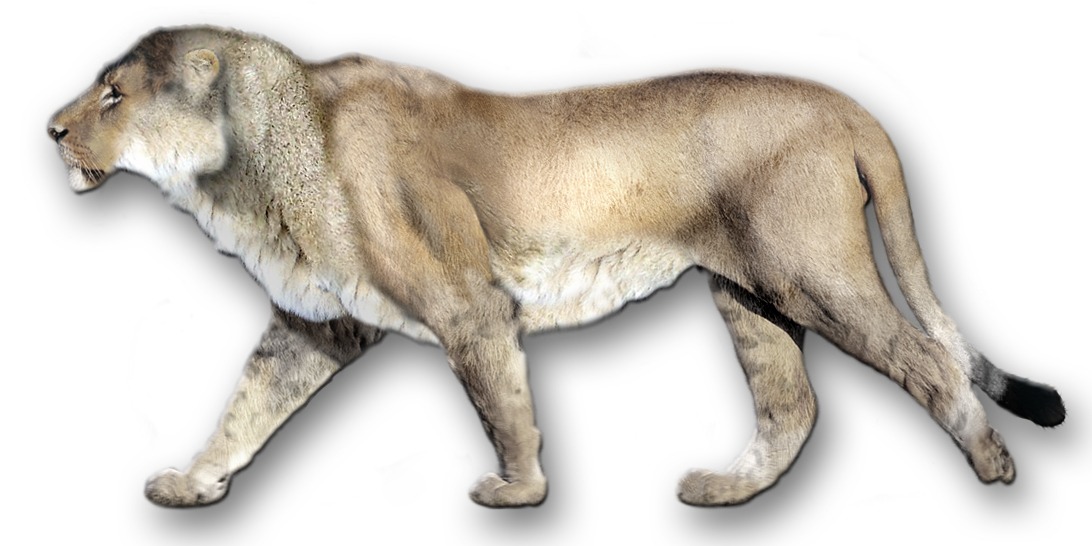
During the Pleistocene, a very large cat once roamed from Alaska to Mexico.
Whatever it was exactly is still being debated.
The current taxonomy of this species is that it is a subspecies of the lion, Pathera leo. Analysis of mitochondrial DNA from extinct Eurasian cave lions, American lions, and modern lions strongly suggests that these animals were all part of one rather genetically diverse species that, as as happened with so many other carnivore species, lost this genetic diversity at the end of the Pleistocene. The Eurasian cave lion and American lions were sister taxon, and it has been established that the Eurasian cave lion was very closely related to the modern species.
However, this same study found that Eurasian cave lions did not interbreed with modern lions, even though their ranges overlapped in the Near East and Southeastern Europe, and Eurasian lions did not interbreed with American lions where their ranges overlapped in Beringia. So they may have represented three distinct species of lion, but one must be careful assuming species status through MtDNA studies. Mitochondrial DNA tells us the inheritance through the matriline. Granted, MtDNA has its own genome and is more resistant to mutation, which makes it a useful tool in determining relationship, it is only one part of the genome.
To make things even more confusing, some authorities have suggested that the American lion was a tiger–hence the stripes in this depiction.
A recent morphological study that compared the skulls of American lions with other pantherine cats found that the American lion’s mandibluar morphology was more similar to jaguar than to the lion. The study suggests that the American lion was actually its own species, which was closely related to the jaguar.
However, the genetic evidence suggests that the American lion was a form of lion. Maybe it was its own distinct species of lion. Or maybe it was nothing more than a subspecies of a once quite diverse species that we call Panthera leo.
Panthera leo atrox or Panthrea atrox it seems clear that this animal was a lion, not a jaguar or jaguar relative. The reason for having a jaguar mandible probably result for living in the North American Pleistocene environment, which was populated by an even greater diversity of megafauna than exists on the Serengeti today. Jaguars have very powerful jaws, which they also evolved to deal with this type of prey. (Jaguars lived in North America long before they lived in South America). It would make sense that the lion of the Americas would have evolved similar adaptations to hunt similar prey.
One should be as leery of morphological studies as MtDNA studies. Morphological studies could never tell you that pugs and borzoi belong to the same species. However, genetic evidence very clearly would show this relationship.
More study is needed to determine where the American lion and the Eurasian cave lion fit in the taxonomy of the Pantherine cats. My guess is that they are actually subspecies of lion, and nuclear DNA studies, should any be able to be performed, will find more evidence of a gene flow across these types. But if not, they were all likely interfertile, and whether we consider them subspecies or separate species might always be up for debate.
We don’t have modern American lions or cave lions around to do any experimentation. We do know that male cave lions lacked manes.There are definite male lions depicted at Chauvet Cave in France that clearly have no manes. Because American lions evolved from the ancestors of cave lions, they probably didn’t have them either. There is evidence that Eurasian cave lions lived in prides, but there is also evidence that American lions did not. So there may have been behavioral reasons why these lion populations did not interbreed, even if they could.
Many questions have been raised in the research on the exact taxonomies of these two extinct big cats. One can only hope that a nuclear DNA study might be possible.]
Of course, those are old lion remains, and DNA is hard to extract. Complete sequences are ephemeral phantoms when it comes to ancient specimens.
Their exact position is simply nebulous– as it is with so many different species that went extinct in the eons of prehistory.




Panthera spelaea? Maybe it was a ring species, interbreeding only with close geographical populations.
http://jkendrickensis.wordpress.com/2011/11/23/reindeer-and-bear-cubs-a-la-carte-for-cave-lions/
It could have been, but my instincts are with lumping, rather than splitting species. I contend that there is only one species of wolf, which includes domestic dogs, dingoes, and New Guinea singing. And the nuclear DNA studies on the red wolf is that it is almost of coyote ancestry. Genome-wide analyses have found that the Indian wolf is very closely related to Middle Eastern wolves and dogs, even if it has a unique mitochondrial DNA. MtDNA doesn’t settle all the arguments.
I disagree very strongly that the American lion was any kind of jaguar.