The following foxes have nothing to do with Dmitri Belyaev Siberian fox farm experiment:

Pearl foxes. Marked like border collies but not selected for tameness.

Irish marked marble fox, full body view.

Marbled fox. Almost entirely white.
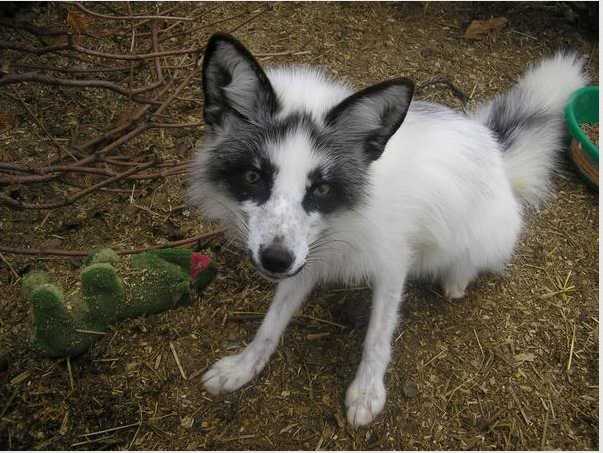
Another marbled fox. These foxes are sometimes sold to rubes as arctic foxes. They are nothing more than red foxes with unusual coat colors. Arctic foxes are white only in winter. These foxes are always predominantly white.
These phases not result from their ancestors being systematically selected for flight distance or decreased aggression towards humans.
They resulted simply from unusual sports that popped up in farm fox breeding operations, and then the owners began to select for these color varieties. They normally aren’t uniform enough to make good pelts, but they often sold to roadside zoos.
These colors probably popped up as a consequence of being bred in captivity. Belyaev suggested that his team was actually selecting for for genes that affect neurotransmitters that also affect melanin production. So in this hypothesis, the selection for “tameness” increased the likelihood of producing spots. But captivity produces a series of selection pressures on wild species that might be connected to selecting for both neurotransmitters and spots. It’s not tameness as defined by this experiment that affects morphology. It is simply being bred in captivity that produced the spots.
Again, we actually don’t know the exact genetic basis behind the spotting, but we do know that these are phases that have been selected for in captivity.
Mark Derr in How the Dog Became the Dog points out that the control population of foxes in the Belyaev experiment also produced these spotted forms. It was not the selection for tameness or docility that produced the spots.
The truth is we just don’t know why they are spotted. The neurotransmitter-melanin hypothesis is worth exploring.
However, wild animals have been born with spots.
As I mentioned earlier, the leopard complex in horses existed when horses were wild animals. There were “Appaloosa” horses 25,000 years ago. People were hunting horses in those days. They weren’t selecting them to be tame at all.
There are also piebald white-tailed deer. They are rare, but they are just as wild as the ones without spots.

It is possible that spotting is less of a problem for large ungulates in the wild than it would be for predatory mammals, even among those– such as wolves and foxes– that don’t use their coloration as camouflage. Animals with lots of spots would have a hard time hunting for whatever reason, and nature would strongly select against these colors.
However it may be that spotting is of no consequence with certain species of ungulate.
Of course, there is research that shows that most ungulates are uniform in color because predators tend to select those that are aberrant. That’s why you don’t often see white gnus or dalmatian-spotted gazelles.
The truth is we simply don’t know why some animals develop spotted pelts.
We have many hypotheses.
But the truth is likely quite complex.
And artificial selection is too often ignored as an agency.
The fox farm experiment likes to make a lot of hay out of the coat color changes in the domesticated foxes, but it doesn’t answer why marbled and pearl foxes turned up in populations that were never selected for tameness in this fashion.
We are simply not served well by such reductionism.



