The narration is very hard to hear, but it is amazing footage:
These dholes truly are Cuon alpinus, the mountain dogs.
February 21, 2012 by retrieverman
The narration is very hard to hear, but it is amazing footage:
These dholes truly are Cuon alpinus, the mountain dogs.


 | retrieverman on Rottweilers are not bulld… |
 | Earth Whisperer Cons… on World’s most notorious I… |
 | Jen Robinson on Rottweilers are not bulld… |
| Nuthatch working at… on Bird buffet | |
| retrieverman on Rottweilers are not bulld… |





Thanks for your labors- We get to read your cherry picking. Sub-species of Cuon alpinus, or Cuan alpinus is a subspecies of what? How close to jackals or wolves- or foxes?
Close relative of the golden jackal, wolf, and coyotes species
Should be in the genus Canis.
The Dhole is the only extant member of the genus Cuon, which differs from Canis by the reduced number of molars and greater number of teats. There are six molar teeth in lower jaw, and 12-14 teats. That’s 40 teeth vs 42 teeth for Canis. Though both have the same number of chromosomes Dholes are too different to hybridize with the golden jackal, wolf, or coyote.
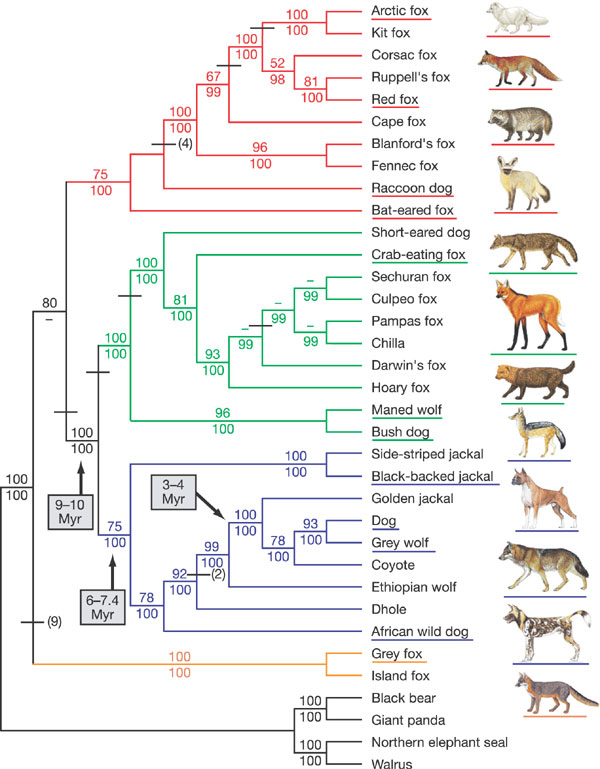
I disagree. Both Lycaon and Cuon are more closely related to the interfertile Canis than the side-striped and black-backed jackal..
See my post on how to correct the paraphyletic nature of the genus Canis:
http://retrieverman.wordpress.com/2012/02/04/canis-is-a-paraphyletic-genus/
To make it work as a monophyletic genus, you have to drop Lycaon and Cuon and merge them with Canis.
Tooth morphology is a loser when it comes to dog taxonomy. At one time, it was believed that bush dogs were related to dholes and African wild dogs. They are actually the closest living relative to the maned wolf.
Perhaps another basal species w/ connections to all of the above?
Do the Tibetans’ Buddhist sensibilities prevent them from trying to wipe out the dogs, or is this yet another instance where human needs and priorities will eventually spell the demise of a native predator?
The IUCN considers them endangered.
They aren’t just found in Tibet, but they have a wide range from Sumatra to the Russian Far East. However, in none of those places do they exist at high densities.
These pale Tbetan wild dogs (with which I should admit I have no familiarity) that kill a domestic goat in the video don’t look much like a dhole to me. As the narrator observes, they look more like someting intermediate between a fox and a wolf. Dholes are a much deeper red, have — to superficial inspection — a blunter, more brutish muzzle, and a dark black tail. They would appear to belong in Canis, not Cuon. Is there a scientific description of the Tibetan wild dog?
Sorry — that last comment of mine was a bit rushed. I meant to make clear that it is the Tibetan wild dogs of the National Geographic video, not the typical dholes, that I think look more like some species of the genus Canis than of Cuon. I presume that typical dholes are properly referred to a genus other than Canis, such as Cuon (or is it Lycaon?).
Dholes vary greatly in appearance, as do wolves. Those in the Russian Far East are quite robust and shaggy. Some in Burma are gray in color.
All dholes belong in Canis. Excluding them and African wild dogs and including black-backed and side-striped jackals makes Canis a parphyletic genus.
http://retrieverman.wordpress.com/2012/02/04/canis-is-a-paraphyletic-genus/