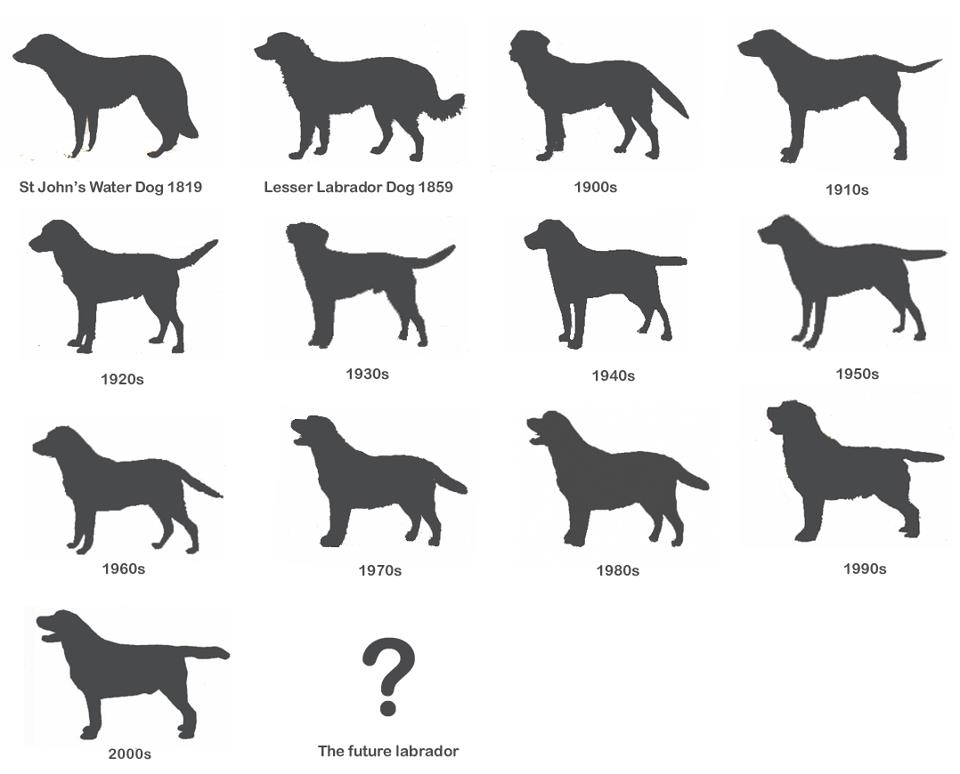
The first two are pre-Labrador retriever.
They are both St. John’s water dogs, which are the ancestors of all the British retriever breeds. (Here’s the 1819 version, and the second dog is Billy from Stonehenge’s The Dog in Health and Disease. Billy could have been registered as a wavy-coated retriever.)
This chart shows how the Labrador retriever was developed from the St. John’s water dog landrace and then selectively bred into different types as time as progressed.
This is really the story of all purebred dogs once they enter the closed registry system.
They start out as rougher and more diverse, then they become more conformed and, paradoxically, more prone to fads within conformation breeding.




You need to add some silhouettes of field type dogs, too.
Jess, there are – most are dual purpose. All the pre-war are pure working types.
I can trace many of the siluettes to their originality.
Something lacks. There were bulky dogs already in the 50s. For exam. Poppleton Lieutnant b. 49 http://www.slav-trophy.ru/site/img/publik/156.jpg, was one of the modern ancestors to start out the big-barrell-look overcome in the next decades.
Also the sporty, strong-muzzled, stocky Irish-American type lacks.
Poolstead Kennels made much to the cosy English type as we know it today. The new type was barrel-like so the legs looked (or even were?) shorter than before. This was especially typical for the Poolstead dogs already in the 50s-60s.
It’s a stereo-typed chart, and what is that 90s fluffy dog to be presenting? A Golden crossed Lab ?
The ring has, as the silhouettes show, selected Labradors for a ‘level top line’ and ‘well sprung rib cage’, and dog portraits have favored the open mouth. Field dogs, Guide Dogs, police and military dogs haven’t followed this trend. The Labrador is in better shape than most (or should I say, ‘more diverse shape’) because its popular image is defined at lease as much by working dogs as by the show ring. There are even some show judges who don’t like the beefy look that is shown in the last four dogs. Should also be noted that if you fed them less, dogs who look like the bottom four would look more like the earlier dogs. Breeders who try for dual championships often fatten their dogs up for the ring and starve them for field trials.
The show conformation feature that most attracts the general public is the enlarged (‘boofy’) head. If selection-for-show is going to create problems for the breed, I think the enlarged head is the biggest worry.
The desire to breed for a barrel-shaped dog in the ring has also encouraged people to show dog that are obese. That was the Kennel Club’s big worry about Labradors, and when the Labrador standard was examined, they made sure that people weren’t confusing bone with fat.
Yes. What’s with the level top line? Does it have any functional significance?
The Saints seem to be getting beefier and beefier as well…this is not a good thing in a giant breed.
the modern lab is more context than content….leavin few of the american lines
I agree the last four dogs do look overweight. My previous labrador looked like that (she was overfed), but my current one is not overfed and is nice and trim with a slim waist.