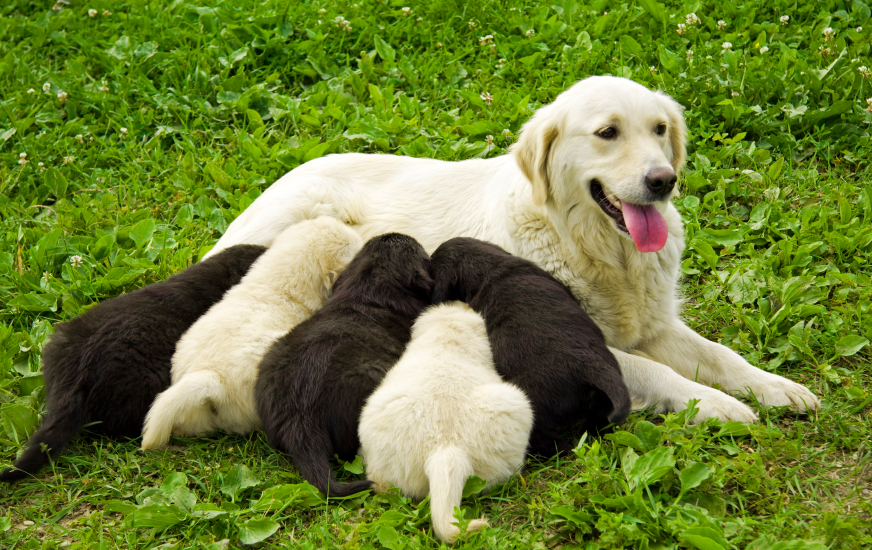
When a golden retriever has puppies that aren’t gold, red, or cream, you know she’s a cross-breeder!
The father of these puppies was a chocolate Labrador.
Advertisements
November 27, 2012 by retrieverman
When a golden retriever has puppies that aren’t gold, red, or cream, you know she’s a cross-breeder!
The father of these puppies was a chocolate Labrador.


 | nebbie916 on Red spots in a mudhole |
| Never Yet Melted… on First elk calf born in West Vi… | |
 | massugu on Goldfinch on the old gate |
 | dorothea penizek on Birds of Peace in a Black Cher… |
| massugu on Mourning Dove on the Wire |





Well…someone was sleeping around…
Those chocolates are adorable…
I’ve long come to the conclusion that crossbreeding will often be the healthiest option as the resulting F1 generation will usually only carry unexpressed genes for whatever inherited adverse conditions each breed may have – provided, of course that the two animals of the first cross mating do not share any of the same bad genes.
I think that those who think they can exploit, for saleability, the popularity of certain crosses, such as ‘labradoodles’ for just one example, may sometimes fail to anticipate the tendency towards extreme variabilty of structure and appearance among the F2 pups, when they mate, say, labradoodle to labradoodle. They also fail to realise that the genetic problems suppressed in the F1’s genomes will readily surface again among the F2 pups, when two sets of the same bad gene pair up of course.
I have to confess however that provided strict selection is carried out at the F2 stage it should be possible to produce a small percentage of F2 (and beyond) pups which are free of both sets of bad genes possessed by the parents of the first crossbreeding.
Obviously, breeding genetically healthier stock can also occur purely from judicious (or lucky) matings within one breed. It is just that the crossbreeding of two breeds known to be not carrying the same problem is an easy healthy option provided you are not breeding for show animals.
It is unfortunate that a number of genetic problems take time to appear and, by that time, affected animals may themselves have been used for breeding. As we all know, the overuse of a popular stud dog can quickly ruin a breed’s genetic health. The cavalier king charles spaniel is just one example of a breed which is now doomed because of poor breeding practice. When I last looked, some seventy percent of cavaliers carried the gene for mitral valve disease and because may of the affected cavaliers struggle on with a bad heart, albeit at great expense to owners and at great suffering to the dogs it just goes on and on. Basically the owners of this breed are extremely unwise for not calling it a day. And then, dare I finally mention, there is the disease cavaliers suffer from which ends up with the brain outgrowing the skull.
“When I last looked, some seventy percent of cavaliers carried the gene for mitral valve disease and because may of the affected cavaliers struggle on with a bad heart, albeit at great expense to owners and at great suffering to the dogs it just goes on and on.”
That look must have been some time ago. The specialist researchers have long acknowledged that 99%+ carry the genes (it is a polygenetic condition) for MVD. What they are attemting to do is guide the breed so onset is not early, but (almost) all Cavaliers are eventually affected. 95% have Chiari Malformation, which can have symptoms on its own, but also predisposes to Syringomyelia. 70% have syringomyelia by 7 years of age. As of last studies 20% are carriers for Episodic Falling Syndrome, and 10% are carriers for Curly Coat Syndrome. The breed also faces many other of the ailments common to all dogs – allergies, hip and patella problems, eye conditions, cancers etc.
I happen to love the breed by temperament and phenotype. An F2 generation smooth Cockapoo will likely be what I will be going for in the future.
I should add that when I state 70% of Cavaliers have syringomyelia by 7 years of age, that it is only symptomatic in some of those. It is an incompletely penetrant condition. I believe the estimate is 25% of dogs with syrinxes will show symptoms.
Look at those fat little butts! I can believe there’s some Lab in there. Bet they’ll be lovely dogs.