
This flat-coat, like most retrievers, descends from the St. John's water dog.
The short answer to that question is Newfoundland. The breed was used to haul nets, pull carts, and retrieve shot game. The dog was sometimes called the “black water dog.”
But how did the dog get there?
In Farley Mowat’s Sea of Slaughter, the author posits that black dogs were owned by the natives of Newfoundland. In this book, Mowat says that the Beothuck of Newfoundland owned dogs, but most scholars believe they did not. No dogs have been found in Beothuck sites. It’s a peculiarity of the Beothuck because most Native American peoples had some dogs. Mowat uses a 1593 account of the dogs by someone who was traveling on the Marigold. “[A]nd their dogs, of colour black, not so bigge as a greyhound, followed them at their heels.”
However, a later book called The Farfarers: Before the Norse, the dogs are mentioned just as an aside as they accompany the Farfarers across the North Atlantic. The Farfarers are the aborginal population of Scotland, whom Mowat calls the Albans. He argues that the word “Alb” is associated with pre-Indo-European people who had to escape to the mountains and distant islands as the Indo-European peoples took over the continent. As you may be aware, Alba was once a name for Scotland.
Mowat argues that these Alban people made their living trading walrus tusks to other Europeans. However, they were unable to sustain the Pictish and Celtic invasions of their own country. (Mowat thinks the Picts are relatives of the Albans, while some scholars think the Picts are non-Romanized Celts). What really hurts the Albans, though, is the arrive of the Vikings to Shetland. They harry and enslave the Albans, who then escape to Iceland, which they already knew from the voyages in search of walrus tusks.
Then they begin to exploit the Greenland walrus rookeries, and some begin to live there. They then run into the Dorset culture people who take them to Labrador. When the Vikings take Iceland, large numbers of Albans run to Greenland and then to Labrador. With them they have dogs and other domestic animals.
They then move to Newfoundland, which the Vikings call “Albania.”
Mowat believes that these European people always lived in Newfoundland, practicing the Roman Catholic faith. He thinks that they eventually melted in the mixed French and Mi’kmaq people who are known (derisively) as the Jackatars. Mowat associates the Jackatars with small farmers (he uses the Scottish term “crofter”) who also fish and trap and who also keep “black water dogs.”
Mowat’s writing is beautiful and engaging. However, he always writes as the iconoclast, which means that mainstream scholarship is very much opposed to his findings. However, it was Mowat who began to argue that the Vikings first came to Newfoundland. This is now axiomatic.
The difference is that we have lots of evidence of the Vikings in North America, but we have very little evidence of the Albans in Iceland, Greenland, Labrador, and Newfoundland.
However, if Mowat’s historical theories are ever proven, the St. John’s water dog may have descended from the Albans’ dogs. The dogs sighted by the Marigold were owned by these “natives,” not the Beothuck. (This is my connection of the inchoate thoughts in both of these books).
We do know that “black dogs” are often part of British and Anglo-Saxon mythology. There are several black dog stories, such as the Old Shuck and Barghest. These dogs are demonic creatures that are harbingers of doom. Most scholars believe that these stories are Viking in origin. Perhaps the Vikings had black dogs, and the dogs were associated with their pillaging. Or maybe it was an association that resulted from demonizing the aboriginal population of Britain, who may have possessed black dogs.
The truth is the St. John’s water dog developed as a region dog on Newfoundland, but its exact origins are entirely unknown. It is probably a mix of many types of dogs brought there by the Basques, the Portuguese, the French, and the English. Perhaps Inuit dogs from Labrador were also including, along with the very retriever-like brindle mastiff from Portgual called the Cao de Castro Laboreiro. I don’t think that Richard Wolters was correct that these dogs descend from the St. Hubert’s hounds, because those are not water dogs and the “retrieving” he mentions them doing is actually bloodhound work (scenting blood spoor from wounded animals).
The truth is we just don’t know. The St. John’s water dog’s origins are a mystery.





This dog has the same talkative gift that Mowat’s Albert dog seemed to have. It’s either brought from the Newfoundland or is English breed, half a lab, half a collie, or something.
Anyway they call him longhaired lab in this old clip:
http://www.britishpathe.com/record.php?id=38372
Intresting, even sensational to any real retreaverfan.
Mowat is in fact incredible. Haven’t heard a word of him before till I came across with your blog.
I’m very surprised, because he’s very popular in parts of Europe.
The Soviets used to heavily promote his books, and he was invited on a book tour of the USSR in the 60’s. He eventually wrote a book about it:
The Siberians
His most famous book is this: http://www.amazon.com/Never-Cry-Wolf-Amazing-Arctic/dp/0316881791
It’s not 100 percent true– wolves do not live on mice. But it convinced the Soviet government to ban wolf hunting.
This is a book of his I’d like to read: http://en.wikipedia.org/wiki/People_of_the_Deer
Mowat had his own St. John’s water dog, and here’s a video of him with his dog named Albert: http://archives.cbc.ca/arts_entertainment/literature/clips/14934/
I hope you can watch this.
Seen it for you’ve mentioned about it before
I forgot.
I met an old man with an old black retreiver in the park.
The suddenly whispered to me:
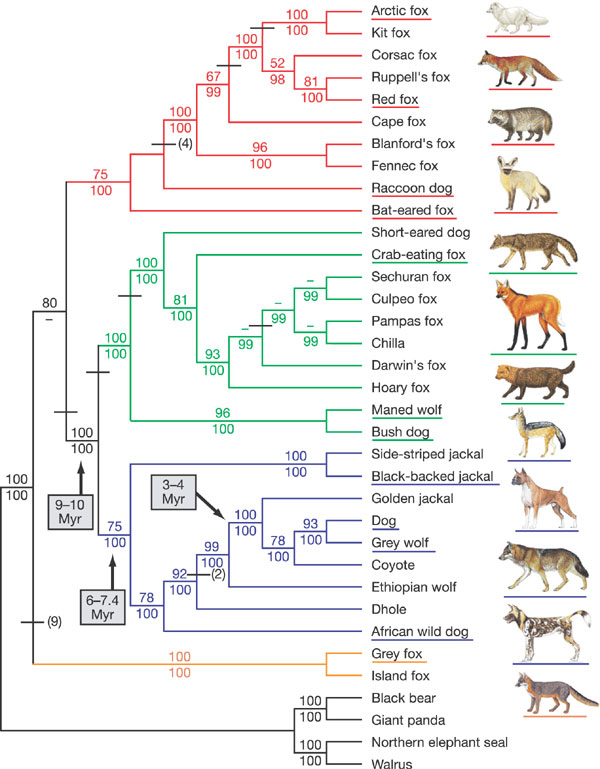
– Do you know if there are genes of the bear and the seal in the labrador?
And by that innocent quiestion I came suddenly to think, actually they have some of the best parts of those wildbeasts.
Of course it’s a long story with a million of years, layers, turning points, incidents.
But how long it would take to create A DOG, that would have a heavy passion for water put in his genes?
The spitzes with curly tails, the terriers with straight tails, swim all tail up. A real waterdog don’t.
What?
A St. John’s water dog is basically a more robust Portuguese water dog without the poodle-type coat.
There is this animal, which is extinct:
http://www.newanimal.org/bdogs.htm
Some cryptozoologists think it is still around; I don’t.
Cryptozoology is study of unknown and undiscovered animals.