
When the first settlers to the Falklands came from Britain, they discovered that even the most remote islands can have large predatory animals on them. The predator on the Falklands, though, is one of the most enigmatic beasts. Even today, scientists are still arguing about its exact taxonomy and natural history. This animal was a canid, but whether it should be classified with the coyotes, dogs, and wolves or with the South American “foxes” is still being debated. However, in the eighteenth and nineteenth century it was called the Falkland islands wolf, the Falkland islands fox, or the warrah.
The animal had no fear of people. Like most wild dogs that have lived free of persecution, the warrah was a very curious animal. In 1834, Charles Darwin wrote of the warrah in his Journal and Remarks ( The Voyage of the Beagle):
The only quadruped native to the island, is a large wolf-like fox, which is common to both East and West Falkland. Have no doubt it is a peculiar species, and confined to this archipelago; because many sealers, Gauchos, and Indians, who have visited these islands, all maintain that no such animal is found in any part of South America. Molina, from a similarity in habits, thought this was the same with his “culpeu“; but I have seen both, and they are quite distinct. These wolves are well known, from Byron’s account of their tameness and curiosity; which the sailors, who ran into the water to avoid them, mistook for fierceness. To this day their manners remain the same. They have been observed to enter a tent, and actually pull some meat from beneath the head of a sleeping seaman. The Gauchos, also, have frequently killed them in the evening, by holding out a piece of meat in one hand, and in the other a knife ready to stick them. As far as I am aware, there is no other instance in any part of the world, of so small a mass of broken land, distant from a continent, possessing so large a quadruped peculiar to itself. Their numbers have rapidly decreased; they are already banished from that half of the island which lies to the eastward of the neck of land between St. Salvador Bay and Berkeley Sound. Within a very few years after these islands shall have become regularly settled, in all probability this fox will be classed with the dodo, as an animal which has perished from the face of the earth. Mr. Lowe, an intelligent person who has long been acquainted with these islands, assured me, that all the foxes from the western island were smaller and of a redder colour than those from the eastern. In the four specimens which were brought to England in the Beagle there was some variation, but the difference with respect to the islands could not be perceived. At the same time the fact is far from improbable.
Darwin understood that the so-called foxes of South America are actually quite closely related to wolf-like canids. In fact, today, the genus for these “foxes” is now called Lycalopex (w0lf-foxes) . I prefer to call these animals “zorros” (Spanish for foxes). They are not Vulpes foxes, and one of these South American animals is called “the gray fox.” It is sometimes called the South American gray fox to differentiate it from the gray fox that we have in North America. However, that name does not work well either. The gray fox of North America has a range that extends into Panama, Colombia, and Venezuela. To avoid confusion, I call the South American “foxes” zorros.
Darwin was quick to point out that the animal was not that similar to the Culpeo, which is the largest of the zorros. Culpeos are well-known as being the coyotes of the South American continent. They are mid-level predators and scavengers, and like coyotes on this continent, they are hated. However, they are not South American coyotes. They are big zorros.
By 1868, trapping and shooting to protect sheep and for the fur industry had wiped out the warrah. Humans killed them off before anyone could properly classify the species. It was the only species of wild dog to go extinct in modern times. (However, the Ethiopian wolf is the species most likely to join the warrah.)
In the 1880’s, Thomas Huxley classified the species with the coyote, not the culpeo and the other zorros. It had the morphology of a coyote, so its scientific name became Canis antarcticus.
However, modern taxonomists have gradually moved the warrah back to the zorros. Today, the warrah is placed in the genus Dusicyon, which was the genus of the zorros at one time. The warrah remains in that genus even though the other zorros are now placed in Lycalopex. It would have remained with the South American foxes forever had somethng strange not happened.
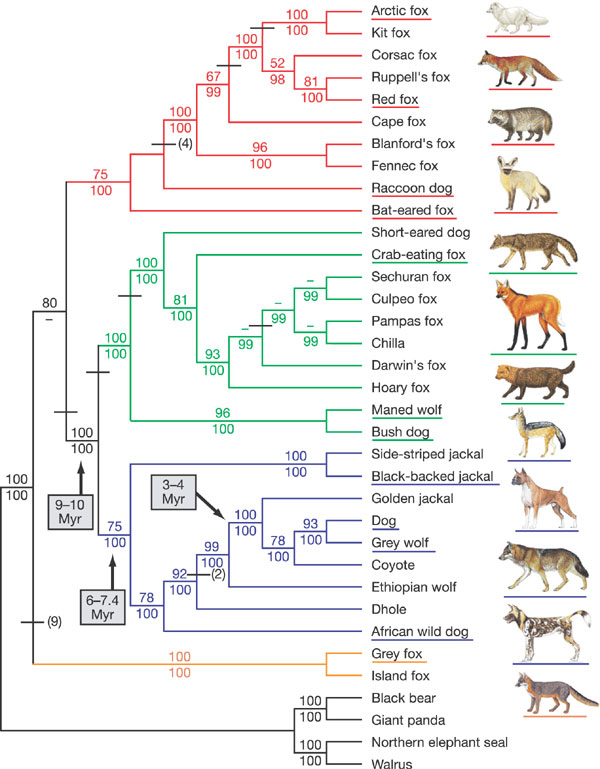
In the 1990’s, molecular biology was coming to the fore. Studies of mitochondria DNA were being used to determine the evolutionary relationships of all sorts of animals. One of the first studies on the dog family was the seminal study by Dr. Robert K. Wayne of UCLA. It was this study that found that domestic dogs were conspecific with wolves, and that the red wolf was derived from mixing Old World and New World lineages of Canis. His study on the molecular evolution of the dog family can be found here.
Wayne also got mitochondrial DNA samples from the preserved skins of the warrah to determine the evolution and natural history of that species. Well, the results were a bit hard to handle.
The study found that the closest relative of the warrah was the coyote.
But that raised lots of questions. How did a coyote-like animal get to islands off the southern tip of Soth America?
Well, James Serpell offers an interesting theory.
Because there are no native members of the genus Canis in South America, the warrah was actually a domestic animal that may have been derived from coyote-like wild dogs in North America. (I should add that the Dire Wolf, which did live in South America, was probably much more closely related to the coyote than the wolf. It is possible that there were other species of coyote relatives in the New World.)
The evidence that Serpell posits is the unsual shape of the warrah’s muzzle. “The facial region of the skull is wide and the frontal sinuses are expanded, both of which can be features of domestication….It is therefore possible that this canid was taken to the Falkland Islands in the early Holocene as a domestic animal and subsequently survived as a feral species.” (The Domestic Dog). He also uses the Wayne data, which he received in the preliminary stages, to argue that the warrah belongs in the genus Canis.
So where does the warrah belong? That is one question that has yet to develop anything like a scientific consensus. Perhaps more analysis of the morphology and molecular evolution can provide a better picture. It would be nice to know whether there were any mainland South American canids that were similar to the warrah other than the culpeo.





Absolutely fascinating! I had no idea there had been an indigenous canid on the Falklands. The English never really used mastiff type guard dogs that were turned out with the sheep to protect their flocks, unlike herders on the Continent. Had they come from a culture that used them, perhaps the Warrah would still be alive today.
And nobody has any clue how they got there. And the fact that they are probably more related to coyotes is an even bigger shock.
After reading through the article, I just feel that I need more information on the topic. Could you share some resources please?
http://www.messybeast.com/extinct/warrah.htm This is a good one.
And another that says that this species was a feral dog– Juliet Clutton Brock is a well-known zoologist and domestic animal expert: http://www.lonelyplanet.com/shop_pickandmix/previews/falklands-south-georgia-island-natural-history-preview.pdf
James Serpell’s book that includes reference Wayne’s DNA study: http://books.google.com/books?id=I8HU_3ycrrEC&pg=PA12&lpg=PA12&dq=james+serpell+falkland+island+wolf&source=bl&ots=BaaAXxf8q5&sig=BZ02Hj7oMYLxIV4TRdVCdvPV8Q8&hl=en&ei=DNzlSezEF6flnQfUl6WmCQ&sa=X&oi=book_result&ct=result&resnum=1
You can also check out Charles Darwin’s account of the warrah in the journal he kept while traveling on The Beagle.
Hello Sir!
I found your site on Google and read a few of your other entires. Nice Stuff. ‘Im looking forward to reading more from you.
[…] Remember my post on the enigma of the warrah or Falkland Islands wolf? […]
[…] Remember my post on the enigma of the warrah or Falkland Islands wolf? […]
[…] Remember my post on the enigma of the warrah or Falkland Islands wolf? […]
I think the warrah is a great example of species, like the dodo as mentioned by Darwin, which humans have historically eradicated without a real sense of foresight. One thing I try to teach my students is how our behavior, while not exclusively, often illustrates how poor we are as a species at learning from past exploits, and then using that hindsight to inform future actions. Then, peeling back further the layers of the onion, the underlying reason for there being such poor consideration of past endeavors is due to a lack of universal access to education in all countries.
I very much agree.
You know that the warrah and the sea mink are the only members of the Order Carnivora to have gone extinct in modern times (but more than a few are close to it right now.)
A few months ago, a study was released that showed that the warrah’s closest relative was not the coyote. It is actually the maned wolf: http://retrieverman.wordpress.com/2009/11/03/the-warrah-mystery-has-been-solved/
Absolutely – in the case of the Warrah, one bizarre aspect was the bounty placed on the animal, which was continually raised as the animal got rarer (and less of a threat either to humans or livestock, which it likely wasn’t in the first place), to the point where it was maintained for years after the beast was finally extinct. Quite bizarre, and indicative of our irrational attitude to any animal tagged as ‘wolf’.
[…] noted in an earlier post, the maned wolf is the closest relative of the warrah or Falkland Islands wolf, which is one of two members of the Order Carnivora to have gone extinct in historical […]