
Last September, a melanistic red fox was spotted in Britain. The article is here.
There are a few inaccuries in the article. The first of these is that black or silver foxes in Europe are extremely uncommon and probably always were. It is an interesting theory that the silvers/blacks were all killed off because of hunting. I just think the genes that cause that coloration have always been rare in Europe. I don’t know whether
Virtually all silver foxes descend from North American populations. In fact, I’ll go as far as to suggest that all silver foxes or melanistic foxes in captivity are descended from North American populations.
And these populations are native.
Native?
Well, where I live, there are no native red foxes. If you live in the US east of the Mississippi, except northernmost New England and Upstate New York, the red foxes are descended from English imports. This map of red fox subspecies in North America is really good. Number 6 is the subspecies that is descended from imported foxes. All of the rest are native.
However, in other parts of North America, including virtually all of Canada, red foxes are native. And in parts of the Maritimes, black foxes, were more common than reds. These foxes were in demand for the fur trade.
It was in the province of Prince Edward Island that the silver fox was developed as a fur farm animal. The island had a large number of melanistic foxes that sometimes had silver hairs. These foxes were captured and bred as domestic animals, although the truly domesticated strain that we often talk about was started in the Soviet Union in the 1950’s. They were selected for the silver coloration over the solid black coloration. I am uncertain whet ther PEI foxes were native to that province, which is an island, or whether they were introduced from the mainland. However, coyotes live on PEI. These coyotes walked across the ice in the Northumberland Strait to get there. It would make sense that red foxes would be able to do the same thing.
Silver foxes and black foxes are uncommon in Europe. They are also uncommon among British red fox descendants in the US. I’ve never seen a wild silver fox. Some fool tried to turn some farm strain foxes loose here, but they did not last. Even “undomesticated” strains that have been propagated in captivity for generations cannot make it in the wild.
(This is something that needs to be considered about all sorts of carnivores currently bred in captivity. I seriously doubt that we are going to save the tiger by breeding them for generations in captivity.)





OTOH domestic cats don’t seem to have any trouble establishing themselves in the wild if they have to – even to the point where they become a threat to the population of genuine wild cats. They’re a bit different from the foxes I suppose because they’re not being selected for tolerating life in a cage.
Does it strike you that there’s something odd about the black fox’s eyes? To me it looks as if they’re almost bulging out like a pug or a peke’s.
Cats are really interesting in that they might be the wildest of all domestic animals. Cats and pigs seem to go feral more easily than virtually any other domesticated animals, except maybe pigeons. For centuries most cats lived in a semi-wild existence, and even the nicest cats can go feral at the drop of a hat.
In Britain, there are actual wildcats that can cross with domestic cats and produce fertile offspring. In the US, we have no such species. If a bobcat ran into a domestic cat, it would be more likely to eat it.
They only threaten the population of wild cats by mating with them! There is a guide online to distinguish between Scottish wild cats (which are protected) and crosses with domestic cats (which are not). Crosses seem to be doing fine in the wild, however, as indeed do domestic cats, although domestic cats live much better and longer lives as domestic animals.
Bobcats are actually a species of lynx and are often quite a bit larger than domestic cats. Allegedly, they can interbreed, but it’s far more common for bobcats to kill and eat domestic cats. The Europeanwildcat is actually the same species as the domestic cat (which is a Middle Eastern version of the African wildcat), although it is of a different subspecies.
Unfortunately, in some parts of the US, bobcats are called wildcats, and this nomenclature confuses many people.
That not surprising that Felis sylvestris sylvestris would cross with the descendants of modern day Felis sylvestris lybica, although I am not sure I would want to share my home with one of the offspring. Here’s link to the most recent determination about the ancestors of today’s Moggie ( Brit slang for kittehs).
http://news.bbc.co.uk/2/hi/science/nature/6251434.stm
Melanistic wolves only exist in N.A., true? Perhaps there is some specific environmental factor or factors that allowed for melanism and be somewhat successful ( ie: survive to pass on the color) which did not exist in Europe, or perhaps was more lethal across the Pond???
Black wolves existed only in North America until recently. There are now some in Italy as well. However, there have been odd black wolves in Europe before. http://en.wikipedia.org/wiki/Black_wolf_(animal)#cite_note-smith-6 However, these have all been isolated cases, and most likely are dog wolf crosses. The animal we call the red wolf, which is probably a subspecies of regular wolf, often came in black. In fact, its original scientific name was Canis niger, the black dog. I call it Canis lupus rufus, but the taxonomy is still being widely debated. In taxonomy, I’m a lumper, and so is this book: http://www.bucknell.edu/msw3/browse.asp?id=14000738
The last one killed in Scotland by the deerstalker MacQueen of Pall à Chrocain was a black one. This makes sense. Once wolf numbers dropped really low they started breeding with dogs. Further, this “wolf hybrid” was accused of killing two children, which also makes sense for what we know about wolf hybrids.
The black wolves of this continent were much more established, and it is has recently been shown that their black coloration comes from dogs.
As for the foxes, it is possible that the blacks and silvers were killed more readily in Europe. However, they may have been rare in Europe all along. Perhaps the only foxes that could survive in the Great Northern Forest, which runs across Eurasia into North America, were dark colored ones. These would be the foxes that would cross the Bering Land Bridge, and thus, black foxes became established here as part of the founder effect. I really don’t know. No one has spent any time trying to figure out much about red foxes and their evolution. But we do know the ones that live in West Virginia are from English stock. The ones that live in northern Maine are native.
ps: Looking at British fox picturs, they due tend to have more protruding eyeballs than their descendants here in NA. The ones around me tend to have more of an almond shape and are less protruding. Again, that could be an adaptation, or the fact British foxes have remained relatively isolated thereby developing more of their particular subspecies’ phenotype/genotype than the hodgepodge that is the N.A. fox.
I dunno. Just tossing ingredients into the speculative soup.
Okay–my friend who hunts squirrels says this fox is the closest-looking thing to the dogs he saw at a “coon dog trial” that a guy said were squirrel dogs.
Any idea what that little dog might be?
Hmm, wish my dad were still around to ask about your black squirrel dog, f-n-L.
We have real N.A. foxes here in Vermont. You see more in town, perhaps because the coyotes are taking over the exurbs/rural areas. There is definitely a new pack of coyotes around here this winter (I think we have a small resident pack). I’m hoping the new guys are here to drive the flatlanders out. (I’ve been here over 10 years now, so they let me speak at town meeting.)
Melanistic animals are fascinating. I went on a squirrel reading binge after your squirrel posts and was amazed to see how silly looking those British red squirrels are — they always look surprised. Also, I now have a hankering for squirrel-hazelnut pate. I hear tell from a fellow in Arkansas that squirrel is pretty good eating, as long as you skin them right.
Well, anyway, I used to live near East Lansing, MI, where there are a lot of black (melanistic) squirrels. Then when you cross some boundary (known only to squirrels) into Lansing, there are only grey squirrels. Black squirrels are found all over the place in the U.S.A., but a lot of them have groups (colonies?) in the midwest : Ohio, Michigan, Kansas, etc. Seeing one is supposed to be good luck. One theory is that melanism makes them better adapted to cold weather as they could gather solar heat. Would this account for black foxes? And why would there be groups of black squirrels in California.
It seems that Central Texas is the place to go for melanistic deer.
A black squirrel dog could be a black Norwegian elkhound, which is a separate breed from the more common gray dogs that are recognized by the AKC. http://www.dkimages.com/discover/previews/963/50022403.JPG
My own grandfather swore by them as squirrel dogs and as grouse dogs. He got started in Walker-strain American foxhounds, but then moved onto an easier dog to train that could be used as (in his words) “a combination dog” for several different prey species.
I grew up on a ridgetop woodland that had a very unique feature about it. About half of the Eastern gray squirrels were melanistic. This ridge top got more snow and cold than the surrounding valleys, and I read somewhere that black squirrels were better able to handle the cold– and not just because the black fur absorbs the solar heat. But I can’t lay my hands on it. Lewis and Clark were traveling down the Ohio, just below Wheeling on their way to the Missouri River, and they encountered tons of black squirrels swimming the Ohio from what was then Virginia to what was then newly open lands in the Old Northwest. Their “Newfoundland dog” (who could’ve been any kind of Newfoundland) fetched a ton of these squirrels from the river, which they then had for dinner. It was better than what they ate once they got into Upper Parts of the Missouri– they had to live on dog meat (not the Newfoundland, though, he survived).
Grey squirrels are good to eat, depending upon the skinning and the whether they’ve been eating nuts or human refuse. If they’ve been eating nuts, they are wonderful to eat– no fat on them at all! Like lean roast beef or the finest rabbit.
The North American red squirrels aren’t that good to eat. They are small and kind of tough.
You don’t have these in Vermont, but the fox squirrels we have down here are not that good to eat either. They have a rather dry texture.
Yes, I’m from West Virginia, and I have a taste for squirrel meat.
Yes, you do have native red foxes in northernmost Vermont, and probably in the Green Mountains, too. In West Virginia, most red foxes den much closer to houses and towns now that coyotes are around. I’ve come across a pack of six, which is rather disconcerting. The first coyote I ever saw in West Virginia was within ten feet of me. It just walked right down the trail and stopped when it saw me. It was much bigger than I expected, because I had seen them in Arizona on a vacation a few years before that and they were tiny.
They may have some wolf in them, which makes them larger. And they are located further North than they were in Arizona, and then you have Bergmann’s rule that says the biggest animals tend to be in the northern reaches of any mammal or bird’s range. Plus, they have a better food source here than in the desert, and they can pack up to hunt larger prey.
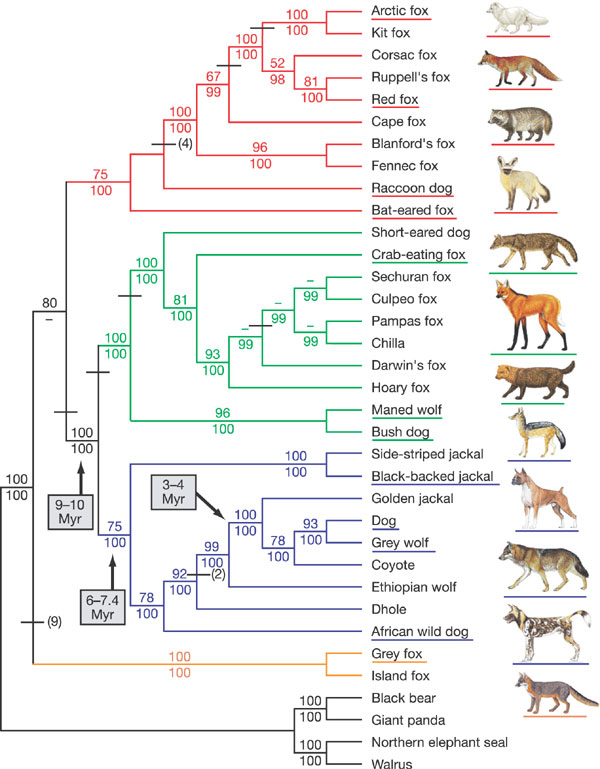
The red foxes are only just now figuring out how to survive coyotes, but the gray foxes already have a trick to avoiding coyotes. They live deep in the forest where coyotes don’t often hang out, and if a coyote runs into a gray fox, the gray fox just takes to the trees. (I don’t know if you have those in Vermont, because they aren’t as hardy to very cold conditions as red foxes are. And they aren’t that closely related to red foxes at all. They are actually the oldest species of wild dog.)
I live around the Green Mountains, near Mt. Mansfield — I hope that makes my Appalachian (Blue Ridge) ancestors happy. We don’t have grey foxes that I know of here. Interesting to imagine a fox climbing a tree. Oddly enough, I grew up in Florida, where I was exposed to completely different critters, such as armadillos and hammerhead sharks. And the dogs I knew were mostly English Pointers & various hounds.
I came across this reference to melanistic deer: http://www.freerepublic.com/focus/f-news/1932263/posts
I used to have a picture of a piebald (mosaic) deer & a mosaic Icelandic ram, but having a computer hasn’t made me any better organized.
Fascinating stuff about Lewis & Clark!
These foxes are quite common in some areas, especially where forests are denser and there are fewer fields.
They don’t have as much undercoat as red foxes do.