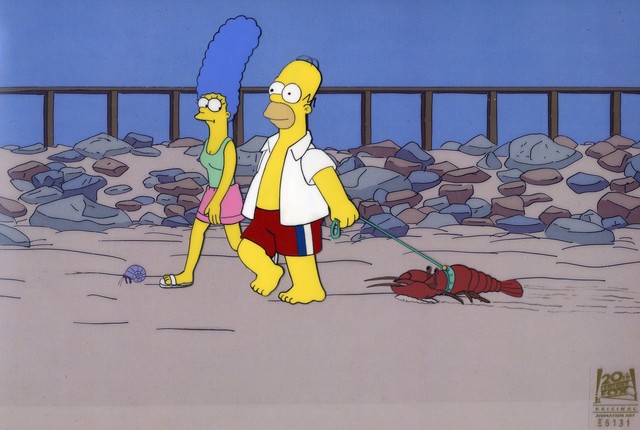
One of my favorite episodes of The Simpsons is called “Lisa Gets an A.” The main story involves Lisa, the overachiever, cheating on a test and receiving an A+++.
The side story involves Homer buying a puny lobster from a tank and then fattening him up, so he can “eat the profits.”
He winds up getting very closely attached to this lobster, which he names “Pinchy.” He winds up turning Pinchy into a little coddled pet, which he walks on a leash.
In the end, Homer leaves Pinchy in a hot bath, and the hot water cooks him. The closing scene is Homer eating Pinchy while sobbing hysterically.
Now, a lobster would die if you put him in even relatively warm water, and if he was even dipped in fresh water, that would be the end of him.
But walking a lobster on a leash– well, that’s partly true.
It turns out that someone actually did walk a lobster on a leash.
The French writer Gerard de Nerval had a pet lobster named Thibault that he would walk in the Palais Royal gardens in Paris.
The lobster wore a silk thread for his leash, and the lobster set his own pace.
Nerval once remarked:
Why should a lobster be any more ridiculous than a dog? …or a cat, or a gazelle, or a lion, or any other animal that one chooses to take for a walk? I have a liking for lobsters. They are peaceful, serious creatures. They know the secrets of the sea, they don’t bark, and they don’t gnaw upon one’s monadic privacy like dogs do. And Goethe had an aversion to dogs, and he wasn’t mad.
Goethe may not have been mad, but Nerval was.
He had severe mental health issues, which eventually culminated in his suicide in 1855.
 retrieverman