
Modern pet hoary fox (Lycalopex vetulus) in Brazil.
I have intended to do a post on the domestication of South American canids, using several historical texts, including Charles Hamilton Smith’s The Natural History of Dogs (1840), Charles Darwin’s accounts of domesticated culpeos in Tierra del Fuego, and as well as some other accounts from more modern sources.
However, it turns out that John Ensminger at the Dog Law Reporter has done far better job than I could ever do.
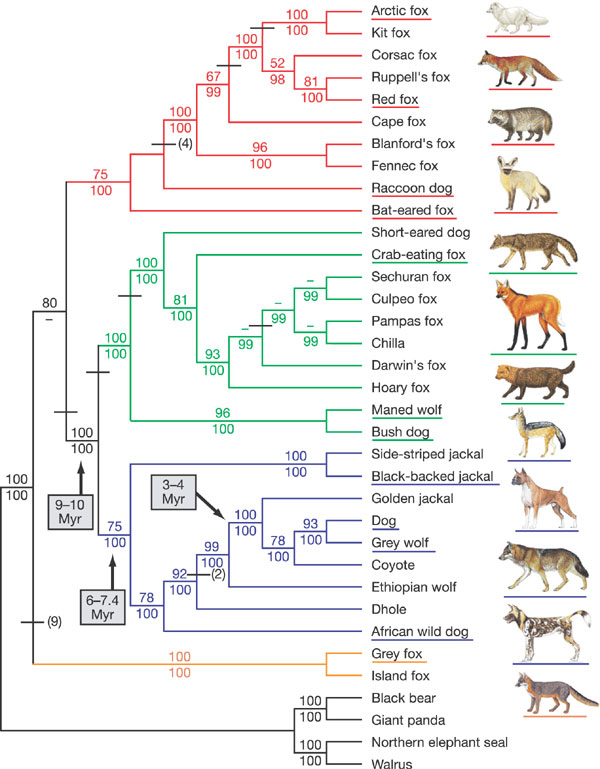
The South American wild dogs– although sometimes referred to as foxes or wolves in the vernacular– aren’t actually true foxes or true wolves at all.
It is true that they all belong to the tribe canini, which makes all of them more closely related to the true dogs in the genera Canis, Lycaon, and Cuon.
And the best genetic evidence shows that they are monophyletic– they all derive from the same common ancestor that split off from the ancestral Canis-type wild dogs.
Many of these animals will readily approach people, probably because there has been little historical persecution of them– at least not to the extent of persecution that wolves and coyotes have experienced.
It is very likely that the ancestral wolves had similar behavior when they first encountered people, but then this was heavily selected against when man began to engage in pastoralism. It is true that domestic dogs have undergone lots of selection for cooperation with people, but wolves have experienced lots of selection for paranoia and extreme fear.
In addition to these South American domestication attempts, there is also evidence that man tried to domesticate golden jackals. John Bradshaw in Dog Sense (2011), mentions depictions of what appear to be tame golden jackals from a Neolithic site in Turkey. There was also a recent discovery of what appears to have been a pet red fox that was buried in a Pre-Natufian site in Northern Jordan. The Hare Indian dog may have been a domesticated coyote, though there is some contemporary evidence that it was nothing more than a coyote-like domestic dog.
People have tried to domesticate several different species of wild dog.
But only the domestication involving the wolf has ever been successful.
Why was this domestication successful and the others failures?
That’s a big question, and I don’t think we have very good answers yet.
It’s certainly true that the South American examples may have fallen apart as the result of the conquest and subsequent destruction of indigenous cultures on that continent.
But that explanation doesn’t show us why the golden jackal and fox domestications failed.
It may be that golden jackals and red foxes simply aren’t as easy to handle as tamed wolves, and it is well-known that jackals are much more aggressive with members of their own family groups than wolves are.
But that alone doesn’t explain why the domestication of wolves had so much success over the others.
African wild dogs and dholes are even less aggressive with members of their own family group than wolves are, and they actually form larger packs than have ever been confirmed in wolves.
But there is no evidence of anyone domesticating an African wild dog or the dhole, though there are accounts of British colonial officials keeping pet dholes in India. The best known account of a tame dhole comes from the naturalist Brian Houghton Hodgson, who took in a young puppy and raised it into such a tame animal that its behavior and demeanor were very similar to that of virtually any domestic dog. Although it has traditionally been claimed that the Bangkaew dog of Thailand has some dhole ancestry, this claim has not been confirmed through any genetic evidence. It is more likely that dholes and domestic dogs are not interfertile, and Hodgson’s claim about the dhole being the ancestor of the domestic dog is something that we probably should not regard as accurate.
We don’t actually know why the wolf domestication was so sucessful. There are just so many different variables, and because the behavior of wild species may have totally changed over the years, trying to figure this out requires a lot of speculation.
But it is clear from the historical record that people have tried to tame wild dogs.
Perhaps the reason behind some of these attempts is that humans evolved a certain amount of caniphilia– a natural attraction to dogs of whatever species. There is a lot of talk about the co-evolution of domestic dogs and humans, and it is possible that our attraction to dogs led us to try to domesticate other species.
The failure of these other domestications should be a warning to us to try to avoid overly reductionist models for how dogs were domesticated.
Dog domestication was a much more complex process than one might have assumed, and trying to come up with a unified theory about how, where, and why dogs were domesticated is really a bit of a fool’s errand.
There’s just so much that we don’t know, and so much that we do know is often quite contradictory.
But if South America had not been colonized, these domestication attempts might have been much more successful.
And we could have several different breeds from several domestic canid species today.
Just imagine that.
At some point, we will have “breeds” of tame red, arctic, and fennec fox. We already have several color strains of red fox that are derived from fur-farmed stock, and it won’t be long before domestic fennec populations begin to offer variation in phenotype from which we can selectively breed.
But if the South American domestications had been left to develop, we might be able to buy breeds of herding culpeo or pointing Pampas fox today.
It’s a bit mind boggling even to consider this possibility.





According to Erik Zimen’s “The wolf: his place in the natural world”, the one thing that stands out about wolves, other than their size, is their range of expression. They are capable of elaborate forms of facial communication, whereas other species seem to limit themselves to threat gapes.
Its been pretty well established that domestic dogs can read human body language, while wild canids cannot. I can’t help but speculate on the possibility that this trait, in a relatively small, group of early Eurasian wolves, may have been yet another major determining factor in the success of the dog/human symbiosis.
What’s interesting is that there is a study quoting in that post about Pampas foxes responding to human body language.
In looking at the sparse evidence for New World domestication (ie the “old yeller” dog of the natives, and potentially the South American canids) that most of the indigenous people died (80-90%) between the arrival of Europeans and Africans and the beginning of the 18th century. The loss of people and cultural upheaval likely would have had led to a loss of their dogs as well. Is there any evidence of these other canids in the archeological record in South America?
http://scienceblogs.com/tetrapodzoology/2010/07/19/identifying-fuegian-dogs/
It seems tempting to speculate how an outcast or orphaned wolf pup might venture near and scavenge for scraps and eventually get adopted into some group of early modern man. And then its complex usefulness would soon be obviously apparent. Selection for tameness would soon follow. Even today we know that lone wolves in particular are given to scavenging amongst our leftovers which is a clue to how domestication took place all that time ago. If you want a friend, they say, then get a dog and this was probably as true to the caveman then as it is to us now They were lucky to meet us and even more so we were sure lucky to meet them.
In a much lesser example of tameness here in Britain we love our robins. They even perch on our forks as we garden and keepwatch for worms being dug out. No Brit would even dream of shooing a robin away even less of harming one. Yet in mainland Europe robins are as nervous of man as any other species of bird would be. Historically in Europe they ate robins and we did not and so the trust they have built up in us is hard wired into their tiny brains, but not so with the same species in the rest of Europe. Virtually every rural garden in Britain has at least one pair of robins living in it.
As a boy I once rescued a robin, found by my dad, which had only one leg and one eye. I kept it in a small aviary for several years until it went to robin heaven and I gave it worms and other insects every day. It was competely tame and perched on my shoulder all the time. What we call a robin, incidentally ,is a different bird to the one you in America gave that name. I think homesick plymouth bretheren just applied ‘robin’ to the first bird they saw with red breast.
All these two species have in common as species is that they both belong to the thrush family I believe.
But on the general subject of domestication,there is much evidence in stone and papyrus that the ancient Egyptians were very successful in taming all sorts of unlikely species most of which are no longer domesticated today, including jackals, but cats and dogs remain domesticated although probably not uniquely descended from those from ancient Egypt I suppose in fact certainly not.
An awesome post!
Peter, while in England, I observed and remarked on the tameness of British birds–particularly Robins, both in the parks of London and in Scarborough, Yorks. Having them perch upon my arm was an exhilarating experience.
W/ the exception of the Black Capped and Carolina Chickadees (and the occasional Hummingbird) that just doesn’t happen here very often.
If the wolf was the first canid encountered and domesticated, it might well be that several things operated to keep them the main canid.
1. Wolves and dogs are very territorial. It’s very likely that an intolerance by the existing dogs (or proto dogs) would have prevented establishment by the newcomers.
2. where the newcomer wasn’t exterminated, fertility of the domestic dog would have swamped them. This may in fact be one of the reasons for the domestic dog’s higher frequency of litters and higher numbers of litters. Humans select for higher fertility in their domestics, but this would have been an advantage over any occasional jackal, dhole, etc.
3. disease – as with the new world bat fungus being introduced from old world bats, the contagious cancer in Taz Devils, etc, we have distemper, rabies, parvo and others that can and have decimated canids. If any of the alternate canids were even slightly more susceptible, this is yet another Darwinian advantage. For that matter, the evidence is that the K dominant black gene in wolves/dogs provides some immunological advantages and that it apparently originates at about the point in time of domestication of the wolf/dog – so this may have been a real factor.
4. function. As others already noted, the wolf (and thus the dog) is very good at interpreting our expressions. They are social, but the super sociability of dholes and Lycaon pictus may have been too much of a good thing – one of the earliest uses of dogs was as an ally in fighting other groups of people. The combination of traits – alarm barking, defense of territory, big game hunter (and thus an ally in hunting them), tracking, draft animal (foxes can’t pull sleds or travois or carry heavy loads), etc, probably meant that taking all 4 factors together, any incidental domestication of alternatives didn’t succeed once in competition with the dog. This would apply to S. America as well –mostly lacking real dogs, some domestication of alternatives DID occur – as with the Falkland Island “wolf”. But they had no more chance than the Thylacine did against the dingo.
Now that many people don’t depend on a dog’s talents, an exotic pet (like the parakeet or macaw) is a possibility. Hence the Russian tame fox trend and others. Having something exotic is always a draw, if you can manage to keep the animal. Humans tried taming cheetahs too. We may succeed better with the other canids if they can thrive better than cheetahs (or even elephants) did in captivity, but the success of the wolf as the dog isn’t that surprising. We haven’t done well with zebras instead of horses, either. Some attempts to domesticate oangers and kiang have also occurred, but with little long term success.
Hi Peggy, in re your point 4: Once again I wish I’d saved the source reference, but within the past year I watched a study presented on TV demonstrating a clear difference in response to human gestures between dogs and captive wolves (as well as chimpanzees). The key difference was that the dogs watched the human specifically for gestures such as pointing to clue them in on where a treat was. Under the exact same testing procedures, the wolves and chimps did not. This would seem to be an inherent part of what makes the dog unique. The dog appears to instinctively look to humans for direction, the wolf and chimp don’t, presumably because humans are not a normal part of their basic hierarchical perception.
I briefly looked on-line for refs to this film/study but didn’t find anything that looked like it. However, it appears to be, at least in part, based upon research by Brian Hare and Michael Tomasello. Some of the sites that discuss this research also indicate that the Silver Foxes from the Belyaev experiment read human gestures as readily as do dogs.