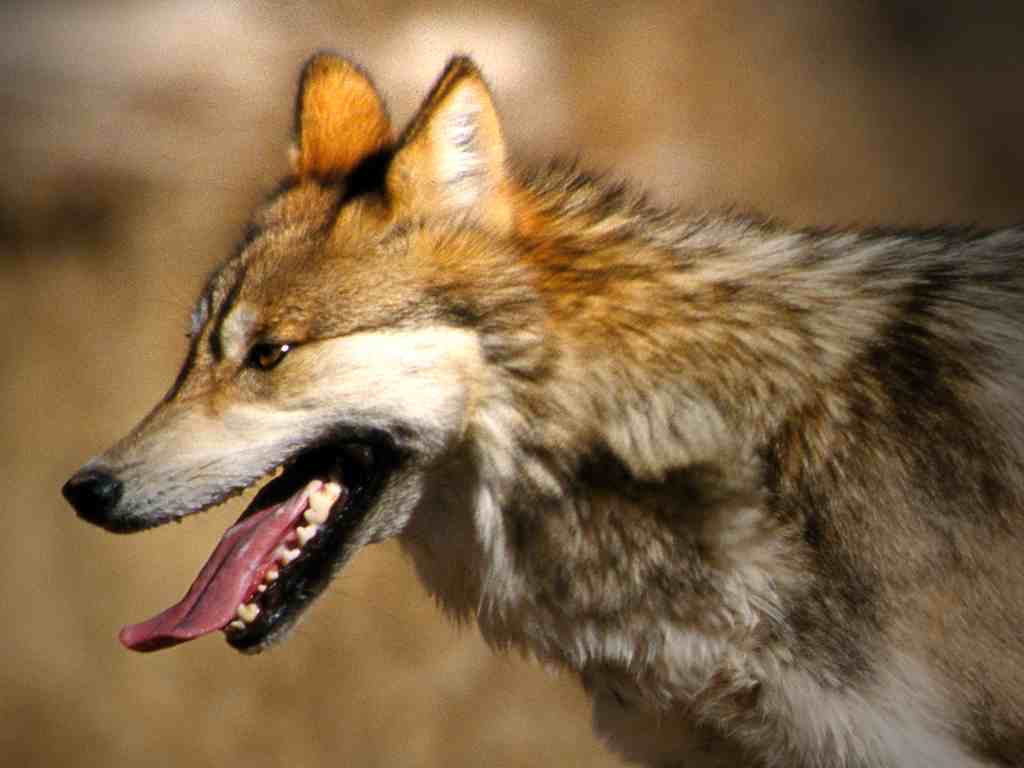
This is a somewhat dated story from last year, but it appeared in the LA Times this past December:
The U.S. Fish and Wildlife Service this week ordered the death of a female Mexican gray wolf after the animal was discovered hanging around a group of domestic dogs.
The lone 4-year-old female was shot and killed in New Mexico’s Gila National Forest on Wednesday after she was apparently attracted to domestic dogs at a private residence. The female had earlier this year mated with a dog and given birth to a litter of five hybrid pups. Four of the pups were euthanized and the fifth has not been found.
The Mexican wolf (Canis lupus baileyi) is the rarest subspecies in North America. It is also the most genetically distinct, and it probably the most primitive line of wolf found in this hemisphere.
It went extinct in the wild, and it is no longer found in Mexico.
It has been reintroduced to Arizona and New Mexico, but there has always been a lot of debate about the purity of these animals.
A captive line of these wolves that was kept at Carlsbad Caverns National Park was euthanized because they began to exhibit dog-like features. It was assumed that they were hybrids, and they were culled from the breeding program.
So when a “pure” Mexican wolf mates with a dog and has hybrid puppies, this gets the US Fish and Wildlife Service pretty nervous.
The puppies were euthanized, and when the mother started keeping company with dogs again, she was also killed.
Now, we can debate the ethics of doing such thing, but we cannot debate that a wild wolf can and will mate with a dog.
We have proof. It’s a simple fact that this can and does happen, and it has happened for thousands of years. Ever since there have been dogs and wolves running the same ranges, they have occasionally mated.
I don’t know why this became such a controversial issue on this blog.
This is one of those things I thought everyone knew.
The Mexican wolf is one subspecies that could become inundated with dog genes. When the US Fish and Wildlife Service was collecting and trapping these wolves, often in partnership with Mexican authorities, they would come across individuals that had really strong dog morphology.
These animals were never used in breeding programs.
So maybe there is some justification for removing Mexican wolves that want to mate with domestic dogs.
It’s the only way to keep them distinct and unique.






Too bad she couldn’t have been taken alive and used in one of the captive breeding programs with other purebred Mexican wolves.
They probably have too many wolves in the breeding program with her genetics. At those breeding facilities, they are working very hard to keep them as genetically diverse as possible.
I think the idea of keeping species “pure” is hogwash. Breeding programs mating non-Florida cougars to Florida cougars to maintain the population are even criticized because it reduces the purity of that population.
It’s based around a fallacious ideal that all subspecies must remain distinct and separate, and I’ve yet to hear a justification for the practice that makes any biological sense. After all, genetic diversity in these isolated populations is low, and to maintain them new genes are not only advantageous but sometimes vital.
I think it is often because the only reason researchers are paid and habitat is forcibly cordoned off or repossessed by the government is because they claim these animals comprise an endangered population.
It’s just another way that government bullshit hides behind “scientific” good intentions.
I’d go one step further and say that if the genetic complex that made them unique is still favored in that particular environment, it (or something indistinguishable from it) will arise again from the cross-bred population. The law of natural selection almost guarantees it.
Ecological niche > genetic purity. Why so many modern conservationists don’t get that baffles me.
Perhaps one factor is their endangered status: if it was known that some of the Mexican wolves were wolf/dog hybrids, that would no doubt impact that status negatively, possibly leading to a loss of funding for the breeding and relocation programs or even the loss of the protected status.
This is wads happenig in Finland just now. Beast -fearers, hunters and poachers, even one nut-headed ex-taxidermist, are claiming that too wolves in the country are not pure but some kinda dog-crosses and thus should be eliminated.
Yeah, you’re probably right. There aren’t a lot of facilities breeding them and those that are have to be very careful to avoid inbreeding. The Cincinnati Zoo participates in their breeding SSP, and I’ve been there several times when they’ve had litters on the ground, but I don’t know how many breeding pairs they have.
I wonder what her pups looked like? What breed of dog did she mate with?
That was my question. LOL.
Devil’s advocate, here. Lois speaks of “true” wolves, not “pure” wolves. I’m thinking if “true” means not just genetic purity but with social life and habitat intact, then I suppose matings between wolf and dog are pretty rare, although they always happened from time to time.
Until recently there was no one on earth who could not distinguish between dog and wolf. Then the molecular biologists told us they were the same species. Well, I’ll be damned, we said, so they are. But that leaves begging the question, “just what is the difference that we can see but can’t define in genetic terms?” The fact is that we can’t define it except to say that dogs are the domesticated branch of the family and wolves are the wild branch. It’s kind of like the differences between men and women: everybody knows there are differences but no one can spell out what they are to everyone else’s satisfaction.
Just sayin’.
The key here I think, is that though they have basically the same genetic tool kit, the environmental stressors that drive expression of the genes are vastly different.
Too, there are distinct morphological differences between Old World and New World wolves as well as between southern and northern wolves. These initial differences, average size for example, as expressed in southern, Old World wolves may play a much larger part in the unique characteristics of the domestic dog than one would expect.
I would be very interested to see a true empirical comparison of the morphological and behavorial characteristics of each of these groups of wolves, both to each other and to domestic dogs as a whole. Categories to be examined/compared would be average size, average lifespan, unique physical characteristics, sexual dimorphism, pair-bonding, type of hair or fur, primary prey species, primary habitat, inherited diseases/disabilities, sociability, pack behavior, care of the young, heat cycles, etc. Add this to the current genetic comparisons and it might put the quietus to a lot of the current debate.
I’d like to see that, too. Wolf always seems to me like the Neanderthal of the species, a very robust northern version. All the Pleistocene animals moved north and south as glaciers waxed and waned. Some became stranded in strange habitats such as N Africa or S. Asia.
I wonder whether all these strange dog color genes are present in the wolf genome.
The experts say not, at least for the melanistic gene set. But given the patterning of Lycaon pictus, one does have to wonder. It seems strange to me that L. pictus’ patterning poses no apparent threat to species survival and yet other canids–who may be carrying the same set of color/pattern genes–are usually either gray or tawny. That also leads me to wonder if the coloring/pattern sports that appeared in the Belayaev experiment were expressions of an inherent genetic set w/in the Red Fox genome or rose spontaneously as a result of other factors.
Yes, that’s what it is basically, because the whole colour-devoloping thing in a foetus is all connected with hormonal / nerve developing. Those odd-colour genes never show up, because too tame or peaceful animals won’t survive. They do excist to a some amount, but only human can provide home for those natural misfits . Females tend to be more tame than males, but they never have a chance to mate with a tame male in the nature. Only human can make these symmetric lineages to combine .
There is quite trustable evidence, that the white female moose, living in the forest in Southern Finland, is remarkable peaceful, almost tame animal. The hunters have let her alone (she’s now ab. 10 yrs). You can say this is not right reasoning for that, but I think it’s an evidence, still.
I think they may be. There are naturally spotted moose, so how about a spotted wolf pup somewhere in a den ? I think I’ve seen a faintly black brindle -pup in a documentary, but she didn’t survive long.
You might be interested in this study. I was going to do something on it but I’ve done too many wolf stories recently.
http://www.plosone.org/article/info:doi/10.1371/journal.pone.0046465
Bucking the Trend in Wolf-Dog Hybridization: First Evidence from Europe of Hybridization between Female Dogs and Male Wolves
That’s very interesting!
Most of what I’ve found is female wolves mating with male dogs, but with coyotes and wolves, it’s almost always a male wolf mating with a female coyote.