Feeds:

Archive for July, 2008

Golden History from Zomarick Golden Retrievers!

The owner of Zomarick golden retrievers, Djanick Michaud, put this video together. He points out how his dogs look so much like the originals. This is in French, but you don’t need to be Francophone to see the similarities.

You can visit Zomarick’s webite here. The website is in both English and French, and all of his dogs have hunting titles and working certificates or are working on them.

In a post coming soon, I will talk about how goldens evolved into several different types. The working type most closely resembles the orginal dogs. If the dog business was about “original intent,” we would be able to preserve so much of our dogs’ working abilities and working conformation, which is different from show conformation. Of course, I don’t think rational people think we should maintain the old fighting bull terrier of yore, simply because its original ability was used for something barbaric.

Read Full Post »

Grey Foxes– The Most Primitive Canine in North America

These foxes were filmed in Pennsylvania.

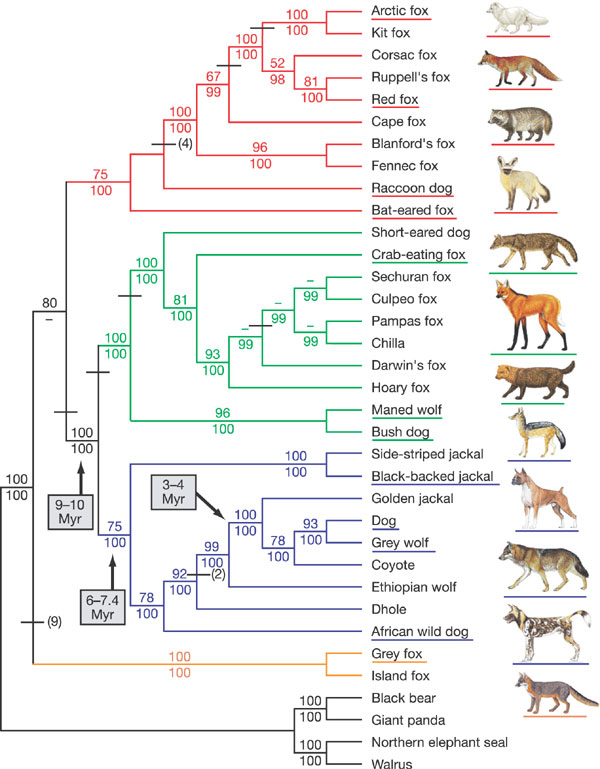
Grey foxes and raccoon dogs are the most primitive of wild dog species. They both retain their ability to climb trees. All dogs derive from tree climbing ancestors. Most dog species have developed in to carnivores that run on the ground and have lost this ability.

Grey foxes are in their own genius. The mainland grey is the most common species, but two other species exist, although one may be extinct. The island fox lives on the Channel Islands off the Coast of Southern California, where each island has its own subspecies. The foxes have suffered as introduced species have come to the islands. One population of these foxes was destroyed when the bald eagle population crashed. The bald eagles kept the golden eagles off the island. Bald eagles are mainly fish predators. Golden eagles eat foxes, and as soon as they colonized the islands, they began eating the foxes.

Cozumel fox is also a close relative, but it may already be extinct. It lives or lived on Cozumel, Island in Mexico.

The mainland grey fox has a wide range. It is sometimes spotted in Canada, especially Southern Ontario and the parts of Quebec that border on New York and New England. It also has been found in southern Manitoba. It also is found in American Southwest through most of Mexico. It is found on the Pacific Coast of Central America, and populations exist in Colombia and Venezuela.

An article on the grey fox can be found here.

Read Full Post »

Pet Fennec Fox

I know we’re not supposed to encourage the keeping of exotic wildlife, but some people have made rather excellent pets out of Fennec foxes (Vulpes zerda or Fennecus zerda).  These are the smallest members of the dog family and are native to North Africa and possibly parts of the Arabian Peninsula and the Levant as well.

If  you want one as a pet, do your homework! There is no guarantee that even bottle raised fox will be a tame as this one. They have been kept as pets by the people of the region. They might be better pets than other foxes because they are social foxes living in family groups with a single male and several females. They also lack the foxy odor that red foxes exude from their tail glands. Even if you think one is right for you, it may be illegal for you to have on in your area.

My suggestion, check out the toy breeds of dog– yorkies, chihuahuas, and similar breeds. There are members of those breeds that are actually smaller than the fennec, and they are domesticated. However, even these dogs can have poor temperaments.

The pet fennec might tell us something about how dogs were domesticated. Perhaps some hunter-gatherer human brought home a young wolf and gave it to his children or to his potential mate. Modern wolves cannot be socialized to human after they are 19-21 days old. However, it is possible that the wolves of ancient times had longer socialization periods, and the adults were much more curious animals, rather than the fearful wolves we have today, which do everything to avoid humans. Again, most discussion of dog domestication winds up being speculation because it happened so long ago.

Read Full Post »

Some working type goldens

Here are some working type goldens.

The first video is of Zomarick golden retrievers in Quebec.


Just to prove to you that this type of golden can relax and make an excellent house pet, here’s some footage of a golden named “Chewy.” 

The darker colors do NOT necessarily mean that a golden has been crossed with Irish setter, although crosses with Irish Setters do resemble red goldens. The main way to tell the difference is that the setter coat is dominant. Setters do not have as thick an undercoat as goldens do. A pure golden will have a very thick undercoat. Even the darkest goldens have some yellow shadings or even a slight yellow tinge to the coat, which shows up when the light hits the coat at a certain angle. Most goldens have cream-colored “breeches” (the long feathering on the backside up the upper part of the dog’s hindlegs), while setters will be uniformly red all over.  Setter-golden crosses do vary, especially if the setter is a field bred Irish setter, which are a lighter red than the show type. These lighter red dogs also have smaller ears and may have a larger head (making them look like goldens, too!). But most setter-golden crosses are probably working type goldens, because Irish setters are not as common as they once were. Goldens DO have setter in them, and it was an important outcross in the development of the breed.

The original goldens imported to North America, including “Lady,” the golden who worked on the Marjoribankses’ Texas ranch in the 1890’s, were dark in color. The really light colors were not popular until relatively recently in the US and are considered faulty under the AKC breed standard. (The really dark ones are, too).

For some reason, the lines that produce working type goldens tend to be darker in color. This is probably the result of a “founder effect” in these bloodlines. This means that the dogs that founded these lines were probably quite dark in coloration, and this color passed down into their offspring. Dark color probably secondary to working retriever behavior, and there are some working goldens that are light gold in color.  In these lines, it is not unusual to find dark goldens with splashes of white on them, too. White spots on the chest are very common, as are white tail tips and white feet. It’s not unusual to see the odd  white blaze running between the eyes either. Many of the early goldens had white markings on them. For some reason, it’s very unusual to see light-colored goldens with any white on them.  It’s also not unusual to have brown skin pigmentation on working goldens, with brown noses, brown lips, and yellow or amber eyes. Even those with black noses will occasionally have brown noses in the winter months in what is called a “winter nose.”

In addition to these quirks, a tiny minority of working goldens wll develop a “water spaniel coat,” which is short and very curly.  This is throwback to the Tweed water spaniel, which played such an important role in the development of the breed.

Keep in mind that working dogs are bred largely for work, not for looks. Some working goldens are big and muscular, while others are lighter and more setter-like. These traits can appear in the same litter.  Divergence in type occurs in all dogs that are bred for behavioral traits. Border collies and Jack Russells are just the two breeds in which this is most celebrated. (Jack Russell purists wouldn’t even call their breed a breed. It’s a type.)

Read Full Post »

The Ethiopian Wolf–The Endangered Wolf of the Highlands

Native only to the highlands of Ethiopia, the Ethiopian wolf is the world\'s most endangered wild canid. Originally classified as a species of jackal, the Ethiopian wolf is now considered to be a species of wolf, after some analysis of its mitochondrial DNA showed that it was much more closely related to wolves than jackals.

Native to the highlands of Ethiopia, the Ethiopian wolf is the world's most endangered canid.

Canis semensis is a critically endangered species of wolf that was once classified as a jackal. Analysis of its mitochondrial DNA show that it is a species of wolf, closely related to wolves, and by extension, domestic dogs.
It’s because they are so closely related to dogs that conserving them is so difficult. These wolves evolved in isolation, rather distant from other canine populations. When humans and their domestic dogs infringe on wolf territory, the wolves have virtually no resistances to canine diseases, like rabies. And these are social animals. One rabid animal can quickly decimate a whole population.
They also can interbreed with domestic dogs and produce fertile offspring, just as coyotes and wolves can. It’s also more common with Ethiopian wolves than with other populations of wild dog, perhaps because the need to find new genes leads female wolves to seek out male dogs.
Here’s an article that gives a good summary of the challenges facing this rare species of wolf.

Read Full Post »

Welcome! This Post is Golden Retriever History I.

Hello,

This is the first post on this blog. Let me tell you I have in mind for it!

I am a person who has some training in historiography and social science methods. I also have a background in golden retrievers, which are the fourth most popular dog in the United States, according to American Kennel Club registrations. Originally a retriever of waterfowl and descended from the St. Johns Water Dog (as are ALL retrievers), the golden has shifted from a hunting dog belonging to the British aristocracy to a  pet. Some enjoy the talents of a working retriever in the field, using those talents to flush and retriever game. Others use those talents in creating sniffer dogs for bomb and contraband or train the dogs in search in rescue. The talents that made the golden a hunting retriever are used in all of those tasks; however, the golden is rarely chosen to be a competitor in retriever field trials.

One of the reasons for this shunning in field trials is that goldens are such beautiful animals and are easily trained. They are widely recommended as family pets because of their good nature. Whole generations of goldens have been bred that have never fetched a duck or flushed a pheasant. These dogs make up the majority of the breed throughout the world. In Europe, the tendency has been to breed goldens with more muscle and bone than could ever be practical in a field dog, while in North America, the tendency has been to breed much more feathering on the dog. When one has to compete against a short-haired dog that can swim very fast (the Labrador) that has well-established working lines, it becomes obvious that the golden is not going to be the field trial competitor’s first choice. Goldens are known for their high trainability, even in the lines that are not bred for work, but the field trial Lab has been selected through the generations to be a retriever trial specialist.

Although I am not currently a breeder of goldens, I would like to have contact with those who are working on producing the working golden, one that can compete with the Lab. I see no reason why selective breeding cannot produce a golden that can work as well in the field as the Labrador, except that there are not enought people out there who consider the golden a working retriever.

The golden has proven to be a superior competitor in obedience and dog agility competition. Goldens have dominated the Lab in obedience and dog agility. However, the golden is often thought of in the field as being the more hard-headed of the two most common retriever breeds. A disconnect must exist here, and I think it has more to do with selective breeding. Generations of Labradors are bred for the field trial, and its peculiar environment. There are specialist lines of Lab that have done nothing but win trials. A short-haired dog is also more streamlined and can swim faster than a long-haired dog. The Lab is also more accepting of harder corrections than the golden, in general. Most retriever trainers use corrections that might be a little strong for a more sensitive dog like a golden.  All of these factors might explain why the Lab is the field trial dog, and the golden is the “swamp collie.”

First of all, let’s talk about how we got golden retrievers.

Here is a look at some goldens of the 1920’s:

Silence of Tone, Noranby Black -Eyed Susan, Ch. Noranby Diana & Noranby Jane--Note that Noranby Diana is dark and appears lightly built and is a show champion!

Silence of Tone, Noranby Black -Eyed Susan, Ch. Noranby Diana & Noranby Jane--Note that Noranby Diana is dark and appears lightly built and is a show champion!

The original golden was considered a variety of the wavy-coated retriever, which became the flat-coated retriever. The golden was considered part of the flat-coated breed until 1920 in the United Kingdom (by the Kennel Club) and 1925 in the United States (the American Kennel Club). The golden retriever club of America was not founded until 1938, and the breed was very rare.
If you don’t believe me about the flat-coated retriever’s close relationship with the golden compare the dogs in the first picture with a modern flat-coat:
The flat-coated retriever still maintains its working ability and its lighter build for fast retrieval work. However, the breed is often considered more difficult to train than goldens and Labs, but this breed is far rarer than either of those two breeds, even though the three were interbred extensively!

The flat-coated retriever still maintains its working ability and its lighter build for fast retrieval work. However, the breed is often considered more difficult to train than goldens and Labs, but this breed is far rarer than either of those two breeds, even though the three were interbred extensively!

 Because the golden was a color variety of the flat-coat, the two breeds have a very similar history. They both derive from the St. Johns Water dog, often thought of as the ancestral Labrador. These were crossed with setters (each region in Britain had its own setter, like the Welsh black setter), water spaniels (of which there were many, many varieties) and working collies to produce a dog that would retrieve game that was shot.

In the early to mid-nineteenth century, economic conditions had led to the development of new economic titles. Romanticism was deep within Britain’s intelligentsia and economic elites. Many people with means to buy land were purchasing estates in Scotland and rural England solely for the purpose of having a shooting estate. Game-keepers raised pheasants for their master’s gun, and the wealthy began to want a dog to pick up shot game. The retriever is the dog developed for this purpose. Originally, the dogs used for this task were water spaniels, which are rather old breeds. They are mentioned in Shakespeare, and often described as a cross between a land spaniel and a “water dog.” A water dog is a dog much like a poodle or a Portuguese water dog. A cross between the two would look something like a cockapoo or one of the other poodle hybrids. However, selective breeding for a mixture of spaniel and water dog traits could result in a dog very similar to the Irish water spaniel and the American water spaniel. The most important water spaniels in the development of retrievers are two extinct breeds: the English water spaniel, which was often liver and white or black and white in color, perhaps similar to the English Springer spaniel into which some of these dogs were absorbed, and the Tweed water spaniel from the Scottish Borders region, which was “liver,” meaning like a chocolate Labrador or pale cream to a tawny coloration.)

The St. Johns Water dog comes from Newfoundland, and its exact ancestry is an utter mystery. Some think it was mixture setters, water spaniels, and hounds that were brought to Newfoundland by settlers and fisherman. Others think that Iberian breeds played a role in it, because Portuguese and Basque fisherman had long frequented the Grand Banks fishery. The breeds of that type usually suggested are the Portuguese and Spanish water dogs and any of the Iberian livestock guarding mastiffs, particularly the Cao de Castro Laboreiro, which resembles a brindle Labrador. Brindle was a coloration of the St. Johns Water dog, so the speculation is rather strong that this breed or its ancestors played a role in its development. Although one does wonder why a livestock gurdian dog would be accompanying Iberian fishermen. The other mastiffs of the region are also suggested, like the Great Pyrenees and the Spanish Mastiff.  One of the reasons why this is discussed is the modern Newfoundland has definite ancestry with the St. Johns Water Dog. It would make sense, then, that big mastiffs were in that breed’s background. However, it’s just as likely that the original Newfoundland was not of the large mastiff type at all. There is a great debate that has long raged through the dog fancy about what the “original” Newfoundland looked like. It is possible that the modern Newf has been bred from the St. Johns Water Dog when it was crossed with mastiffs when it became extremely popular in Europe as a pet. In fact, the Newfoundland was the dog that was ever marketed as a family pet. It was once as popular as Labrador, its close relative, is today. The St. Johns water dog was crossed with setters, water spaniels, and collies to make the first retrievers. The most common type in the early to mid-nineteenth century was the wavy-coat, but the curly-coated retriever was also quite common. The difference between the two was not as obvious as one would think. The curly was not the tightly curled dog of today, and the wavy-coat sometimes had a straight coat! The curly had a much closer ancestry with water spaniels and possibly the last remaining water dogs. It does closely resemble the Wetterhoun of West Friesland in the Netherlands. Both breeds are more protective than the Labrador, golden, and flat-coated breeds.
Curly-coated Retriever:
The curly-coated retriever was in development before the importation of St. Johns water dogs from Newfoundland. However, it was crossed with it at some point. It shows a very strong water spaniel ancestry and may include the last remaining European water dogs in its ancestry. It was once a very common breed.

The curly-coated retriever was in development before the importation of St. Johns water dogs from Newfoundland. However, it was crossed with it at some point. It shows a very strong water spaniel ancestry and may include the last remaining European water dogs in its ancestry. It was once a very common breed.

Wetterhoun:
\

\

This concludes “Golden Retriever History I.”  Continued with “Golden Retriever History II,” which will be coming soon!

Read Full Post »

Hello world!

Welcome to WordPress.com. This is your first post. Edit or delete it and start blogging!

Read Full Post »

« Newer Posts

Follow