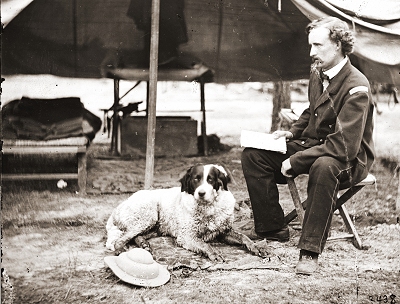
This dog was captured by George Armstrong Custer during the Peninsula Campaign in 1862. This dog is a Newfoundland. It looks more like a retriever than the modern breed called the Newfoundland. Black and white (Landseer) Newfs were much more common than solid black dogs during the nineteenth century.
This breed was very popular from the mid-eighteenth century to the late nineteenth century. Samuel Adams owned one in Boston in the early days of rebellion against the crown. Lord Byron would keep one named “Boatswain,” which died of rabies. The dog was buried at Newstead Abbey with a famous epitaph. Lewis and Clark took a Newfoundland named “Seaman,” all the way across North America to the Oregon Country. The dog was purchased at Pittsburgh, where they took boats down the Ohio at the start of their journy. Seaman proved useful in catching and retrieving squirrels that were crossing the river from Ohio to Wheeling, Virginia (now West Virginia). Napoleon was recued by a Newfoundland when he fell overboard on his return from Elba, showing that the breed was common Europe by the early nineteenth century. John James Audubon took a dog named “Plato” into Florida to retrieve shot birds. The retrieving abilities of these dogs so impressed Audubon, who saw one in Newfoundland retrieve a shot seal that sank down into rough seas. Thus, it made sense that he would take one into Florida.
British sportsmen used the St. John’s Water dog as an early cross to create the early retrievers. It is the “Ur dog” from which all the retrievers derive. However, it is also ancestral to the Newfoundland dog, which was taken from dogs of this type that were offered for sale as pets. When the St. John’s breed began to disappear, the other Newfoundland lines were used in the retrievers.
One cannot imagine how popular the pet Newfoundland was during this time period. It was as popular as the Labrador is today. It had become legendary as a rescuer of people who fell in the ocean, as a net-hauler, and an easily trained working dog. The Newfoundland’s popularity was celebrated by Landseer, who painted big black and white Newfs. Today, we call black and white Newfs Landseers, which are recognized as a separate breed in Europe.
The popularity of this breed was fueled by the democratization that appeared in the wake of the American and French Revolutions, some of which appeared during the Concert of Europe period in which the conservative nations tried to hold off the potential of another bloody French Revolution, and the Industrial Revolution. Both of these forces led to the development of a growing middle class in Europe. Disposable incomes meant that the average person could buy a fad dog with no real purpose. Romanticism was also growing at this time, and a rugged working breed like a Newfoundland would have wonderful back story for a fad dog. In fact, I will go as far as to say that the Newfoundland was the first fad dog. It was mass produced as a pet by all sorts of people, some of whom crossed them with big mastiff dogs to make them larger. It took nearly a hundred years, but the breed began to change its form and function. By the beginning of the twentieth century, the Newfoundland fell from favor. By the First World War, its popularity dropped. In fact, the breed nearly disappeared entirely following the Second World War. It was rare in most of Canada and the US and nearly gone from Europe. It was saved when Swiss Newfs were found and added to the gene pool. Most of these dogs were big, hairy, and black. The large but moderate Newfoundland was replaced by the big hairy dog.




[…] In fact, he looks like Landseer that has been crossed with a black Newf. He looks very similar to Custer’s Newfoundland. It’s amazing how much breeds change over the […]