Feeds:

Archive for March, 2009

A very aggressive golden retriever

From sharriman2

I mean does anyone see that this is NOT what this breed is supposed to be!

This dog has real issues.

And they want to ban pit bulls?

Yes, that will take care of all the biting dogs in the country.

And if you believe that I’ve got some ocean front property just outside of Pheonix for you.

And there’s a Nigerian bulldog puppy waiting for you!

A good way to reduce dog bites is to breed supposedly “safe” breeds to have the absolute best temperaments possible.

These “safe” breeds often don’t get the training and socialization they need, and if you have a inbred tendency to get a little nasty that just starts to appear in these dog, you can have a nasty dog on your hands.

The golden retriever is one of the top breeds for biting in North America. And this is a real shame.

This breed has severe health problems.

So many lines have lost their biddability and “intelligence.”

But the one thing they had going for them was their wonderful temperament.

That’s why I keep saying that this breed must lose popularity. Only then can it be rehabilitated into the almost universally wonderful dogs that they once were.

I say this as someone who deeply loves the golden retriever, who would never be without at least one, and who cherishes these dog for what they are.

Read Full Post »

An aggressive goldendoodle

And yes, even the goldendoodles are turning into possessive dogs.

BTW, this is not how you deal with an aggressive dog!

The owner is basically rewarding the dog for aggression.

There are two schools of thought on what to do here:

1. Koehler/Cesar Millan– throw his ass on the ground and stand over him like a wolf. This works, but there is a good chance you’ll get bitten, perhaps badly. My main critique with Cesar Millan isn’t that it doesn’t work. It does. It’s just that it’s very easy to get into a dangerous situation where a person could get badly injured. Further, as per Millan’s views on energy, most people have a hard time getting that particular essence he’s talking about. I know I do.

2. The Dodman/McConnell model– “Smith Barney” plan for dogs. Make him work for everything–food, toys, attention. And never allow this dog to get on the furniture or under a table. It does take longer, but the chances of getting badly bitten are lessened.

I would also add walking this dog hard several times a day or something else to wear him out.

Now, I’ve never had an aggressive golden retriever. I didn’t know they could snarl until recently.

Read Full Post »

Another aggressive golden retriever

From lostangel912.

This dog is possessive over toys.

My own dogs never were. In fact, my current dog will let you take her recreational bones away from her.

I’ve had goldens that would chew the same bone, each chewing the separate bone.

Obviously, a possessive dog is useless for the normal use of a retriever.

But that’s what happens when you start breeding away from the proper working temperament of the breed, or you believe all the malarkey about them being good natured and refuse to train or socialize them properly.

I have some theories on golden retriever aggression. However, this dog appears to be from at least distant working lines. It is unlikely that this dog was bred to be calm.

I think it’s more likely that this is an intelligent dog that didn’t get enough training and socialization. Or it could be one of the pushy dominant retrievers that sometimes pops up in working lines.

Aggression is not acceptable in golden retrievers. It’s not really acceptable in other breeds, but controlled aggression can be part of a functional temperament in other breeds. It is never functional in a golden.

Read Full Post »

A nice little website

red-nice-goldens

Swamp Collie Retrievers.

And I thought I was the only one who loved that name!

Read Full Post »

Answer to the species trivia

binturong

As most of you guessed, this species is a binturong.

It is also known as a “bear-cat.”

The bear-cat is the University of Cincinnati’s mascot.

It is also one of two species in the order Carnivora with a prehensile tail.

The other is the kinkajou.

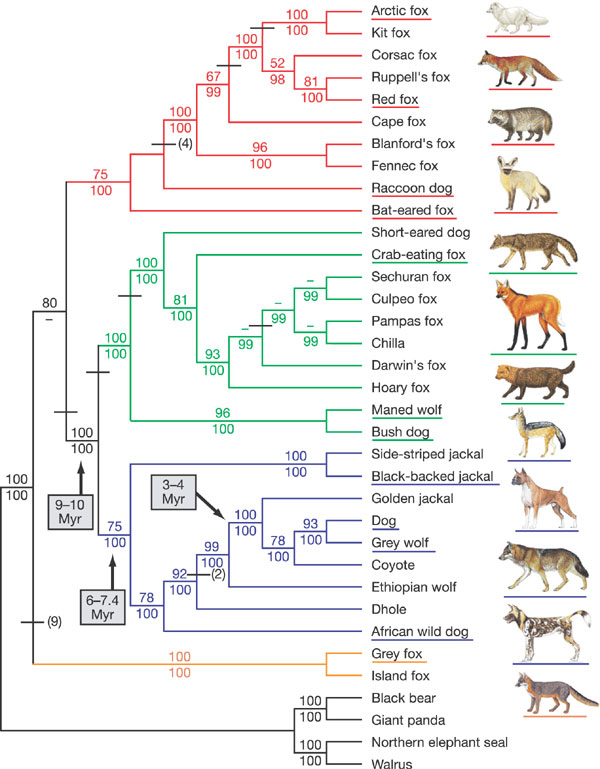
Kinkajous are procyonids, which is the raccoon family. These are caniform carnivores, which also includes bears and domestic dogs, as well as skunks and stink badgers, the red panad, and the weasels.

Binturongs are viverrids . This family includes civets and genets, some of which look like the large weasels, like the martens and fishers. However, this is a feliform family. These species are related to cats, hyenas, and mongooses, as well as the Malagasy carnivores, such as the fossa. (The African palm civet is in its own family.)

Binturongs smell like corn chips, which is one of their weird characteristics.

So the bear-cats are actually more related to cats than to bears.

Read Full Post »

The Parrots of the United States

From defendersofwildlife

Although several species of parrot have been introduced to the United States, we once had two species of native parrot. One of these is extinct, while the other is being reintroduced.

The extinct species is the Carolina parakeet, which is generally believed to have range only as far north as the Ohio River Valley. However, remains of one were found in Southern Ontario. However, it is very likely that this bird was a vagrant or an escaped pet or ceremonial animal. So it likely that the northernmost part of this species range is my native region. The last of these birds became extinct in the Cincinnati Zoo in1918. This institution is the same zoo that housed the last of the passenger pigeons.

Taxidermied specimen of Carolina parakeet in North Carolina.

Taxidermied specimen of Carolina parakeet in North Carolina.

The other species is not extinct, but its range in the US was somewhat less extensive. The thick-billed parrot, which is featured in the video, once ranged into New Mexico and Arizona. The species prefers either pine forests or stands of mature pine-oak forest. Its main diet is pine seeds, and it uses old woodpecker nesting cavities to raise its offspring.

These forests have often been cleared. And because the parrots already live so close to US pet markets, they were once widely captured and sold in the pet trade.

So yes, we once had native parrots living in the United States, and we may have them again. The thick-billed parrot has been reintroduced to the Madrean Sky Islands of Arizona, and it may become established there once again.

Read Full Post »

What is the species? And what does it have to do with a university in Ohio?

species-6

And for bonus points: what does this species share with the kinkajou?

Read Full Post »

« Newer Posts - Older Posts »

Follow