Feeds:

Archive for April, 2009

Wolf misinformation

Source.

Count the number of incorrect things this man says.You’ll lose count in about a minute or two.

He’s not the only one, this fellow has a bizarre conspiracy theory about wolves that you’ll have to see. (He’s also got conspiracy theories about our current government that are quite a hoot to watch, if you go to his channel.)

Read Full Post »

How can you not know what this is?

Seriously.

It’s a common pheasant rooster, probably a mixture of Chinese and Manchurian strains.

Read Full Post »

Everything you wanted to know about the Curly-coated retriever

curly-coat

This is the one retriever breed I’ve not seen in person.

The SoftMaple Curlies website has everything you ever wanted to know about curly-coated retrievers. It’s really impressive. I’m going to be going through it very carefully to find out more about this breed.

I do know that this was a common show dog in the nineteenth century, but by the twentieth century, it was unknown in working trials. It was said to be too coarsely built and too aggressive to be a good working dog.

However, look at these dogs. They are far from being coarsely built. And I guarantee that the temperament has also improved. They should be more protective than the golden/Lab/Flat-coat family, but they should be less so than the typical Chesapeake, which was actually bred to be both a working retriever and a good guard dog.

Read Full Post »

Cruelty at a Moscow “Animal Shelters”

The Russian klepotcracy even takes advantage of dogs.

Read Full Post »

Show working gundog certificate

golden-retriever-cream-pup

Here’s a video of a European show golden with a Show Gundog Working Certificate.

Now, that all sounds good.

But then I looked up what a Show Gundog Working Certificate actually was.

The KC awards a Show Championship, but no gun dog can be a full champion unless it passes this working test. Originally, they had to be run in actual trials, but now, they get to do the sort of amateur behavior. These certificates are given at trials or a special show gun dog working certificate test.

The retrieving behavior tested during this test is pretty much remaining steady to a line and retrieving a dummy from the land and the water. It is the same as the true trial dogs. However, these dogs aren’t expected to beat the performance bred dogs, which they would have a very hard time doing. Instead, they are looking for a modicum of instinct that has been polished through some training. These tests are a wonderful way of getting more dogs in trials, so that the actual performance-bred dogs can clobber them. Brilliant move.

It does take  a lot of training to keep a dog in a line. That really is impressive. The fact that these dogs have enough retrieving instinct to be trained to do this work at this novice level is amazing. But it doesn’t disprove a very simple truth: Performance bred dogs are better at this work than these dogs are. You might find some dogs in the European show-lines that really can do the work. These dogs should be bred from. We need dogs with retrieving instinct to be bred. However, it doesn’t change the fact that their bodies are built incorrectly to really do the work. It also doesn’t change the fact that the very light colors are the result of fad breeding, which started around 1960. The original colors were light gold to mahogany. Some of the early dogs were light golds with cream shadings (like my dog), but none were so pale as to be mistaken for white.

The fact that this dog’s owner says it’s so hard for a show golden in the UK to make the grade here is an admission of what I know and what most serious retriever people know. The European show golden is not the best example of a working dog.

While they were breeding for light color, bone, and blockiness, they forgot to also breed for biddability and drive. And that’s why I’m very wary of these lines. The vast majority of these dogs are not selected for their retrieving instinct, and even if they have it, they may not be properly built to really do working gun dog work.

Read Full Post »

Curious Ruffed Grouse

Source.

I’ve never seen this behavior in this species, but apparently it’s common enough for there to be several youtube videos of different ruffed grouse approaching people, like this one in Minnesota.

Source.

I’ve never known anyone to raise these birds in captivity. I don’t even think you can raise them in captivity, so they aren’t imprinted on people.

They occasionally get curious.

And that’s all it is.

Read Full Post »

Using the E-collar to Save the San Clemente Loggerhead Shrike

loggerhead-shrike

Let’s say we have an island with two endangered species living on it. This situation isn’t hard to imagine. Lots of islands have their own endemic native species that are very often endangered. Most island jurisdictions do all they can to protect their endemic wildlife.

But here’s the twist: Let’s say it has been determined one of those endangered species might be a major factor for mortality in the other endangered species. What do you do?

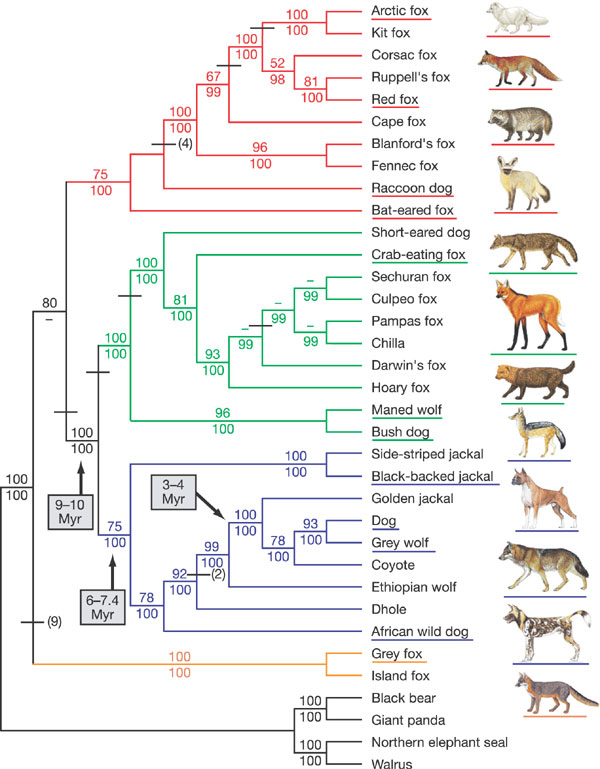
Well, we do have a real case in which one endangered species is harming the population of another. On San Clemente Island, the local subspecies of the island fox is preying upon an endangered subspecies of Loggerhead Shrike.

In the 90’s, it looked like the San Clemente Loggerhead Shrike was on its way to extinction.

Because the foxes are also quite endangered, there was little that could be done to reduce fox numbers.

However, a plan was devised and implemented in 1998 to solve the fox predation problem. The first part of this plan was to trap the foxes and hold them until the shrike breeding season was over. The second part involved the building of an electric fence around the shrike nests.

But the third part of the plan was the most novel.

E-collars have been part of dog training for a very long time. These collars are often employed to keep dogs from running deer and to generally control predatory behavior. A similar collar is also used as an invisible fence to contain dogs to their owners’ yards.

It was decided that these collars could also be used to train the foxes to leave the shrikes alone.  The foxes were trapped and fitted with e-collars that could be activated when they approached an antenna sensor. It was the invisible fence to protect the shrikes. If a fox approached the trees where the shrikes were nesting, it got shocked. (These foxes, like their mainland relatives, can climb trees to raid bird nests.)

When this three pronged plan was implemented in 1998, the shrikes had a successful nesting season, and no foxes had to be killed to save the shrikes– thanks to a little “shock therapy.”

(In case you didn’t know, island foxes are native the Channel Islands off the coast of California. They are very closely related to the more common gray fox.)

Read Full Post »

« Newer Posts - Older Posts »

Follow