Feeds:

Archive for July, 2009

Yesterday’s Critter

ghara

Yesterday’s critter was a gharial. Not only that, it was a male gharial.

How do I know?

Well, male gharials have bulbous lump on the end of their snouts. It’s called a ghara.

In fact that’s how the animal got its name. In one of the Indian languages, ghara means “pot.” The bulbous lump on the males does look a bit like a pot.

Now, in the comments, virtually everyone got it right.

However, I bet you didn’t realize how big one of these crocodilians can get.

The males have been known to exceed 20 feet in length, and there is even a record of 23 footer killed in the River Kosi in Bihar, which makes them as long as the longest saltwater and Nile crocodiles.

Unlike those creatures, however, the gharial is not a threat humans. Although they can bite and slash with their teeth, their jaws are too weak to really damage a person.  As a result, they don’t consider large mammals to be prey. Indeed, they live almost entirely on fish, which is why they have needle-like teeth. They need them to hold on to slimy fish. Those teeth are poorly designed to grip the leg of a human or any other large mammal.

I first saw a gharial at the Cincinnati Zoo when I was probably 5 or 6 years old.

And then I saw a Nature (with George Page) documentary about them, and they had me totally fascinated. It turns out that gharials are in a lot of trouble. They need clean, clear water in which to fish, and clean and clear water is very hard to find on the Indian subcontinet these days.

Attempts at stocking captive-bred gharials in the wild have not been that succesful.  The animals were found to be unable to handle heavy metals in the water, and that’s a very bad sign for the gharial’s future.

They are strange looking, but they aren’t a threat to man. They may look like river monsters from some horror movie, but they are nothing more than harmless fishermen.

It would be a tragedy if these crocodilians disappeared from the earth forever. However, they probably won’t. They do breed in captivity, and I’ve seen them at more than one zoo. But that would be a sad state of affairs if the only gharials in existence in the world were in zoos.

Read Full Post »

Source

If so, then I’m out. I have two rather cumbersome left feet!

Read Full Post »

Source.
If so, then I’m out. I have two rather cumbersome left feet!

Read Full Post »

Another color not to breed for

When I was growing up, I regularly read dog magazines, and I always looked at the classified ads of various breeds.

I remember seeing an unusual advertisement in one of the magazines: “Rare, white dobermans!”

I didn’t think anything of it. After all, people were mass producing deaf white boxers and nasty white German shepherds. How were they any different?

Well, what I didn’t know is that they were doing something quite different.

White boxers are true white dogs– the white masks either fawn or brindle.— and white GSD’s are e/e’s– a variation on the same color as the golden retriever.

White dobermans are albinos. If you look closely, you can see where the tan or rust kiss marks would be on a typical doberman.

And albinism in dogs is a bit more complicated that in other species.

Albinism causes them to have greater photo-sensitivity, which sometimes manifests itself in greater aggression.

The dogs are prone to skin cancer, as one would expect from a think coated dog with pink skin.

The genes that cause albinism are believed to be related to the genes that cause issues with the blood, kidneys, and liver. They also often have skeletal issues and missing teeth. This is very different from albino rats and ferrets. It’s also different from people with albinism.

As far as I know, no one has put a title of any sort on an albino doberman. (Obviously, conformation titles are out!)

There used to be a very good site on albino dobermans, but I can’t seem to find it. It was so good that the albino breeders are now putting up their own propaganda sites. (I’m not posting any photos of them, because they are all either associated with these unscrupulous breeders or their propaganda sites. Just go to Google Images and type in “albino doberman”  too see for yourself.)

And you can still find the breeders offering “rare, white dobermans.” I guess if I wanted a dog to show off, I’d get one, but if I actually wanted a doberman, I’d get one of the more standard colors.

I’ve never known of an albino dog of any breed to be of any use– save St. Hubert’s May, a yellow Russian retriever (golden retriever), who probably wasn’t an albino at all!

This is just a gimmick. It makes money. White golden retriever, white boxers, and white GSD’s are all in the same vein. It’s a fad color. It’s just in this case, the dogs are more likely to be defective than the breeds that are normally sold for their pale pelts.

I bet that one could sell a normal black and rust doberman for a lot more if it carried the albino gene or was suspected of carrying. Wonderful.

This is on the same level as the freak show owner who wanted to buy a five-legged puppy.

No one in their right mind would breed a five-legged dog.

And no one in their right mind would intentionally breed an albino dog.

But if it sells, it sells. Who cares what happens to the dog?

Read Full Post »

ID this critter

This shouldn’t be hard. (The answer).

strange critter

Read Full Post »

Worldwide Civil War Among Chihuahua Fanciers!

fierce chihuahua

I’m not a toy breed person, so this debate entirely slipped under my radar.

It turns out that concerns over health have led several registries, including the Kennel Club, the Canadian Kennel Club, and the Australian National Kennel Club, to disqualify the merle coloration in Chihuahuas. Not only that, but the KC has new regulations that prevent any Chihuahua that is either merle or from merle parents from being registered. FCI countries are trying to breed out any merle genes in Chihuahua.

Health issues were a major reason for this change in these breed club standards. Merle in Chihuahuas is very closely associated with deafness, so it could be a major victory for breed health.

However, some breeders have always contended that merle Chihuahuas weren’t purebred, so that may have had something to do with the ban on merles. After all, Dachshunds come in long and smooth-haired varieties, and they carry the gene for merle (called “dapple” in Dachshunds). The theory goes that these dogs had falsified pedigree and were derived from crossbreeds.

Dapple in Dachshunds is a dominant gene, and the Chihuahua merle gene is also dominant. In Dachshunds, dapples cannot be bred to dapples, because it will produce “double dapples,” which are known to have several defects.

Now, it could be that the Chihuahua people don’t want these defects, so they banned merle. It also could be that they wanted to ban a coloration in the breed that supposedly came about through crossbreeding.

Now, the AKC and its parent club for the Chihuahua refuse to ban merles. Thus, the AKC and its parent club are out of step with most of the world. That has caused a worldwide civil war among Chihuahua fanciers.

And there are strident merle Chihuahua fanciers. On their sites, they blame the “BBC” and “UK vets” (probably in this documentary) and claim that no merle Chihuahua has ever been found to be deaf.

I have no dog in this fight.

So I really don’t know whether merle in Chihuahuas is really connected to deafness or not.

My guess is part of this movement to ban merle Chihuahuas has less to do with health and whole lot more to do with the possiblity that these merle Chihuahuas are part dachshund.

Blood purity matters a lot to these people.

If this had truly been a health revision, I think they would have gotten rid of the apple head requirement and strictly banned moleras.

So there may be a health victory in the banning of merle Chihuahuas and their progeny. Or it may be more jockying around with eugenics and blood purity– this time using health as the front to ban a color that may have arisen from crossbreeding.

Boy, times have changed. Remember, golden retriever people had to make up a story about their Russian origins to get their breed split off the flat-coat! Now, they are using health. Maybe the health issues are justified, or maybe  it’s just the same old wine in a different bottle.

My guess is we’ll see a lot more of this in the years to come.

For the record, I think merle should be banned in Chihuahuas, just as double dapple is banned in Dachshunds. But the Chihuahua standard needs several revisions.

And color is but one of them. The extreme small size and large,  rather unnatural head are two things that should be reformed. I would think those would take precedence over the extreme minority of Chihuahuas that are merle.

Read Full Post »

Taco Bell dog dies from a stroke

Source

Yet another celebrity has passed away.

The Taco Bell Chihuahua has died at the age of 15.

Although voiced by a man, the Taco Bell dog was actually a female named “Gidget.”

Her trainer reports that Gidget had had normal day with nothing to suggest that she was ill in any way.

Then while the trainer was watching television, Gidget  “began making ‘strange noises’ and suffered a stroke.”

Another icon is gone, but I certainly hope we aren’t talking about this a month from now, wondering who will get custody of her pups or whether the vet prescribed too many drugs for her.

***

Now, I’ve always been peeved at the grammar in those commercials. “Yo” means “I.” However, it’s almost never used in Spanish sentences, because “Quiero” is used only as a first person. “Yo” is simply redundant.

***

Now, Gidget was a faulty dog by show dog enthusiasts.

You see, Chihuahuas must have what is called an “apple head.”

apple head chihuahua

Apple heads are very different from Gidget.

I have not seen any studies on this condition, but I think we can at least question whether apple headed dogs might be predisposed to hydrocephaly, which is a bit of a problem in Chihuahuas.

Gidget was what is called a “deer-headed” Chihuahua. They aren’t preferred in the show ring.

But somehow I doubt that the Mexican pariah dogs that are the ancestors of the Chihuahua had these apple heads. Apple heads were very common in “English white terriers,” which I’ve always suspected were a partial ancestor of the modern Chihuahua.

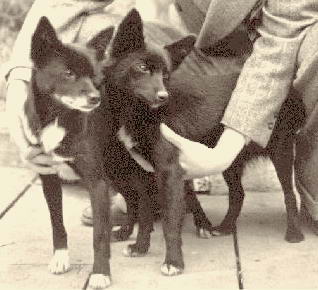
The modern dog is really an invention of the show ring. We have some evidence of what these dogs might have looked like in Mexican and Meso-American Art, but I think the best evidence from which we can infer some idea of what they originally looked like. I think the breed that gives us the best idea isn’t from Mexico but from Western Canada. The Tahlta people kept a small hunting dog called the Tahltan bear dog. (Here’s another photo.)

*Yes, they were used to hunt bears, which explains why so many Chihuahuas have good prey drive. My grandpa even used his little Chihuahua bitch to flush grouse and tree squirrels, which further adds evidence to my theory that the two were related.

And then there is a dog called Techichi, which is probably the Mexican version of this little Native American dog.

Then they were crossed with small terriers, toy spaniels, and toy spitz breeds to produce the modern Chihuahua.

The apple heads look cool in the show ring. I don’t think they are of much use to the dogs or in keeping with their ancestry.

Read Full Post »

« Newer Posts - Older Posts »

Follow