
It all started with a dog that looked very much like this Barbet.
I know I have written about this at length in other posts, but I think I need to condense this history. I’m getting lots of comments from the historically challenged lately, so I think we need to put some of this in perspective.
The oldest water dog breeds are those of the poodle-type. The earliest depiction of this type of dog is on a Roman coin that dates to 112-111 BCE. Now, this dog is not hunting from the water, but it clearly looks like the proto-poodle-type, which most likely evolved as a herding breed in Central Asia. The puli and its relatives in Hungary are very good examples of this type. (Although we believe the word poodle comes from the Low Saxon word “pudeln,” which means “to splash,” I find it rather interesting that puli is not that different from the word poodle.)
Why these dogs became the first water dog is a good question. Their coats are very inefficient in the water, and almost all of them were clipped in some fashion to make them stream-lined in the water. In 1621, Gervaise Markham wrote a treatise on shooting birds called Hunger’s Prevention, which included a description on how to clip water dogs to make them faster in the water and yet still maintain their insulating properties of their coats. (I don’t call the breed that Markham wrote about a poodle. I call it the English rough water dog or water-rug, which is referenced in Macbeth.)
Now, the reason why the heavily coated herding dogs became used as retrievers is really quite simple.These dogs were smart. As this type became established in Europe, they soon became used for all sorts of different things besides herding.
The earliest way of hunting ducks involved using a dog as a decoy that enticed the ducks into cages. The herding dogs would have been a good choice as an early decoy breed, because they were playful. And playful dogs attract ducks. The dogs may have originally been chosen because they helped herd geese that had molted into pens. They were also used in falconry, where the dogs flushed birds into the talons of the falcons or hawks. They also were used to sniff out truffles and lost arrows.
It was just a very short leap from doing that work to helping fishermen with their nets and lines, and then helping hunters retrieve shot game from both the land and the water.
Now, these dogs existed in virtually every European country. Some of them evolved into the poodle, the Lagotta Romagnolo, the Barbet, and the Portuguese and Spanish water dogs, all of which look very similar to the original dogs. Others became bantamized and helped found the bichon breeds. Others most likely retained some of their herding ancestry and founded lots of different shaggy herding dogs from the Bearded collie to the Polish lowland sheepdog. One of the German herding dog landrace-types is a dog called a sheep-poodle, which is of this type.
Now, as time progressed, these dogs were outcrossed with other types. By the seventeenth century, new types of water dog were developing. In the Dutch province of Friesland, where the Frisian people live, their local water dog was crossed with the local spaniel-type dog and some other local dogs (perhaps of the spitz type). This resulted in a dog we now call the Wetterhoun, which literally means “water dog” in Frisian.
The poodle-type water dog coat is dominant, but it is easily lost when bred to other strains. It is actually quite easy to breed away from, and this would be the case with other derivatives of these water dogs.
During the same time period in Britain and Ireland, crossing these dogs with spaniels and proto-setters was actually quite common. It was thought to be a good way of introducing very strong bird dog tendencies into the water dog type. This resulted in dogs called water spaniels. These dogs tended to replace the old English rough water dog type by the eighteenth century, although George Stubbs painted two portraits of two water spaniels that really were more of the old water dog type. (One here, and the other here).
The Portuguese and Basques from Spain also likely brought their poodle-type to Newfoundland. It is from these dogs that foundation of the dogs called the Newfoundland and FCI Landseer breeds and the St. John’s water dog were founded.
None of these dogs is of the poodle-type. Indeed, the Newfoundland and Landseer are mastiffs.
But nonetheless, they derive from these poodle-type ancestors.
After England claimed Newfoundland, it became obvious that the fishermen had a new sort of dogs on their hands. In the book Hunting Dogs of America, a writer Jeff Griffen describes this new canine:
In time…the St. John’s Newfoundland [arose], a … water dog about the size of a Pointer with a heavy, oily coat that shed water like a greased balloon …. a most practical dog. During the fall and spring when great masses of migrating ducks and geese clogged the island, he worked tirelessly with gunners as a retriever. By and large, though, he was a fisherman’s dog, working around the nets, on the boats, recovering anything that fell overboard, fetching a cod that slid back into the water as the fish were being transferred to the pier, swimming from ship to shore with a hawser line. In those days a ship dog was a handy asset, not only for companionship but for practical use. From 1750 on, these Newfoundlands from St. John’s rode the ships to England and the Continent. They were a captain’s pride and joy, friend of the crew and general handyman.”
Of course, this dog is the St. John’s water dog. When he says that dog had a heavy coat, that does not necessarily mean that it had the coat of a poodle. I think it more likely had the coat very similar to this dog, which is listed as a “St. John’s Labrador” (a synonym for the St. John’s water dog).

I should note here that Griffen gets the dates wrong in the text, for the Portuguese and Basques were in Newfoundland before the English claimed it.
I also should note that even today Portuguese water dogs will have puppies that have coats very similar to the dog above. It is a recessive trait that pops up every once in a while. In addition to this, it is likely that other Portuguese breeds may have had a role in creating a water dog without the traditional poodle coat in Newfoundland. It is often suggested that the Cao de Castro Laboreiro had some role in its development, and because this breed is a really hardy, multipurpose farm dog from the north of Portugual, it would make sense that some of them were among the early Portuguese settlements. It is believed that the brindle that once existed in early retriever dogs came from this breed. (This color still exists in Labradors and Chesapeakes.)
Other suggestions are that the wolves of Newfoundland and possibly spitz-type dogs and Native American dogs played a role in their development. The wolves of Newfoundland were known to be quite docile and approachable. I disagree with the suggestion that sometimes appears that these wolves were domestic dogs, simply because the Beotuck, the only native people living on Newfoundland at the time of settlement, kept no dogs. These were simply curious wolves that had never experienced persecution by people, and they could have exchanged genes with the imported dogs from Europe.
There is also another possibility. In Labrador, there was a dog of the North American hauling spitz race, which we now call the Labrador husky (It’s not mixture of the Labrador and Siberian husky). It could have been an ancestor of the St. John’s water dog.
The smaller dog was the older of the two, but the addition of some sort of mastiff-type dogs from England and maybe some cart-hauling dogs of the heavy poodle and hauling mastiff-type from the Low Countries and France helped create the larger dog that became the ancestor of the Newfoundland dog and the FCI Landseer.
It is also possible that the very cold winters in Newfoundland also selected against the poodle-type coat. When a poodle gets wet, it is very likely to hold some of the water in its coat. In very cold conditions such an animal is likely to get its coat iced over, and it will lose its protective qualities. Maybe some of these dogs froze to death, and natural selection chose the shorter coat.
Feathering appears to have existed mostly in the big Newfoundland, but feathering was not considered an asset among those who used their dogs for waterfowling. William Epps Cormack, who was the first person of European descent to visit the interior of Newfoundland in 1822, wrote about the dogs used for hunting ducks and ptarmigan:
“The dogs are admirably trained as retrievers in fowling, and are otherwise useful…..The smooth or short haired dog is preferred because in frosty weather the long haired kind become encumbered with ice on coming out of the water.”
So it is likely that the long-haired dogs were often sold to British merchants at this time. This might explain why the wavy-coated retriever was so common, and the short- haired dogs that became the Labrador retriever were virtually unheard of. The short-haired dogs were also held very closely by the Earls of Malmesbury and the Dukes of Buccleuch.
The big hauling dogs were also probably easier for Europeans and Americans to procure, and once they became popular at the end of the eighteenth century. The big dogs were in demand. Dog dealers began to hawk them. They bred them with English mastiffs to make them bigger. Virtually every up and coming family had them, and such a fad continued well into the nineteenth century.
The bulk of these dogs were black and white, which are called Landseers today. Sir Edwin Landseer painted many painting of this type of dog, which fell out of favor in later decades. In the FCI countries, this dog is recognized as a separate breed from the Newfoundland, which includes only the solid colored dogs in the FCI countries. It has a lighter build and far less feathering– in keeping with the original dogs.
Now, as both the Newfoundland-type dog and the St. John’s water dog were appearing in Britain, a new type of dog was evolving. The shotgun had made the sport of shooting rather popular, and British landowners were anxious to have a new kind of dog. One that could pick up wounded game birds and rabbits.
Originally, they used setters and spaniels that could retrieve to do the work. Water spaniels were always useful, of course, and collies often also were used. But when these dogs from Newfoundland appeared, they began to use them. The St. John’s water dog is the one most often credited with helping found the modern dogs we call retrievers. Indeed, it probably deserves that reputation.
However, the big Newfoundlands were also used as retrievers. The most enigmatic dog of this type was Zelstone, who may have been Newfoundland or St. John’s water dog but was registered as a wavy or flat-coated retriever. He is also one a very important sire in both golden and flat-coated retrievers and probably an important sire for Labradors through his role in developing the flat-coat.
Just as the water spaniels supplanted the English rough water dogs, the retrievers supplanted the water spaniels in Britain and Ireland. Indeed, today only one breed of water spaniel from that part of the world still exists– the Irish water spaniel. This breed is itself rather unusual with its topknot and rat-like tail. It represents the Southern Irish water spaniel that was common around the River Shannon in the eighteenth century. Its roots may go farther back than that, although it is hard to tell whether sources are talking about that breed, another variety of water spaniel, or the English rough water dog. Even more strangely, only one strain of the Southern Irish water spaniel still exists. This strain is the McCarthy strain, which was founded by Justin McCarthy in the 1830’s.
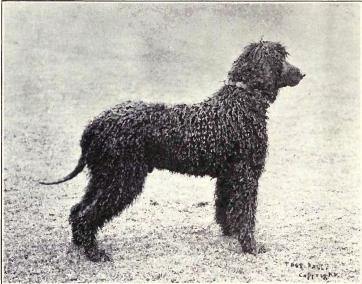
Irish water spaniel
Now, all of these water dogs are related. They have an interwoven history, the nature of which is so complex that one must understand the history of all of these dogs in order to figure out the real history of one particular breed. That’s one of the things I’ve discovered since I started writing about these dogs last summer.
Not only did the St. John’s water dog found the retrievers, but it also founded a breed of water dog or water spaniel that played a role in developing the Labrador and the golden retriever– the Tweed water spaniel or Tweed water dog. This breed of water spaniel was said to look just like yellow or tawny curly-coated retriever with less curl to its coat. That appearance is exactly what you’d expect from a dog that was a mixture of native water spaniel and imported St. John’s water dog, as Richard Lawrence said they were in 1816 in the Complete Farrier and British Sportsman. Although Lawrence says that these dogs were part Newfoundland, their short hair and retrieverish appearance suggests that they were part St. John’s water dog.
By the end of the nineteenth century, the Newfoundland lost its status as the fad family dog. It nearly disappeared into obscurity. It now exists in a very exaggerated form. It almost went extinct during World War II, simply because it was too hard to feed and care for. It has since returned to more sustainable numbers, but it is unlikely to be as popular as it was in the nineteenth century.
The retrievers began to standardize as actual breeds, with the curly-coated retriever becoming the first one to really dominate as a show dog and the wavy or flat-coated retriever became the first to really dominate the trial circuit. The former had a lot of water spaniel in its background, and it had some history as a poachers’ retriever, which resulted in a dog that could be a bit protective and little less friendly with people and other dogs during trials. However, its bizarre appearance guaranteed that it would make a nice show dog. As a result, it nearly disappeared as a working dog. The wavy-coated breed dominated the early trials. This dog would eventually evolve into the golden and flat-coated retrievers, and it would play a role in developing the Chessie, the Labrador, the Nova Scotia Duck-Tolling retriever, and the Murray River curly-coated retriever, which doesn’t yet exist in this hemisphere.
After World War I, the flat-coat fell from favor as a working dog and was replaced by its newly founded cousin, the standardized Labrador retriever. The Labrador would soon dominate trials and tests and become the most popular dog in the world. Its ancestry was with the last of the St. John’s water dogs, which became obsolete in Newfoundland with the development of better fishing gear and the passage of the Sheep Protection Act, which levied a high tax against dogs not used in sheep production. The last remaining dogs were exported to Britain over a period from the 1880’s to the 1940’s. The Earls of Malmesbury made a deal with the Dukes of Buccleuch to help save the strain and make the breed better suited for gun dog work. The move paid off, because currently, the Labrador retriever, the breed that they helped found, is really the top water dog right now.
In fact, it’s the top dog right now.
It is quite strange that this lineage that began with shaggy poodle-type dogs has finally ended up with a dog that has smooth hair like an otter’s. It requires almost no grooming, and yet its coat provides enough protection against cold water. And it’s got its ancient water dog ancestor’s very high trainability and playful, docile disposition.
I have a lot of information on the history of all breeds of water dog. It would simply take too long. The Poodle History Project is a great place to start. It is truly a remarkable site and boon for anyone interested in the history of these dogs.
I’ll just leave you with some final words. Dog history, like all histories, must be based upon evidence. Lore and legend are totally poisonous to our understanding of dogs, and in trying to understand where certain breeds come from, we are often confronted with the absurd, the stupid, and the romantically gullible. We need to look carefully at the evidence we have before we start making fantastic claims.
We should also understand that no breed exists within a vacuum, and if two breeds look similar and have a similar function, there is probably a good reason for it. Indeed, as is the case with these water dog breeds, if they have a similar function, there is probably a good chance that they are related. And sometimes we have to look at the historical function without our rose-colored and often breedist glasses.




Thanks for the history of retriever and water-dog breeds. It was very interesting and actually better done than a lot of the ones you find in the breed books.
I know that you concentrate on goldens and flatties. However, this history also explains at least some of the mismarks and coat “faults” that are often found in Labrador retrievers.
I wonder if in the course of your research you have gained any insight into two other Lab curiosities.
First, the very curious tan points that show up in pure-bred Labs – I’ve actually seen this mismark in an AKC litter.
Second, the fact that Labs generally seem to be far better at following ground scents than other retrievers – a hound characteristic rather than a gundog characteristic. At the same time – notwithstanding their use as pointing dogs – Labs will air-scent on their own noticably less often than other retrievers or sporting breeds.
Thanks again for the history.
Gordon setters and collies were crossed into wavy-coated retrievers:
1. http://chestofbooks.com/animals/dogs/British-Dogs/Chapter-XXXII-The-Black-Wavy-Coated-Retriever.html
2. https://retrieverman.wordpress.com/2009/02/20/the-black-and-tan-color-in-the-way-coated-retriever-landrace/
The wavy-coats were heavily interbred into St. John’s water dogs to found the Labrador.
To make yellow Labradors more common, lemon foxhounds were used, as well as golden retrievers, as were pointers of the same color. These explain why you have pointing Labs and some Labs that look like hounds.
Another source for the yellow color in Labradors was the Tweed water dog, which according to Dalziel’s book, were crossed with bloodhounds.
I have to admit that I wrote most of this while ticked off at some trolls who have infested this blog.
Goldens air scent because they’ve got a lot of setter in them, as do flat-coats.
The trend now is actually to breed better marking Labs– dogs with phenomenal visual memories. Such dogs don’t need good noses at all, but they are useless in working gun dog that works in heavy cover. He can’t see where everything falls.
Haven’t an idea about such a trend.
Mayby that’ll be useful in Sahara?? Yeah, why?
Flattie-pics of very good looking/working male from Russia.
http://images.google.fi/imgres?imgurl=http://www.dogy.ru/images/IMG_7022_1_small.jpg&imgrefurl=http://www.dogy.ru/results.htm&usg=__p4q-It5-1YOufxsnkcgKhxgik9M=&h=336&w=412&sz=31&hl=fi&start=9&um=1&tbnid=cPLjskrPvjdmuM:&tbnh=102&tbnw=125&prev=/images%3Fq%3D%2522Russian%2Bretriever%2522%26hl%3Dfi%26sa%3DG%26um%3D1
The ones I always see present so much the setter-style that they look just flat both head and body.
Black and tan/cream, or “phantom,” poodles are in the poodle gene pool (but not allowed in the AKC show ring). See http://tinyurl.com/yaeofq6.
Good grief – here’s the link I was trying to post – http://www.htpoodles.com/phantom-standard-poodles.html.
Sorry…..
That’s interesting. Do you think they could have existed in the Iberian water dog population? Does it exist in, say, Spanish water dogs?
Actually, they do. They are called ‘orito’ and the official standard does not like them. Near Malaga, and the south of Spain you see them a lot though. http://www.perrodeaguadeportivo.com/2011/09/el-color-orito-en-el-perro-de-agua.html
“I’ll just leave you with some final words. Dog history, like all histories, must be based upon evidence. Lore and legend are totally poisonous to our understanding of dogs, and in trying to understand where certain breeds come from, we are often confronted with the absurd, the stupid, and the romantically gullible. We need to look carefully at the evidence we have before we start making fantastic claims.
We should also understand that no breed exists within a vacuum, and if two breeds look similar and have a similar function, there is probably a good reason for it. Indeed, as is the case with these water dog breeds, if they have a similar function, there is probably a good chance that they are related. And sometimes we have to look at the historical function without our rose-colored and often breedist glasses.”
Bears repeating.
And, even this terrific blog springs out of breedism.. And it’s also a window out of it – many.
Oh, thank you!
In these links “…two portraits of two water spaniels that really were more of the old water dog type. (One here, and the other here).” — the first “here” link is dead.
Is there any information that goes along with the Irish Water Spaniel photo you included?
Patrice
http://patricedodd.wordpress.com/
I’ve fixed the link, but here it is: http://www.tate.org.uk/adventcalendar/2006/artist.htm?18
The photo of the water spaniel is from 1915 book called Dogs of All Nations by W.E. Mason: http://www.archive.org/details/dogsofallnations00masorich
I have a very hard time writing about the Irish water spaniel because most of what we know about them comes from the period of Justin McCarthy, and their history before that is rather unclear. The Northern Irish water spaniel was very similar to some strains of English water spaniel, and it went extinct.
Well, I just posted the link to this blog entry to an IWS group — you may get some useful commentary. I know the IWSCA has a whole archive full of historical documents, but I have no idea how far back it goes or how one would go about getting into it.
Oh, I hope so.
Water spaniels have always fascinated me. I can see their traits in my dogs. My golden has the head shape of a water spaniel, and I had one with curly topknot, although not as profuse as that of an IWS.
I love the photo of the Barbet, for purely anthorpomorphological (if that’s a word) reasons–he looks like a dog one could have a conversation with.
I’d love to know where the Lab’s wondrous coat and tail come from (I don’t know that they go together, really, but something intuitive tells me that they do–or is there another water breed with the otter tail?).
Also, the Labs I love in particular have a certain laid-back goofiness that I adore–I see some of that in my flattie and her relatives (and yes, I know, they’re ALL related), but the flatties are a bit more exuberant and “childlike”, relatively speaking, and more me-me-me. It has it’s charms, for sure, but I find it a little overwhelming occasionally.
While Labs certainly aim to please, there’s just a tinge of detachment or independence or (if I may REALLY anthropomorphize) sense of irony, sort of a “yeah, I’ll work with you, just so long as you remember that I’M the dog, here, and you’d best respect that.” Where does that come from, I wonder? The same place the tail and coat do?
My flattie and Lab both have webbed feet, and I’ve always assumed goldens do, as well–where do those wonderful webbed feet originate?
All dogs have some webbing in between their toes. All of these dogs have a lot of webbing toes and probably was there when they turned into water dogs.
Goldens have webbed feet, but many have lots of hair in between their toes. The webbing often collects the snow and ice.
Ah, yes, the snowball problem–Ms. Allthat has the problem as well. Another reason the Lab’s coat is special (or, at least, convenient).
The long hair between the toes collects the icy snow, not the webbing.
Yes, agreed–it’s the long hair, not the webbing.
Pulik owners were asking why their dogs are called Hungarian water dogs when so many of the dogs loath the water. This was a suggested explanation.
Re: hungarian water(?) dog – Blame Hoffmann!
In the book “LIVING HERITAGE Old Historical Hungarian Livestock” a book made to
mark the Millenium by the Hungarian Ministry of Agriculture and Rural
Development the culprit is named (and possibly shamed)
the description of the Puli within the book reads as follows:-
“Purposeful breeding of driver-dogs started in Europe in the 17th Century only.
Heppe (1751) described first the Ancient Puli: “its fur is very knotted and
felt-like, generaly raven-black, there are smaller and larger body-sizes. The
medium-size body is stout, the look obstinante.” Also Buffon (1773) mentioned a
similar dog belonging to the group of sheep dogs: “the whole body except the
face and the feet are covered by a fuzzy, black fur. Its task is guiding the
herds and keeping the order.” An Austrian kinologuist, Hoffmann called the
medium-size driving dog as “Hungarian water-dog”. As a matter of fact, the
herdsmen of Hortobagy and Kinkunsag distinguished one of the variants as the
“Puli walking on water”. Probably the name is derived from the German
designation of the poodle (Pudel) which was called in the 18th century as “water
dog”. The poodle originating from Spain arrived, likely, together with the
larger and more wooly type of sheep to Hungary. Raitsits and Turcasanyi supposed
that the Puli name was an adaptation from the German language. Zoltan Kenez
(1820) wrote about the dogs of Hortobagy and Kunsag: “The stud browsing next to
the swampy lake is a beautiful spectacle. The mares with colts are driven toward
the barnyard among the tussocks by two Pulis walking on the water, because there
the stable-lads cannot follow them.”
Its an interesting book and it looks like somewhere back in the mists of time
things got lost in translation between the herdsmen’s regional name for one of
the varieties of “puli walking on water” to Hoffmann’s “Hungarian Water Dog”
I’m not sure how easy this book is to get hold of (mine was an E-bay christmas
present from my Husband!) it is printed by Agroinform Kiado with a run of 1000
copies ISBN 963 502 739 7.
Susan
NE Scotland
Excellent!
I didn’t know this.
I don’t know if you’ve checked out Spanish water dogs, but unlike Portuguese water dogs, they are primarily herders that sometimes work on boats and as a gun dog.
“The trend now is actually to breed better marking Labs– dogs with phenomenal visual memories.”
Probably that’s the trend in the States – but the old world’s
t r i a l l i n g dogs still need to have excellent noses in the job, too… ;)
Trialling ground is very often heavily covered and in quest of occasional runners the scent ability is naturally of paramount importance… :)
That’s the trend in the US.
The trial golden is actually a European dog in its behavior, so it’s often outclassed in our trials.
I have no experience with European trial Labrador, but if I did, I think I’d really like them. After all, they do very, very well at European trials, which I happen to like.
If you ever do a post on a Barbet again please contact me for more photos as I have excellent photos of Barbets….
I would love to have some good photos of Barbets!
So I will definitely contact you!
check out http://www.americanbarbet.com :) thanks!
Interesting blog post btw!
Yes, I will definitely contact you when I do my next post on the barbet.
Very interesting website and blog.
I didn’t know that barbet came in black and tan.
A lot of early retrievers–wavy-coats (flat-coats) and Labradors– came in black and tan. We’ve always thought that came from Gordon setters and collies that were crossed in. Maybe it also comes from their water dog ancestors.
Black and tan Labradors still pop up every once in a while: http://www.guidingeyes-md.org/Misc%20Files/Black%20and%20Tan%20LabradorsBCWEB.htm
[…] The history of water dogs […]
[…] ignore this post on the history of water dogs. It was based solely upon various historical research that was later largely debunked through […]