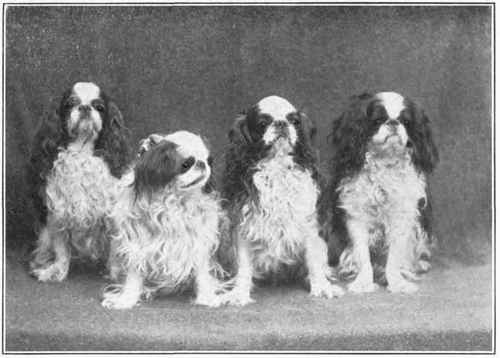
This photo comes from W.E. Mason’s Dogs of All Nations, which was published throughout the 1910’s.
This breed of toy spaniel has a very strong influence from the pug. As I have noted before, the original toy spaniels were more like the papillon, although without the spitz characteristics. Crosses with the pug are believed to have flattened the face, but the Belgian griffons, the Japanese chin, and the pekingese could have also played a role.
There was also a short-haired companion dog that was very similar to a toy spaniel that was never given a name. Someone tried to reconstruct this breed in the 1990’s by crossing whippets and Cavalier King Charles spaniels. The breed was called Tudor hound, but I have heard nothing from that particular breeding program since the late 90’s.
Nothing is cuter than a toy spaniel with a flattened face.
They remind me of muppets.
These little spaniels originally had a function.
They were often used as hunting dogs.
Pisanello depicted two small spaniels at the foot of the horse in The Vision of St. Eustace

The spaniels were probably not contemporaries of the real St. Eustace, who was a soldier in Trajan’s army.
But they were contemporaries of Pisanello, who lived during the fifteenth century.
A closer look at these spaniels reveals that they are not that much like modern English toy spaniels:

These spaniels resemble solid red phalenes (which we North Americans consider a variety of Papillon). They are phalenes without the spitz influence.
And the fact that Pisanello portrayed them them as hunting dogs very strongly suggests that they were of some use on the hunt. Small spaniels have always been the tool of the beater, who wants to drive a bird or lagomorph from dense cover.
But their cuteness also made them very popular among the nobility as pets, and that’s why toy spaniels are not often thought of as flushing dogs. However, both English toys and Cavaliers have flushing instincts, and the papillon/phalene breed is known for being very easy to train.
Because the English toy is so brachycephalic and because the Cavalier is so unhealthy, they aren’t the first choice for anyone wanting to train a working spaniel.
But I have heard of Cavaliers being trained to hunt rabbits.
So it is possible that one could be working as a flushing spaniel.
Somewhere.




Awesome post!
I have a 5 y/o male Cavailer in addition to purely field-bred English Cockers. Knowing what i know now about their health probabilities, i cant beleive i was so naive to purchase one. That being said, he’s the best family dog i have ever owned or known.
Sample of one: The dog is very birdy and does have a strong flush. He is fast enough certianly to kick up pheasants and quail. The dog has ZERO retrieving instinct. I suppose you could FF him, but you’d have to be a cold-hearted SOB to ear-pinch/toe hitch a little Cavalier.
Three more significant physical problems exist in this otherwise healthy dog that would prevent someone from spending a lot of time/money to train on birds.
1. His feet are too splayed to work hard for long days over rough ground.
2. Luxating patella, common to small dogs
3. Terrible endurance, i assume this has a lot to do with his shortened (not flat by any means) muzzle.
I love these dogs, so much and am heartbroken by their genetic condition. If doing a theoretical outcross, wouldnt it make more sense to cross with medium-sized working spaniels (i.e. WSS) than to go with a drop-eared papillon that will have all the patella, and weak feet issues of the Cavalier?
Heather Houlihan (who called me rock slime on her blog for my pitbull comments, which i guess i deserved) was on the right track with her Cav/Welsh Springer suggestion, in my opinion. Sporting dogs at least have the benefit of having had a lot of serious physical working faults culled out.
CKC spaniels are one of my favorite small dogs; we have a surprising number around here doing agility, which they seem to love. But then they seem to love everything.
I find squish-faced dogs, even dogs with very short muzzle, to be repulsive. I don’t understand the appeal at all, especially if the eyes point in two different directions or bulge at all. I much prefer my skinny slinky (so called by my mother) blood-thirsty dogs. To me nothing is cuter than Afghan hound pups.
The only squish-faced breed I like are Japanese Chins, and even then, only certain ones. I don’t know if I’d ever own one though, simply because of the breathing/eye worries. I always assess the ‘worst case scenario’ before I consider getting a certain breed, and I don’t know if I’d be willing to risk the chance of needing to have expensive surgery done on my dog’s face so it could have a normal life.
Dog acne I can handle. But reconstructive surgery? Not so much.
I have a fascination with long-haired Chihuahuas but they must be a certain type: longer muzzle, both eyes facing forward, not such a high-domed head.
Bulgy eyed, looking in two different directions dogs creep me out.
You mean the deer-head type. Those tend to whelp easier and not have molera (soft spot) issues too. They’re unacceptable in the show ring, though some do get born to apple-heads still. They’re mostly bred by non-showing folks.
They’re also the original Chihuahua type, before the breed was ‘improved’ by the show fancy.
Is an English toy spaniel and a king Charles spaniel (no cavalier) the same thing? I have a British dog book that only lists the KC spaniel, amid it looks a lot like those dogs.
The Brits have a different name for this breed.
We call it an English toy spaniel. They call it a King Charles spaniel.
It’s not the same as the Cavalier.
The cavalier was meant to be a reconstruction of the older type of toy spaniel from which the English toy descends.
There was a fellow named Roswell Eldridge who offered a prize at crufts for an toy spaniel that had a slightly longer muzzle.
The cavaliers come in the same colors as the English toy, but they are larger and have longer muzzles. AKC ETS’s are docked and show in color varieties. Cavaliers aren’t docked in the AKC or anywhere.
The cavaliers are much more inbred and much less health than the English toys. That’s because they are much more common (in the top ten of KC registrations) and because they descend from fewer ancestors.
ETS: http://englishtoyspanielrescue.org/
Cavaliers: http://upload.wikimedia.org/wikipedia/commons/a/a5/Cavalier_King_Charles_Spaniel_trio.jpg
My guess is that the spaniels in the Pisanello painting are early versions of the cocking (cocker) spaniel. The tails are docked, although left longer than we usually see today but which is still customary in many working spaniels.
Small cockers were no doubt a contributor to the toy spaniels, and also may well have helped in the later re-creation of the Cavalier. Maybe it’s time for another outcross into the Cav, in the interests of health?
Yes.
We were actually having this discussion on another blog.
One suggested that we use Welsh springers. I said to use Phalenes.
Why not small English cockers?
For type the high dome on the American Cocker would be a better fit for an outcross. It will maintain size and look and feel.. There is actually a Cavalier and American Cocker Cross down the road from me…. I’ll take some photos to show.
I sent you a few pics of an American Cocker and Cavalier Mix my friend owns. Enjoy. ;-)
Beautiful dog.
Looks like Pisanello’s dogs.
Thats what I thought. ;-)
But possibly also a savior for the Cavalier. Hmmm.
M.R.S. makes a good point.
[…] English toy spaniels« Retrieverman’s Weblog […]
[…] English toy spaniels« Retrieverman’s Weblog […]
[…] English toy spaniels« Retrieverman’s Weblog […]
[…] English toy spaniels« Retrieverman’s Weblog […]
I was the proud owner of one of the so-called Tudor hounds in Australia (whippet/cavalier). She was born in ’91 and lived for 14 years. Very active and quick as a youngster, and an amazing friendly pet as she got older and fat. The cutest dog I’ve ever seen – a little tiger. If I could find another one, I’d jump at the chance!
Thank you.
The first (and last time) I heard of a Tudor hound was on a documentary that was shown at some point in the mid 90’s.
I never heard of the cross again.