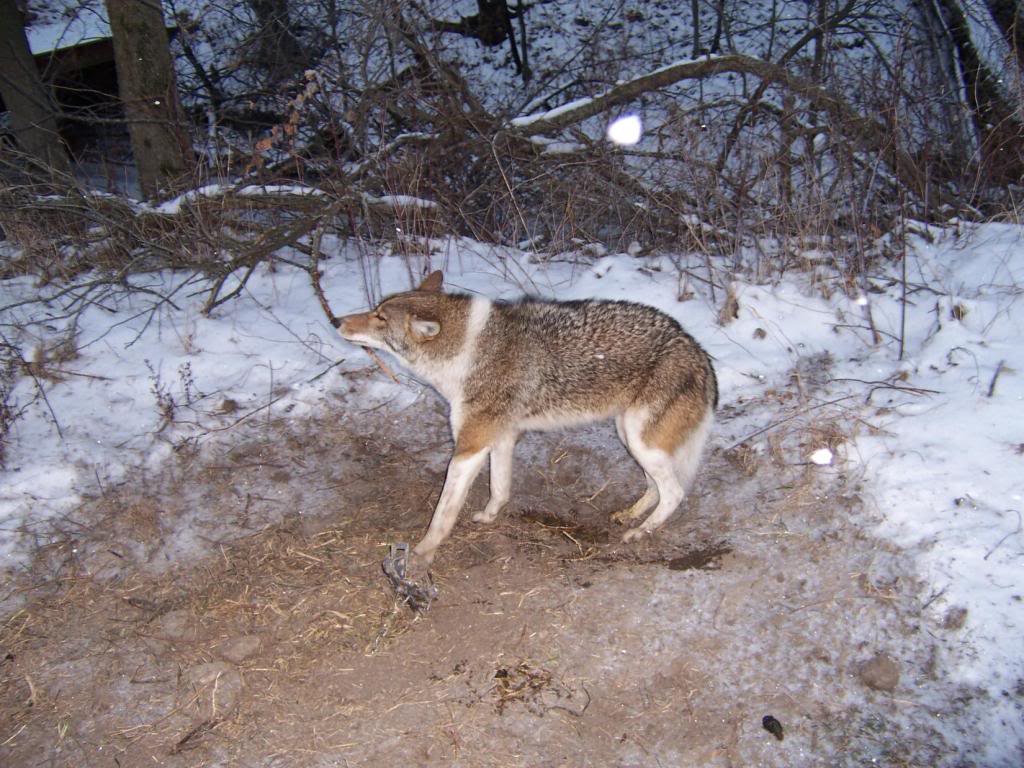
This is a coyote, but it obviously has a dog somewhere in its ancestry.
We have a name for these particular white markings in domestic dogs. It is called Irish spotting or Irish markings.
No wild canid has this coloration. The existence of these markings is indicative of domestic dog genes within a wild population.
This coyote got likely its white markings from a dog ancestor that bred with a female coyote. The hybrid was fertile and had enough coyote characteristics to survive in the wild and mate with another coyote. The dog ancestor is likely several generations away, for this animal really looks very much like a coyote, just with unusual markings.
These particular white markings are very hard to get rid of in domestic dogs, and it is likely that they are very hard to lose within coyote populations once they are introduced into the gene pool.
And you still doubt the studies about the black wolves getting their coloration from the same source?
If you can get Irish markings from dogs, you can get also get black color from them.
It’s really that simple.




Thanks for finding this gem.
Probably not applicable in the case of the coyote, but Belyaev’s foxes developed white markings without any introduction of domestic dog.
Actually, I’ve seen first generation crosses of coyote X dogs that looked MORE coyotelike than this–I would think this was an F-1 myself….but then there can be SUCH variety when crossing different types(including different dog breeds), unless you KNOW the breeding, it’s impossible to be certain just by looking. LOTS of totally wild animals throw “mutant” colors occaisionally, that have NOTHING to do with domestic crosses or captive breeding–one of the most bizarre I’ve seen is Piebald Bison–some of which were recorded by early explorers long before domestic cattle in the area might have confused the issue. And I don’t doubt that SOME wolves may have gotten black gene color from past crossings with dogs, I just doubt ALL wolves that are black have–black being a not uncommon perfectly natural color phase in MANY perfectly wild animals with no history of crossing with any domestics. That last article you posted, Retrieverman(I think it was about jackal coloration) where you brought this up again, the conclusion of THAT study was that MOST of the examples studied of black wolf coloration were NOT linked genetically to dogs–did you not read all of that article?
Lane,
You’re just wrong about black wolves, okay?
There is also a fawn coloration that came from dogs into wolves and coyotes.
http://jhered.oxfordjournals.org/content/98/4/351.full
There is one from 2002 that makes this claim, but the genomic evidence.
http://www.sciencemag.org/content/323/5919/1339.abstract
And here’s how they know the gene came from dogs.
If this is the one you’re talking about, you just read the first few paragraphs.
http://www.nature.com/hdy/journal/v103/n6/full/hdy200977a.html
This is the good genomic evidence they have found, and it’s in coyotes, too.
“The events in this scenario have been dated using the amount and pattern of variation at single-nucleotide polymorphisms linked to CBD103. For example, there is very little variation at single-nucleotide polymorphisms closely linked to the KB allele in wolves, resulting in a very recent estimate of time to most recent common ancestor and indicating a recent selective sweep. Conversely, there is more variation and evidence of recombination, among the same single-nucleotide polymorphisms on the KB haplotypes from dogs, suggesting a somewhat older time to most recent common ancestor.”
The problem with black coloration is that it comes in two flavors in canids. a — a recessive, and K — a dominant. There is no way anyone just OBSERVING a wolf would have known it was K or a black. DNA is required to tell them apart. The theory is that K is “new” and comes from dogs. But the article acknoweldges that K arose at about the same time as domestication –so I respectfullly continue to assert that there is, therefore no way to tell if it came from dogs TO wolves or from wolves TO dogs. Or for that matter, back and forth among “not yet dogs, not still wolves”. Only a DNA from a bone identifying a clear “dog” having K prior to a wolf having K (or the reverse) would make that clear. The assertion that only NA wolves came in black is silly — it’s like arguing that leopards don’t come in black — clearly, if there can be melanistic jackals, leopards, etc, there’s no reason why there would NOT have been melanistic wolves (ie aa recessive black) — so black wolves DID exist. The only question is if K black wolves did /didn’t exist. And that, frankly, the DNA only does not prove — the gene aparently arose too close to the domestication point (depending on when that really occured) for certainty– only Paleontology plus DNA will actually provide more certainty.
It’s likely the coyote in the photo is part dog. But there are piebalds that occur in the wild — as this deer:
http://www.outdooroddities.com/2010/01/04/another-piebald-deer/
Peggy Richter
Here’s the problem: No recessive blacks have been identified in wolves or coyotes.
That study Lane alludes to suggests that recessive black could be a factor in making black wolves, but when I looked into it, they didn’t even identify the correct gene for dominant black in dogs.
“Morphologic diversity within closely related species is an essential aspect of evolution and adaptation. Mutations in the Melanocortin 1 receptor (Mc1r) gene contribute to pigmentary diversity in natural populations of fish, birds, and many mammals. However, melanism in the gray wolf, Canis lupus, is caused by a different melanocortin pathway component, the K locus, that encodes a beta-defensin protein which acts as an alternative ligand for the Mc1r. We show that the melanistic K locus mutation in North American wolves derives from past hybridization with domestic dogs, has risen to high frequency in forested habitats, and exhibits a molecular signature of positive selection. The same mutation also causes melanism in the coyote, Canis latrans, and Italian gray wolves, and hence our results demonstrate how traits selected in domesticated species can influence the morphologic diversity of their wild relatives.”
http://www.gnxp.com/blog/2009/02/rise-of-black-wolf.php
The study Lane alludes to didn’t know this and tried to find the mutation on the R96C gene. That’s not what causes dominant black color in dogs or wolves. What causes the black coloration is mentioned in the abstract quoted above— ΔG23 mutation at the K locus. No wonder they couldn’t find that black wolves and dogs had the same gene. They were looking at the wrong gene.
The reason why I put that study there is not because of what it said about black wolves. It was very wrong about black wolves, at least in North America and Italy.
But I was more interested in what it found about the introduction of dog agouti genes into coyotes and wolves through crossbreeding.
There may be wolves that have black genetics that are different from dominant black dogs, but they have not been found. There may have been some in the past. I’m just saying that all black wolves and coyotes that have been examined using Barsh’s methodology have been dominant blacks.
The original name of the “red wolf” was canis niger. One does have to wonder if there were, originally, black ones – either a or K. Yet there are no “black” red wolves now. That there are no current black wolves (except for those in Italy, apparently) in Europe is interesting, but not proof. First, in many places, the resident wolves were exterminated (the UK for example) or drastically reduced (everywhere except Russia). It would be odd if a rare type survived, especially as humans tend to go after “trophy animals”. The recessive a black is apparently NOT a new gene and therefore it’s absence in wolves indicates more a targeting of black wolves than abscence of the gene in the species — which would be highly unusual given it’s presence in a lot of mammals (horses, cats, mice, etc). It would be even more unusual if, having been lost in wolves, it arose again in dogs — that’s not how evolution works (loss of a specific gene then regaining it). Therefore “a” logically existed in the “wolf” population that gave rise to dogs. In fact, the assertion that “a” blacks didn’t exist is exactly why I question this study. It doesn’t make evolutionary sense. “a” must have existed in wolves –at least in that population that gave rise to dogs. If the researchers missed “a” wolves, missing “K” wolves –especially as only DNA can distinguish them — is hardly unlikely. If neither a nor K existed in wolves, then one must wonder how dogs got the a gene “back”.
Peggy Richter.
You are assuming that red wolves are an ancient species.
They actually are not.
And there are plenty of accounts of red wolves in Florida mating with Indian dogs. It was very hard to tell domestic Indian dogs from red wolves in the South, which is why the Catahoula people repeat the line about them being part red wolf.
If it existed previously in wolves, it would very likely be different gene– that’s how mutations work. It would be bizarre if you had the same mutation in the same species and it came at different times. That would be something statistically impossible.
Take red hair in humans.
Neanderthals had a red hair gene.
It was thought that humans got red hair from Neanderthals.
But Neanderthal red hair is a different gene. So we know that we didn’t get it from Neanderthal.
With black wolves and dogs, it’s the same gene, and there less variances on that gene in wolves than dogs. So we know that the dogs had the gene first.
BTW, the dogs that had this original black gene. It was during their very early part of their domestication.
What you suggest about Old World black wolves, may be true for Old World silver foxes. But it just hasn’t turned up in extant black wolf populations. It’s dominant black and it is the same gene and mutation as exists in domestic dogs.
Molecular clocks can be touchy about dates, but they are very good at telling what’s older. And the gene is oldest in domestic dogs.
These things are very clear from the genomic analysis, which both you and Lane ignore.
Now, there may have been black wolves with entirely different genetics that exist previously in either Old World or New World populations. They are irrelevant to the discussion now.
But the ones that exist right now have the genetics as has been shown in the Barsh and Anderson studies.
By this logic, smashed faces, dwarfism, long coats, hairlessness, white markings, brindling, floppy ears, dilute colors, rear dewclaws, multiple dewclaws, small size, curly tails, bob tails, odd colors, and all the other heritable mutations that exist in dogs but not wolves must’ve existed in wolf populations first.
They could very well be, but 100,000 years is long enough for random mutations to show up. If some of the most important human mutations popped up in the last 10,000 years, how many more are accented in dogs in a timeline tenfold longer?
The evidence is clear, the current markers for the dominant black in wolves show they are inherited from wolfdogs. That is not to say black wolves never existed or they don’t exist at all until recently, but rather the markers for the black gene in dogs became widespread with the wolves.
I am sorry, but evolution is never static as it seems like people are painting here. Sometimes lines diverge, then they get mixed up again. Anyone who took anthropology would understand this with humans– can’t dog people accept the same thing? Unless people are afraid their romanticism doesn’t hold?
The whole debate kind of remind me of the “back to the land” movement.
Hairlessness, white markings, floppy ears, dilute colors, etc. They all occur randomly. Whether or not they spread depends on the animal’s lifespan and success in mating and raising offspring. Not just whether the mutations allow its survival, but also just everyday factors that often kill animals of all adaptations allow them survival–like maltese tigers and cheetahs, which were an okay color for their enviornment, but were hunted by humans for their unique pelts.
Random mutations that allow rear dewclaws and polydactylism occur within dogs often enough (I don’t think that wild populations are observed thoroughly enough to determine how common they are), even when the breed doesn’t have it as standard and even when neither of the parents is actually a carrier, the gene just mutated. It doesn’t really take that long for a gene to mutate. It can happen in an animal or a hundred born every day. It just takes a while to become widespread.
Piebald, melanism, and albinism are ones that occur extremely commonly. Even if the majority of black wolves are descended from dogs, that is not to say that a wolf can’t be born from two homogeneously no-black parents.
Here’s the issue with that coyote. That looks like an Irish collared, which requires two copies of the white irish gene, or one copy of the white irish and one copy of the piebald. If this were a pure coyote, then there’s either some crazy luck or at least one level of inbreeding.
Sorry, Retrieverman, but I am not “just wrong”–I MIGHT be wrong, but so might YOU on this issue! You state that the one earlier experiment made a mistake, so why couldn’t this other experiment make a mistake, too? ABSOLUTELY NONE of these reports state emphatically, as you do incorrectly on this blog, that this theory has been PROVEN beyond any doubt–that is simply misinforming people on this subject. It IS interesting and intrigueing, and you may really believe it yourself(it’s a free country!), but that does not make it unquestionable(unless, of course, you eliminate further comment by those of us who do not agree, as was done the last time this subject arose!). And no, Jess, this debate does NOT insist on all the doggy deformities and mutations selected by and encouraged by humans had to be in the actual wolf population to begin with–but the POTENTIAL for such genetic mutations are there, or they would never have occured or been bred for by human selection. So, with the enormous range in color wild wolves naturally exhibit, from white to black and every shade of gray and brown inbetween, it seems ridiculous to me(regardless of these limited, narrow-viewed genetic studies that totally ignore common-sense breeding results, and actual historical accounts) that ALL BLACK WOLVES MUST come from crossbreeding with dogs! Which black wolves would that include? The solid black ones? The mostly black ones with lighter undersides? The really dark gray ones? If wolves exhibit such variety naturally without any recent dog crossbreeding(which some isolated populations certainly do), why is it IMPOSSIBLE for them to have a black color phase like so many other animals WITH ABSOLUTELY ZERO crossbreeding from a domestic ancestor? Leopards, bears, jaguars, bobcats, servals, red foxes, and on and on. One problem with the one study that makes NO sense, is that their findings indicated there was the introduction of black color THOUSANDS of years ago, but no further genetic evidence in the samples of further crossbreeding with dogs–when historically and archaeology evidence shows people and dogs were in the same areas CONSTANTLY FOR CENTURIES–still are! But no evidence of further crosses? Of course there were further crosses! What was so magical about that one influx of supposed dog genes that it took in the wolf population then(and ONLY the black color–no other doggy characteristics showing up at all! Ridiculous! As anyone who has bred such animals knows!)and it HAS NOT BEEN PROVEN that domestic dogs associated with people introduced the color–it simply appeared in this population of wolves very roughly around the time humans may have also been there too–very vague!–there is NO WAY they can accurately construe such an association from the genetic evidence! Anyone really experienced with breeding wolves and dogs(and there are a lot of them around) will tell you that dogs quickly lose wolf characteristics unless constantly reinforced with wolf crosses, and wolves also very quickly lose dog traits unless there is CONSTANT crossbreeding with dogs–common very basic breeding sense! Also, wild wolf behaviour, and natural selection makes it VERY hard for dog/wolf hybrids to survive and make much difference in wild wolf populations–if this were not so, wild wolf populations would have been totally swamped by domestic dog influxes CENTURIES ago–this simply does not happen, except in places where wolves are very rare, and living unaturally. So, according to this prepostorous theory, only ONE characteristic got transmuted(black color) and REMAINED in a species where it did not naturally occur, after only this brief period of interbreeding THOUSANDS AND THOUSANDS of years ago(with no further reinforcement of dog genes) and despite CONTINOUS, FOR THOUSANDS of generations, breeding back to animals that supposedly did not have this color phase–just too many hoops to jump through to try to make it fit!! I don’t doubt they MIGHT have found something, but there is NO WAY enough information or study has been done to make these incredibly broad, sweeping conclusions!
Lane,
This study has very sophisticated genomic evidence. It’s not going to make a mistake like that.
so we have EXACTLY the same “a” recessive black in mice
http://www.informatics.jax.org/wksilvers/frames/frameRST.shtml The SAME exact “a” recessive black in CATS http://homepage.usask.ca/~schmutz/catcolors.html#black.
it didn’t come from dogs. It is apparently, a gene variation that occurs in MAMMALS. It predates dogs or wolves. I don’t know how many wolves the study tested but I did not see that NONE had “a” carried recessively even if not expressed. I’m fine with “wolves didn’t express d dillute, etc” and that dogs do — that’s a selection process. Just like the Gypsy moths. They didn’t MUTATE — one color variation was more beneficial at a given time than another so one was predominante. Ditto for the Russian “tame fox” project. They weren’t mutations — genes that were THERE came to the fore based on selection and selective breeding. The “K” gene is the apparent exception as it is not known in most mammals and it is a dominant. And while I don’t question how old the K gene is, I don’t think that proves it occured in dogs –it’s age is right on the point of domestication — earlier and it would be clearly “from wolves” , later it would be clearly “from dogs”. As it is, I’m sorry, I feel it could be “either”.
hair length does vary in wolves — just compare the Ethiopian to the Tundra. It’s a plastic gene that varies in expression based on what works “in that environment” .
As for Neanderthals, I think you will find that the initial claim was that there was “NO” interbreeding. Now the literature backs up the bone record — there was some, and some people have as much as 4% of their genes from Neanderthals. The DNA didnt change. The first reports were just wrong — they didn’t have enough DNA samples, etc.
It is likely that the brindle and other colored coyotes are the result of interbreeding — it’s simpler as a mode of occurance. But all those jackal variations you are finding didn’t come from dogs. It indicates those genes are more basal in the canid population.
Peggy Richter.
I didn’t say we didn’t interbreed with Neandthals, and I have a post on this blog that says we did.
However, we didn’t get read hair from them.
None of those jackal colorations came from dogs, but the genomic evidence on the black wolves if fairly clear.
You can be science denialists all you want.
On the last line, you may be correct, but we need to actually study the genetics behind weird black-backed jackal coloration,
But here’s the thing: many different species have different forms of melanism. Leopards and jaguars have entirely different inheritance of melanism, so we know it can come from an entirely genetic basis.
BTW, the black in wolves was caused by a mutation. Please read the studies of Barsh and Anderson. They even calibrate a date for when the mutation took place.
All this genetic evidence MAY be quite correct; I’m not denying that(although it may also be too limited at this point to make such definite conclusions involving ALL wolves)–but to jump from “this is the time when black color appeared in wolves and dogs” to “wolves got their black color phase from crossing with dogs ONLY”, is a HUGE supposition entirely unprovable by these few laboratory experiments. Color phases and varieties in ALL animals HAVE to have a beginning date. What if studies of the white color phase of black bears(the “Kermode’s bear” of British Columbia) just happened to coincide with the dates believed to be when the first people arrived on the continent(just hypothetically speaking for arguement’s sake, and THOSE dates of the first humans in North America haven’t even been completely settled, for that matter!), would you jump to the conclusion that people HAD to have something to do with that? I would hope that no scientists would be dumb enough to suggest these bears were crossbreeding with white dogs…..If black was NOT a natural color phase in wolves–never mind if it first appeared coincidentally around the time of the First Americans’ arrival– then if ONLY the one genetic episode occurred(as stated by the theory) THOUSANDS of years ago, and the wild offspring continued to mate and mix with wild wolves afterward without this natural color(as they did so mate and have continued to do so), there is no way it would have continued and been so prevelant over that length of time–other than the rare “throwback”, which in no way could influence an entire species that greatly. It’s rather like our discussions on the influence of possible wolf crosses on modern day German Shepherds–could it have occurred? Well, it MIGHT have, a time or two, but even if it did, that many generations ago having an effect on modern GSD’s is moot, at this point. GSD’s bred to other GSD’s with no addition of wolf blood will guarantee that it is a moot point–an ELEMENTARY concept! And this is barely one century’s influence away from such a crossing(did it ever occur)–now imagine THOUSANDS of years away from that cross–can you really believe that ANY characteristic survived that?(unless it was an already established natural characteristic)? It defies basic common sense! Lots of doggy characteristics CAN(and DO!) survive in populations of feral dogs–floppy ears, curled tails, varrigated colors(not normally seen in wild wolf populations)–these DO NOT detriment wild dog populations in their basic survival any way. So WHY, if there were such influential dog crosses then, did NONE of these other obvious doggy characteristics get preserved? And of course anyone researching the history of dog/wolf crossbreeding(which these scientists don’t seem to know about to make such assumptions) KNOWS that occaisional crosses continued to occur, and still do! Yet none of this shows up in their “sample”? Sounds like their sample is much too narrow. Or maybe it could be that unless they come up with something unique and controversial, it’s just, hey, dogs and wolves sometimes mix it up–always have, always will. Not that “we discovered the FIRST instance of this, and only OUR discovery counts and later crossings don’t exist, because then our experiments wouldn’t attract such attention!” Sorry, but that’s what it sounds like to me, and it just irks me to hear such theories stated as a foregone conclusion, when it is anything but–I don’t care HOW sophisticated the science is behind it! Good science wouldn’t just ignore all the behavioural evidence and historical evidence to the contrary–to do good science, you really have to consider EVERYTHING, or you get warped perceptions like this. Or jump to such(at this point in time) unprovable conclusions, just because it makes for an attention-catching article!
Ah… when people misinterpret Dollo’s Law.
Hilarious.
I didn’t even mention it, but I did paraphrase it. LOL.
it’s easily “falsifiable”. Either one will find “NO” a or K genes in a stastitically significant selection of wolf fossils predating any possible canine domestication and one “will” find clearly identifiable a or K genes in fossil dogs such as the ones found in Belgium. I have not seen that study yet.
n 16 November 2006, Lawrence Berkeley National Laboratory issued a press release suggesting Neanderthals and ancient humans probably did not interbreed. That was found to be in error (probably). See also documents such as The Context of Human Genetic Evolution by Robert Foley- doi:
10.1101/gr.8.4.339 Genome Res. 1998. 8: 339-347
Copyright © 1998, by Cold Spring Harbor Laboratory Press
— the original MTDNA study concluded that Neander / Human crosses did “not” occur. It was in 2010 or so that this was falsified.
Please do not assert I am not “scientific” simply because I question which direction the K gene came from — or the a gene either. I’m ok with a solid conclusion that it came from dogs — I simply don’t accept, as you do, that the existing data “PROVES” that. As a theory it has, IMO, some questionable areas. For one thing, I did not see that any ancient bones were in fact studied. the assertion regarding K is based on an assertion of the molecular clock being constant and that neither K nor a is found in ancient wolves — but again, I didn’t see that they actually used ancient fossils to validate that. If I missed it, I’m happy to be corrected.
An example is, IMO, the Lascaux horses. MOST are the “common horse color — dun with a pale belly, black mane & tail. But some aren’t. Now did ancient horses come ONLY in the color now seen in Przewalski’s Horse or were there other colors present? It’s clear that human manipulation has drastically changed the domestic horse. But I would question an assertion that dun was the ONLY color present prior to domestication.
If a occurs in other than C.Lupis — in more basal animals or in more distantly related (ie non canids) then it is most parsimonious to conclude that it came FROM wolves to dogs not the reverse. As for K, I agree that the study concluded that it came from early dogs. I just don’t happen to agree that the conclusion is as solid as you do.
Peggy Richter.
Which is what they have essentially found in Barsh and Anderson…
Molecular and Evolutionary History of Melanism in North American Gray Wolves
Tovi M. Anderson,1 Bridgett M. vonHoldt,2 Sophie I. Candille,1 Marco Musiani,3 Claudia Greco,4 Daniel R. Stahler,2,5 Douglas
W. Smith,5 Badri Padhukasahasram,6 Ettore Randi,4 Jennifer A. Leonard,7 Carlos D. Bustamante,6 Elaine A. Ostrander,8 Hua
Tang,1 Robert K. Wayne,2 Gregory S. Barsh1*
From page 3 —
The dog was domesticated between 15,000 – 40,000 years
ago in East Asia from gray wolves (24, 25), and we estimate
that KB is at least 46,886 years old (95% confidence limit:
12,779 – 121,182), therefore we cannot distinguish whether
KB arose before or after domestication. However, if KB arose
in Old World wolves prior to domestication, our data indicate
that it must have been lost from the gene pool and reacquired
in North America, perhaps from Native American dogs that
accompanied humans across the Bering Strait 12,000 –
14,000 years ago (26) (Fig. 3D).
==Barsh and Anderson say they cannot distinguish if it came before or after domestication. that’s their conclusion. Their diagram shows they don’t assert that K originates in dogs. Their conclusion is that K in NA wolves occurs from dogs. That’s not the same as saying K in Europe came from dogs. Given the widespread extermination of wolves in Europe, a domniant gene could easily be lost. Again, I think only checking the DNA of fossil bones would resolve that.
Peggy Richter.
I don’t know much ’bout no “Dollo’s Law” er genomes er regular-sized gnomes er haploitidinosis, but I DO know wolf behaviour, dog behaviour, wolf-hybrids, and studies on the earliest Native Americans, which are ALL subjects one MUST be familiar with to make sensible theories when doing such lab experiments–these guys who did whichever of these experiments insisting that black color in wolves came from domestic dogs ONLY, obviously have little or no knowledge of ANY of the subjects I mentioned(nor do any of you who are supporting that claim in this discussion). Sure wolves, dogs, and coyotes crossbreed, but the hybrids have very little chance of surviving and spreading in the wild, in a normal ecosystem not totally disrupted by modern man, and/or wherever large numbers of wolves are already well established. Now go back THOUSANDS of years, with, at most, a scattered few hunter-gatherers that did little or nothing to control their dogs’ breeding(and only a few dogs per group to begin with). In a completely wild natural ecosystem frikkin’ SURROUNDED by wolves, that kill any canid interlopers they find in their territories, and which no dog or hybrid can long successfully compete with–we have plenty of modern examples of this, with zillions more people and dogs and way less wolves around, yet doggy characteristics DO NOT get established in wild wolf packs enough to make any noticeable difference. If the color black was not an already naturally occurring color among wolves(however, whenever, it arose in their development), there is NO WAY a scattered few hunters with even fewer dogs are going to make any impact on the genetic or phenotypic nature of wolves! Again, dogs and wolf-dog hybrids CANNOT survive long enough to breed back to the majority of wild wolves–you can’t cross when yer dead! The only reason dogs can survive in such circumstances is because of the protection people provide them–wolves can influence what kinds of dogs people have, but dogs are NOT going to influence normal, wild wolf populations–certainly not back in the Pleistocene! So no matter how “sophisticated” some genetic lab experiment is, no matter how complicated the terms they use and what the scientists’ resumes look like, if such BASIC common-sense FACTS like these are not taken into account(as, of course, they are not by a bunch of scientist geeks stuck in a laboratory with zero experience with the actual animals they are postulating about) you cannot make a very sensible theory–it only sounds good to those who don’t know much about these animals or that part of prehistory……
[…] I posted a photo of a normal gray coyote with Irish markings last year. […]