This is Heidi, the decoy dog at the Nacton Decoy in Suffolk. These images appear in Bill Tarrant’s Hey Pup, Fetch It Up!: The Complete Retriever Training Book (1993). She appears to have been a spaniel/collie-type cross, but she vaguely resembled a Nova Scotia duck-tolling retriever.


In this book, there are photos of her actually tolling the ducks into the trap. These photos, I would think, should put to death the notion that this is somehow a made up claim. The English, the Dutch, and the Nova Scotians would not have used dogs to bring entice ducks into traps or to the gun if it didn’t work. It sounds fanciful that ducks would be attracted to a dog, but it is a behavior that has been observed many times. Why would these elaborate traps, which are called decoys, have ever been built and maintained if the dogs were not of great use in bringing the ducks in?
Why does it work? Tarrant had no clue, nor did Sir Peter Scott, the renowned British ornithologist and waterfowl conservationist, who had a very close relationship with the Nacton Decoy. At the time Tarrant was documenting the decoy, Scott’s Wildfowl Trust was operating it. Although Scott was into the Loch Ness monster, this particular zoological phenomenon was and is well-documented. Ducks will follow a dog for some unknown reason.
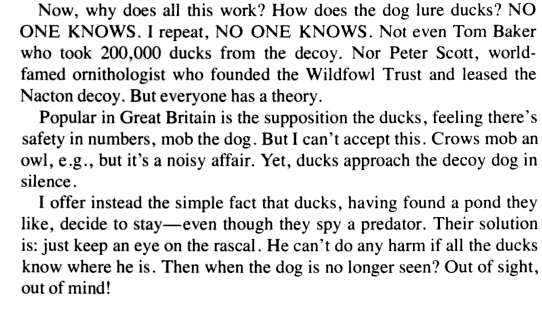
That last paragraph is probably key to how this behavior works.
Most predators rely upon surprise to catch their prey, and if we are talking about a terrestrial predator trying to catch a bird, surprise is very important. If a fox knows the duck see it, it is less likely to try to stalk them. If the fox is seen before it launches an attack, the ducks merely take to the sky, where no fox can follow.
The reaction of ducks to dogs was first discovered in the Netherlands, where it was later introduced to England:
If the decoy dog had been known to Caius he would have included it with delight in his list of bird-taking dogs. But though he mentions the ‘subtlety’ of ducks, and that the water- spaniel, of which he gives an accurate description, was used to retrieve them when wounded, he says nothing of the more artful devices of the decoy-man’s dog. He notes that the water-spaniel was especially useful for fetching back arrows which had been shot at water-birds and were floating, and that the dogs were so clever that they often picked up other people’s lost arrows and brought them as well as their masters’ arrows.
It is clear from this that decoys were not known at all as early as that, and that the belief that they were a late introduction from Holland is correct. The decoy dog’s business is to run in and out of the screens which lead to the pipe, and so to induce the ducks to follow him. A mistake or momentary disobedience by the dog might lose the best ‘ take’ of the season, yet so intelligent and well trained are these dogs that they practically never do wrong.
–C.J. Cornish, “Dogs That Earn Their Living” in The Cornhill Magazine (1900).
The Dutch decoy dog has become a standardized breed, but the English decoy dogs were always considered mongrels. Randomly-bred dogs of various types were used in the decoys. Heidi actually looks like something between a Nova Scotia duck-tolling retriver and a Kooikerhondje, but she came “from the dog catcher.” Other decoy dogs from Nacton were quite different from Heidi. The point was that the dog should be reddish in color and have a bushy tail. It could be of any ancestry, just so long as it was biddable and playful.
Dog historian Col. David Hancock, M.B.E., shows that such dogs could be used to draw ducks into the gun, and that hunters using guns didn’t have to use small red dogs to do so. He points out that even a large dog like a golden retriever could be used to toll ducks in.
Some wildfowlers [duck hunters] hunting the open shoreline have used decoy dogs to lure ducks within shooting range by throwing sticks for the dog to retrieve and arousing the natural curiosity of the birds. The skill of the hunter lies in throwing the stick for the dog the right distance at the right moment so the ducks aren’t frightened away by the menace of an advancing dog, but made curious by the enticing waving of its bushy tail. The dog makes a normal retrieve of the stick, but does so in a playful manner with plenty of tail wagging. This decoy dog does not entice the birds by deliberately frolicking about, as foxes have been seen to, but is used essentially as a retriever of sticks. However, this playful retrieve does lure the duck within range of the hunter’s gun.
I see many resemblances to the Golden Retriever in the Canadian decoy dog, both in their sunny nature and their perpetually waving tails. A Golden was quite recently used as a decoy dog in East Anglia, charming many visitors. So the next time you throw a stick for your Golden Retriever, you may be re-enacting the role for which the dog’s ancestors were greatly valued, not merely idling away time and providing exercise. We may not, in these sophisticated times, need all of the wide-ranging skills of our dogs, but each must be exercised and we should honour their innate desire to be active, their instinctive interest in hunting and their inherent talent for serving mankind.
Hancock points out that decoy dogs were about the only way commoners, who didn’t have ready access to firearms, would have been able to procure ducks for the table. These traps were so effective that they essentially fed consumer demand for wild duck meat for centuries.
The skill of the decoy dog lies in giving the inquisitive ducks only fleeting and seemingly tantalizing glimpses of its progress – usually its tail’s progress – through the reeds and undergrowth. The decoy dog takes great care never to give the ducks cause for suspicion. Before the use of firearms and indeed when their range was very limited, these dogs must have been enormously valuable to duck hunters. For the humbler hunters, they likely represented the difference between eating or starving. In the 19th century, just 10 decoys around Wainfleet produced 31,200 head in one season, mostly for the London markets.
***
At the end of the 19th century, “ginger ’coy dogs” were frequently seen alongside the Lurchers in gypsy camps, especially in East Anglia. James Wentworth Day, the celebrated country sports writer, refers to them in his 1938 The Dog in Sport, linking them with the ‘Fen Tigers,’ the rough countrymen who cut sedge and dug peat from the Fens and were skilled wildfowlers. In his mammoth “ultimate dictionary of over 1,000 dog breeds,” Desmond Morris describes the Red Decoy Dog as a small rufous dog employed to lure wildfowl into nets. He suggests that their behaviour in doing so was modelled on comparable behaviour in foxes.
Because no pedigree breed in this mould has been handed down to us, very few contemporary references are made to these gifted and once invaluable dogs. Rather, as with ancient water dogs, they are rarely acknowledged in the histories of our gun-dog breeds. Both decoy dogs and water dogs were usually handled by humbler hunters such as farm labourers and gypsies. Very little has been written about them.
This type of commoner would have been exactly the same sort of person who would have settled in British colonies, like Nova Scotia.
Although we tend to think of Nova Scotia as being settled by Scots, there were plenty of English settlers. Some of these people were likely wild poachers, who just decided to leave England for the wild country across the Atlantic. Perhaps they were threatened with transport to Australia. Perhaps they just wanted to go some place and live off the land. But this demographic is exactly the same type of person that wound up settling in North America– and doing well. It is likely that these dogs were part of the market culture in Nova Scotia, which was big up and down the East Coast of North America.
It doesn’t take much imagination or logic to see how these decoy dogs could have founded the Nova Scotia duck tolling retriever.
One of the reasons why tolling is not normally used to shoot ducks is that the ducks come swimming toward the dog. It is generally considered unsportsmanlike. Shooting into a body of water is also illegal in many places. However, market and subsistence hunters probably won’t have that same moral or legal restrictions.
So a tolling dog would have definitely been of use.
If this behavior is well-established and has been observed by true experts, like Bill Tarrant, Desmond Morris, and Sir Peter Scott, we might conclude that a Nova Scotia duck-tolling retriever is exactly what its name implies. One does not base hunting strategies, including ones that are this successful, upon on mythology.
So although the use of dogs to decoy ducks sounds fanciful, it is real.
And in the Netherlands, kooikerhondje are still being used for this purpose, regardless of what the “self-styled experts” say.




Nice post! Col. Hancock also mentions a similar behavior in a type of hunting dog known as a *tumbler* where it will *mesmerize* it’s prey with silly antics and then pounce on it.
The decoy dogs and *tumblers* were probably used before guns were all that accurate and even before there were guns at all.
Funny you mentioned the Nova Scotian ancestry. In B.C. and Alberta, if someone poached a deer, he is assumed to be from Nova Scotia. It’s a widely accepted practice to hunt outside season; and because Conservation Officers are poorly funded, it became a culture. In fact, jacking a deer at night with a knife in her own bed is a legal method of take. Both the time of hunt and choice of weapon are taboo in Ontario and westward.
Interesting pictures of the duck decoys in the linked article on Kooikerhondje.
Good work putting together all this info!
The Dogs 101 show on animal planet actually filmed a Kooikerhondje bring in ducks, it was very cool to watch.
The enticing dog need not look like a fox (or a golden retriever) – a monkey, a pug, and a Newfoundland are all mentioned in Sir Ralph Payne-Gallwey’s “The Book of Duck Decoys” (p. 49 – 50) (London,1886) And, see, the “water spaniels” [proto poodle?] in an engraving by Antonio Tempesta (1555-1630) (found here – http://www.britishmuseum.org/research/search_the_collection_database/search_object_image.aspx).
Payne-Gallwey claims the monkey/pug/water spaniel/golden retriever/kooikerhondje were able to attract/entice the ducks because ducks are naturally curious.
Hmmmmm…..
Tarrant mentions that a rabbit also did it, but a dog is much easier to control.
I don’t know if it’s curiosity makes the ducks approach the rabbit, but it’s weird.
That water spaniel was called a “rough water dog,” very similar to a barbet or poodle.
“That water spaniel was called a ‘rough water dog,’ very similar to a barbet or poodle” which is why I come by this information on decoy dogs via the most excellent Poodle History Project. ;-)
I’m beginning to believe that all dogs derive from the Poodle. There is, truly, nothing a poodle cannot do.
Take this with a grain of salt (considering the source), but in Never Cry Wolf, Farley Mowat mentions wolves hunting ducks by cavorting on the shore of a lake and then ambushing them when they get close to the bank.
I wouldn’t be surprised if the decoys were introduced to England after the Glorious Revolution, when William of Orange, the Dutch Stadtholder, became the king of England, and relations between England and the Dutch Republic became very tight.
I think we discussed this earlier, I suggested that trade by merchants on the east coast of England with the Netherlands, the Frisian islands and other coastal ports of the Baltic brought an exchange of dogs between port masters and ships’ captains. Dogs were, as always ice breakers, and were probably gifted as part of the negotiations for favorable trade of goods.
A similar means of trading arrangements in the western coast of England, Bristol, Plymouth, Southampton with the Atlantic coastal ports in France, Spain & Portugal may have brought in the foundation stock of pointers, setters and spaniels. JMHO.
West Country ports were always close to Newfoundland and the Maritimes.
However, Nacton is in Suffolk, East Anglia, on ‘tother side of England.
They traded with France before they went to Newfoundland. After all, the French won the Battle of Hastings. Why wouldn’t they have trade routes?
Of course, but what I’m saying is that there was a huge cultural and technological exchange between the Dutch Republic and England when the Stadtholder became King of England.
Great book on the topic: http://www.amazon.com/Going-Dutch-England-Plundered-Hollands/dp/0060774088
Many of the things we think of as American or British are actually Dutch.
Dutch as an apple pie.
I am not disagreeing but I think you missed my point about regional differences. The cities which were on one coast imported and exchanged different breeds than the other coast.
During the English Civil War, there was plenty of movement between the English and the Dutch. This is a very interesting era in English History.
That’s very right. Especially in East Anglia. Calvinism was very strong in East Anglia, and the Dutch were mostly Calvinists, and it was Dutch and German Calvinist theologians who went along with this.
It’s actually at the beginning of the dived between North and South in the United States. Virginia, Georgia, and the Carolinas were largely settled by people from the West County of England, which was Royalist country during the English Civil War. New England was settled mostly by Puritans from East Anglia, who were also deeply influenced by the Dutch. The Puritans were also of the merchant class, while those of the West Country were agrarians.
Good book on this topic: http://www.amazon.com/Cousins-Wars-Religion-Politics-Anglo-America/dp/0465013708
And why there such fervor for the of the separation of church and state in the Bill of Rights.
Yep. There is actually a text that John Adams and other Founding Fathers wanted the Dutch Republic to be the model on which we based our system.
The Dutch Republic was a federal system, and it was a republic.
Unfortunately, it was on the North European plain, where the French army and that of the various Germans could easily march.
I saw my basenji attempt this. She was not successful and I thought she was just plain nuts to think she could attract ducks. But, then, I’d never heard of duck tolling, decoys, or duck-tolling retrievers. Maybe this behavior is latent in a lot of dogs.