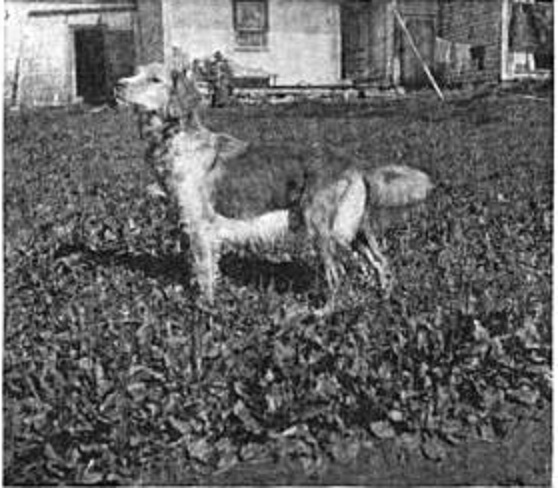
A typical tolling dog from Nova Scotia, 1917.
Now, after you’ve read the accounts of the English and Dutch decoy dogs from yesterday, I’m sure you want to know where Nova Scotia fits in all of this. Is there a connection between the Nova Scotia duck tolling retriever of today and the decoy dogs of England?
Well, it is difficult to make a direct connection, for the earliest confirmed attempt of a Nova Scotian breeding a dog for this purpose was by man named James Allen. The story goes that in 1860, James Allen of Yarmouth County, Nova Scotia, bred an English wavy-coated or flat-coated retriever bitch to a “Labrador-type dog .” Now, we know pretty clearly what a Labrador-type dog in that part of the world was– a St. John’s water dog. However, I don’t think the female wavy-coated retriever was exactly what everyone think she was.
She was said to have been purchased from an English schooner, which seems to be a weird place for a retriever to be. In those days, retrievers were owned almost exclusively by the gentry, and when a dog of the same genetic make-up and origin as a retriever was owned by a commoner, it was normally called a Newfoundland or Labrador. Further, if we are thinking that this dog was a member of the wavy and flat-coated type that Dr. Bond Moore and Sewallis Shirley were “improving” into a standardized breed, we might want to reconsider, for in the 1860’s through the 1890’s, the vast majority of wavy/flat-coated retrievers were large, heavily-boned creatures, like Zelstone or Paris. If the bitch were of the type the Paris or Zelstone represented, breeding her to a St. John’s water dog would produce puppies that looked a lot like St. John’s water dogs. Paris was said to have been entirely of St. John’s water dog ancestry, and it is well-known that Zelstone was primarily of that extraction. It wouldn’t have been an outcross at all, and it wouldn’t have produced smaller dogs.
This bitch was said to have been liver or red in color, depending upon your source. There were red and yellow wavy-coats at the time, but these were far from common.
It seems to me much more likely that she was an “English retriever,” a term that could have meant lots of things, not the least of which is that she could have been a “ginger ‘coy dog.” Such dogs would have been relatively common in England, and it is likely that some people were using them as retrievers. Perhaps the schooner that brought this bitch to Nova Scotia had brought her along with the hope of doing some duck and seabird hunting along the rocky coast. After all, egging and market hunting were common activities along the Maritime coasts, as was duck and sea bird hunting. A dog like this could have been brought along just fill the stores of the ship, which would be longing for fresh meat after the long voyage across the North Atlantic.
Yarmouth County is on the Bay of Fundy, which is an excellent fishing ground, and for its wide variance in tides. The people who lived there, like so many people in Atlantic Canada, were tied to the sea and to the land for survival. Hunting and fishing were not games. They meant life itself.
Perhaps James Allen heard from the ship that this little retriever was of a type that could toll in ducks. Maybe he didn’t believe at first, and then they showed him. And that may have been how he got the idea.
There is usually a discussion in these texts that the Nova Scotians discovered on their own that ducks could be enticed with a fox-like dog. Sometimes, a Native American group is suggested as a source for that information. The simple fact is that using decoy dogs to catch ducks would have been common knowledge throughout England, and the decoy dogs would have been common enough to have occasionally wound up in the Americas. It seems to me that the English would have been a source for this knowledge than the Nova Scotians, who themselves might have known about the technique before they left to settle in the Maritimes.
Allen and later other breeders began developing a strain of tolling dogs, using whatever they had available. Some say that cocker spaniels were used as the primary outcross, and that may be. However, the decoy dogs in England were often mixtures of spaniels and small collies, and it might be that some of these cocker spaniels were known decoy dogs or cocker/collie crosses. The fact that St. John’s water dogs were used in the outcross also would have also increased the size, as would the possible input of the traditional farm collie of Nova Scotia.
Whatever their exact origin, there was a defined strain of reddish-colored retrieving dog in Yarmouth County, Nova Scotia, by 1900. And contrary to what some wags might say, they were actually used to toll ducks into the gun.
I came across this account of a toller being worked in an issue of Forest and Stream which is dated to October 1917. The article includes an account of a man who gunned over these dogs in Nova Scotia. This is an account that “self-styled experts” who deny the history of this breed might not want to read. Tolling is real, and it is was used on both sides of the Atlantic. In Europe, it was used for decoy traps. In Nova Scotia, it was used for the gun.
The account begins with a story of a fox in Nova Scotia catching ducks in this manner, and it then goes into intimate detail how a tolling dog was used in Nova Scotia– by someone who actually did it!
The idea of tolling ducks came from the fact that the fox has been known for many years to possess the power to attract wildfowl by reason of his color and his movements along the shore, and many a fat duck has paid the penalty of his curiosity and furnished a meal for foxy old Reynard on the shores of our inland lakes. It was my delight and privilege to see a fox at work on one occasion. We were hunting moose near the Boundary Rock in Nova Scotia, and as our canoe turned a bend in the Coufang River, I saw directly ahead of us and in plain sight, four blackducks. Wondering why they did not fly at sight of us, I glanced ahead of them, and there on the top of a flat rock which projected into the water lay a fox with his nose between his paws Every second or so he would raise his brush and give it a flip from side to side. The ducks were swimming directly toward him intently watching that whitetipped tail, and not more than fifteen yards away from his waiting hungry jaws. Just then my hunting companion coming down the river in the canoe behind us, and catching sight of the fox, shot at him. The bullet from his Winchester hit the rock beneath him and spoiled what otherwise would have without a doubt ended in a little tragedy, and would have been a sight which very few have ever witnessed.
I have always felt perfectly certain that that fox would have carried away with him one of those four birds, a victim of curiosity. But what a transformation that bullet worked! Into the air went fox, ducks, and pieces of granite boulder, and my hunting companion remarked as he lowered his rifle between his knees, “I guess that rock was red hot, the way that fox took to the air.”
If you are a dog man, the first time you see a Tolling dog, your attention will at once be arrested, and after looking critically at them, you may remark—as hundreds have done before—what kind of dogs are those, Chesapeake Bays, or what? If time is no object, the answer will probably be that they are Tolling dogs, and when the explanation is forthcoming that they are used to toll ducks within range of the gun, your questions will come thick and fast, such as: Do they go in the water? —How far will ducks come to the dogs?— Do the dogs know they attract the birds? —Will they retrieve the birds you shoot?— But if time is limited, you would likely get the answer: Oh, they are duck dogs, or just dog, I guess.
We will suppose you are a duck shooter and are aso skeptical, and came from Missouri and want to be shown, and it is finally agreed that we repair to where we know ducks congregate. It is not yet daylight when we reach our “blind” on the edge of the sandy shore of the bay. This blind is one I have tolled many a fine shot from, and is composed of three or four old lobster pots, which have been cast ashore in the surf, and a few old roots ot trees—the whole covered with dead seaweed, and just large enough to conveniently hide us and the dog. Making ourselves as comfortable as possible, and pulling our coat collars up and our wool caps well down (for the month is December and terribly cold, the lakes are frozen and the ducks are now in their winter feeding grounds), you turn your head and see the yellow flicker of a lamp through the kitchen window in the farmhouse across the great salt marsh behind us, where we enjoyed the warmth from the big wood stove an hour ago, as our breakfast of fresh eggs and biscuit, washed down with steaming tea, was eaten, and you half wish yourself back there again. It is “star calm,” not a breath of air and very frosty. Our dog is curled up tight, his nose covered by his fox-like tail, and he is the only one of us three who is comfortably warm. But just listen to those blackducks as their trembling quack reaches us from out there in the bay! Buff hears them, too, and quick as lightning his ears prick as he raises his head. If you touch him now you will feel him trembling, but not with cold, only suppressed excitement. And now the east begins to pale, and presently objects are dimly discernible. Those old stake butts out there stuck up through the sand look like a flock of geese, while in the gray light the bridge spanning the North Creek looms up like a church spire. We hear the winnow of wings as ducks fly from the salt creeks where they have spent the night, and as they join their companions in the bay in front of us they create quite a commotion among them.
Presently we see a black line on the glassy surface of the water, which slowly develops into a flock of twenty birds or more. The tide is almost up to our blind this morning, and everything seems to favor us. The ducks are now in plain sight—foxy old beggars. Some of them know the danger zone of this shore from years of constant persecution. About two hundred yards away they flap their wings and preen their feathers as the rising sun begins to warm them, and now I guess we will “show the dog.” Reaching into the back pocket of my hunting coat, I pull out a hard rubber ball. Just look at Buff, who has been watching my every movement; see the pupils of his eyes dilate as he spies the ball! Did you ever see such concentration as he watches that sphere of rubber! Next to his master it is the dearest thing on earth to him. One bounce of it upon the kitchen floor will lure him from the finest dish of roast beef scraps and gravy without a moment’s hesitation.
I can divine your thoughts without much study now. You are thinking “what a shame to scare those ducks” and that perhaps they may come on shore again as the tide begins to fall, and you cannot help feeling certain that every duck will “jump” as soon as he sees the dog. But wait, you watch the ducks, and whatever you do, don’t shoot until I give the word, for it is the sure ruination of a Tolling dog to shoot over him while he is outside the blind. If you do so, your dog will soon want the first shot himself, and when the birds come close, he is likely to plunge in after them without waiting for the gun.
Patches of sand stretch out upon each side of us and afford a footing for the dog, and we can play him from either side of the blind. I toss the ball and away goes Buff; picking it up, he canters back and drops it in my hand. Out again, go ball and dog. I watch your face and it is a study, as through the “peekhole” in the seaweed you anxiously watch the birds and this is what you see: With stretched necks and wondering eyes, every duck looks intently at the dog, and as the ball falls in among some dead seaweed, causing him to use his nose to find it, his bushy red tail works and wiggles above the beach grass, and a dozen birds turn and swim for shore, their necks a second ago stretched so long now folded in, and with soft meamp-amp, meamp they swim rapidly toward us with just a gentle breath of wind behind them. Buff plays beautifully, returning with the ball even faster than he romps after it. How round the birds look with their necks drawn in, giving them a stupid appearance, and the sunlight shimmering from the yellow bills of the drakes. Now as the dog comes near us again, the hot scent of duck strikes his sensitive nostrils; and stopping with upraised paw, he looks toward them, but a chirp brings him back to us. Not for worlds would he refuse to “play.” See him tremble as we push up the safeties of our guns. Here are the birds right against us, though not well bunched, being strung out across our front. They are only thirty-five yards or so away when Buff drops the ball into my open palm for the last time, and I whisper “Down.” Now there is one of two things to do, we may either rise up and shoot, picking out our birds and trying to stop one with each barrel, or remain quiet until the ducks begin to get uneasy, and not seeing the dog, start to swim away, when they will invariably bunch.
If you can forget the freezing nights and blustery days when you have almost perished waiting for a shot, or perhaps the long crawls through slush or mud when trying to stalk these wariest of all their kind, then let us each try and make a double and be satisfied. But if you have only occasionally had a flock shot and would like one now, let us hold our fire, which we decide to do. See that old drake stretch his neck and swim up and down, looking with the keenest of all eyes, and turning slowly from us; the birds swim together, their heads turned sideways, looking over their shoulders at the blind. I nod, and the two pairs of 12-bore barrels poke out above the fringe of seaweed of the blind. As we raise to shoot, Buff peers over the blind beside me. With a whimper and stiffened sinews he awaits the report. Both shots snap out as one, and into the air seven terrified birds spring straight up. three of their number falling to our second barrels. There are two cripples, one of which swims about in little circles, shot through the head in front of the eyes, and wading off as far as hip boots will allow, we each kill our bird.
Buff by this time has almost reached the nearest drifting victims. Watch him swim! There is only one breed of dog could catch him now, and that the Tolling dog. No need to tell him to retrieve. Dropping his bird on the sand he plunges in again and again until the eighth and last duck is safely recovered. Buff takes a roll in the sand and a shake, and trotting up to me, rubs against my leg, and while he looks up into my face, I stroke his wet hair—wet only on the outside, for no water ever penetrates to the skin through that otter coat —and if he and I were alone I would take his honest head between my hands and whisper in his ear, “Good boy,” while with a funny little growl in his throat he would say in his own way, “We did the trick.” He always looks for this following a successful toll.
***
It is well known that ducks will not toll to windward. They will come to the dog across wind, from the windward, and also when there is no wind. Blackducks toll with their heads drawn down, bluebills with their heads up and necks stuck out. butterballs on their tails almost, and all the mergansers with heads erect and necks straight up. Perhaps the Tolling dog is most deadly when shooting ducks before they leave the lakes in the fall, and when the birds are young. I have seen young blackducks swim so near the blind that their pads could be distinctly seen beneath the water. Bluebills are said to be the easiest of all birds to toll, but although I have had many fine shots at them in this manner, my personal experience teaches me that the blackduck tolls the best, and I have seen wary old birds in the month of January act like perfect fools at sight of a well-played dog. They seem to be hypnotized, and when once their gaze has become centered upon the dog, will scarcely notice moving objects.
It is as natural for a Tolling dog to retrieve and play with a stick or other object thrown as it is for a setter to point, or a coach dog to follow a team. Most duck shooters use a stick to toll their dogs with, and some a lot of sticks, but the properly trained dog needs but one object to work upon (pg. 463, 490-492).
So the story of the Nova Scotia duck-tolling retriever is exactly as is commonly stated. This is a beautifully written account of how the dog would toll in the ducks from the water, which is not the way ducks are normally hunted. Normal duck-hunters call in the ducks with calls that are designed to bring in the birds on the wing.
With the tolling dog, the ducks come in on the water, and then they are shot. This works almost exactly the same way that the decoy dogs enticed the ducks into the the elaborate traps in England. It’s just they aren’t being led down a pipe. The dog in this case is leading the ducks to the duck blind.
Now, I do know that this whole story sounds like malarkey.
But seeing as this account is by someone who did it– probably many times– I think we can assume that this is exactly how tollers were used.
See earlier post:




Terrierman needs to roll over and show me some calm submission. I just proved two or three of his posts on this topic wrong with one historical account!
Not really sure why he thinks shotguns and floating decoys have anything to do with the decline of the Tollers.
Labradors displaced a lot of breeds around 1920s-1970s because of the results of the hunt trials; not unlike how Border Collies threatened the extinction of many herding breeds because of the emphasis on sheep trials.
Also keep in mind that hunting had more to do with subsistence in those days. In the West, it’s mostly a sport, except for a few places like around here and in the Canadian wilderness.
It’s not sporting to shoot ducks on the water. It is sporting to call them in and have them come into land.
‘Tolling’ dogs makes me think the dogs go BONG.
I was lucky to grow up where toll as a synonym for entice was still used regularly.
One toll over the line, Sweet Jesus.
And therefore never send to know for whom the dog tolls; It tolls for ducks.
For whom the dog tolls
Ducks march on.
Hahah Jess, great minds think alike. My upcoming post on the Toller genetic health (I care not to wade in on their dancing, place of origin, and what not) is called “For whom the Duck Tolls” … lol.
There’s actually a great quote from the original Donne poem that speaks of the inability to recognize ones own mortality but those around you should have this ability (cognitive dissonance).
After reading her study, I think Claire Wade (whom Paddy quotes on one of his ill informed recent wolf posts) is a hack. Her “tollers are not inbred” study is a perfect example of conflict of interest and scientific activism. It basically comes down to “if you only look at 2 generations, our dogs are NOT inbred!!!”
No wonder Paddy quotes her, hacks seem to attract each other.
I was curious about that. She does have the study on Australian dogs and the COIs were not believable to me, too low. I didn’t want to pay for the whole study, but it struck me as being like Mate Select where they are only going back so many generations.
I have to say that after re-reading that account of the tolling dog bringing in the ducks in Nova Scotia that it is one of most beautifully written pieces of dog literature I’ve ever read.
I also should note that it would take a lot for me to be able to write something negative about these dogs.
Golden retrievers ought to be more like these dogs. Virtually every one of them retrieves, and virtually everyone of them is suitable for a family to own.
Health issues aside.