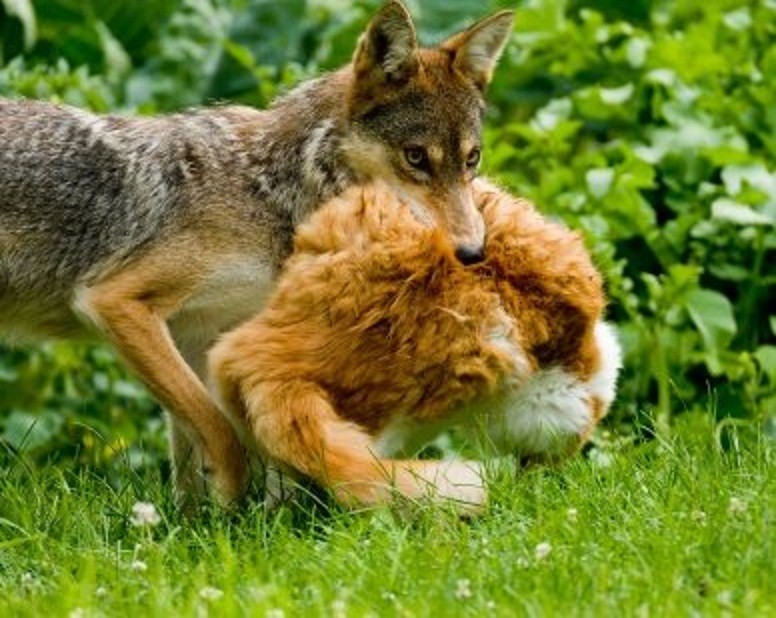
Of course, the coyotes don’t know if a cat is feral or owned.
All they know is cats are tasty and pretty easy to catch.
May 29, 2012 by retrieverman
Of course, the coyotes don’t know if a cat is feral or owned.
All they know is cats are tasty and pretty easy to catch.


 | Peyton on Better than Trump Steaks |
 | Margaret - from Oz on Better than Trump Steaks |
 | Peyton on Deer in the gray thicket |
 | retrieverman on What killed dog blogging? |





Cat owners who defend letting their pets roam the neighborhood like to wax on about the ‘cycle of nature’ when their pets kill birds and small wild animals, so theoretically they should have no issue when the one getting eaten is the cat, right? It’s part of nature, after all.
Of course, they want the coyotes shot when that happens!
LOL
I unfortunately don’t see coyotes being the answer to the feral cat problem. They are easy prey when they are legion, but the strongest survive, and pass on their genes to future generations – including the likelihood of avoiding coyote predation. I think that the coyote threat is just new enough that many cats are being caught – but then again, we don’t see many pictures of the ones that escape. I have a friend who got photos of an old tomcat giving a coyote hell – the coyote looked like it had been in a fight with a lawnmower. According to my friend, that particular tomcat was the terror of the area, attacking people as readily as rottweilers, and it had fended off coyotes before. That cat went on to live quite a few more years (providing my friend with a lot of funny stories), and I’m sure produced copious offspring. To my knowledge, there are still copious feral cats around my friend’s property as well as a healthy coyote population, and the coyotes do not seem to help much when it comes to controlling the cats’ numbers past a certain point. Obviously, the coyotes are taking a good number, but since the cat heyday when that tomcat was a coyote-fightin’ monster, there was a sudden and dramatic drop in cat numbers following his death, but then a slow and steady rebound has been occurring. I would assume once the number of cats is down, they become harder to catch (survival of the fittest and all), and the ones that are surviving to reproduce are more coyote-wise. My friend has commented that he hasn’t seen many cats with kittens on the ground in a number of years, but that he has seen kittens playing in trees and on steep, rocky drop-offs, where presumably coyotes have difficulty navigating. For better or for worse, my friend has only seen two or three other fights between coyotes and tomcats, and at least one of those fights ended with the tomcat driving off the coyote, and that big, bad tomcat is still stalking around the property, terrorizing mailmen, and likely coyotes, regularly.
I do think a cat’s coloration might make it more prone to predation, which would make sense, but I’ve never seen any research on it. All the most successful feral cats I have had first-hand experience working with have been either black/gray with little white, or mackerel-tabby black on brown or gray; the old tomcat was gray mackerel-tabby while the current coyote-wrangler is brown mackerel-tabby. Most of the females are various blacks, a few grays, and then the rest are mostly mackerels. There do not appear to be many – if any – that are ginger or white. Evolution at work everyday.
Actually, they don’t have to kill all the cats to have an effect.
There have been studies on cats and coyotes in suburban environments, and what they found was that the presence of coyotes and their occasional predation on cats actually resulted in a boon for songbirds.
http://www.izilwane.org/interview-with-michael-soule.html
Cats are mesopredators and these environments, the coyote is the top predator.
In William Stolzenburg’s Where the Wild Things Were, Michael Soule also found that cats were afraid to wander into the thickets where coyotes might be lurking.
But that’s precisely the same area where the birds like to nest.
This is called the “ecology of fear,” in which the fear that some animals might have to worry about predators causes real ecological effects.
This is really what coyotes do to control feral cats. They don’t kill them all, but they scare the hell out of them so much that they stay out of certain areas or don’t waste time lurking in those areas.
Thank you for the information. That makes much more sense. I’m not sure why I didn’t extrapolate the benefit to the birds or the reasons for those benefits.
We also have a problerm here with cats killing birds etc. I must confess that I rather dislike cats for that reason, although there is not much which can be done, as inthis country and probably many others the cat owner is not deemed responsible in law for her homicidal feline. And I’m a hypocrite too as we feed a neighbour’s cat when that neighbour is away. I also have to admit to some satisfaction that a cat considers our garden as part of his territory and helps keep rats and mice at bay. So I’m confused is what I’m saying.
Our son has a resident cat that lives in his stables and does the same, so I am very ambivalent about felis domesticus. However this Spring several of our bird nest boxes are occupied as I speak and so far – touch wood – none killed by cats as far as I’m aware.
Talking of our son’s stable cat, one year she bit off more than she could chew – when she attacked a red kite which was stealing her rat dinner in the stable yard. Red kites have a six foot wingspan, by the way.. Anyway the cat got pecked but the kite flew off dropping the cat’s rat..! Last seen the cat was taking its dinner into the tack room for a bit of security.
He got tired of never catching the Roadrunner so he decided to go after Garfield
Another important thing to keep in mind. Predation on cats by native wildlife is never going to solve this problem. While some native predators will prey upon cats occasionally, it’s not this simple.
15 years ago I started a project to increase the populations of the few remaining native predators to try displace all the feral cats on my land. Nearly all the native wildlife on my land was annihilated by cats. Native prey became tortured play-toys for cats. Native predators starved to death from cats destroying their only food sources. By trying to increase the populations of these few remaining predators I was hoping that they would put “cat” on their diet — become my ecological army to fight this invasive-species nightmare. This was all started by one wild animal that was so starved for food that she literally, and I do mean literally, dragged her two surviving pups to my front door for help one day in the early afternoon because she couldn’t even make milk for her pups. Going against every instinct of hers in the world to try to survive. This is what alerted me to how bad the situation had become.
During the many years of my extensive wildlife-repopulation project (which even included raising native mice and voles to help repopulate all the prey that cats had destroyed) I discovered something interesting that nobody else seems to be aware of or is mentioning anywhere. It explains why these man-made cats are able to inundate and displace all native species, from the smallest of prey to the largest of predators.
Any time that a cat would enter my wildlife feeding area all the wildlife would scatter as if a bear had entered the area (which also happened on occasion). I was truly disappointed. These were, after all, the army that I was trying to raise to get rid of the cats for me and here they were running away on the first sight of any cat. Later, when it became obvious that shooting cats was the only solution (NONE of the native predators here would go near a live cat), I thought I could at least put all that shot-dead cat-meat protein to use to feed the starving native wildlife. Surprisingly AGAIN, even if wildlife spotted a dead cat in their feeding area they would still run from the area. They wouldn’t even approach a dead cat to sniff it. Alive or dead, they just would have nothing to do with “cat”. I finally figured out why.
Due to cats’ bold coat-patterns that have been bred into them, native wildlife perceives this as a warning sign. That that animal must have a hidden toxic or olfactory defense mechanism. A universal symbol throughout nature that any unknown animal sporting bold and bright patterns must be dangerous.
You can confirm this “bold-pattern cat = danger” yourself by searching for reports online of how a cat-owner’s cute cat chased that “nasty” and larger coyote out of their yard. The owner so proud of how brave their cat was. The cat’s imagined bravado had absolutely nothing to do with it. That coyote was scared away by the cat’s coat-pattern and nothing else. That cat owner just as delusional and psychotic as all the rest I’ve ever had to educate on these matters.
So, while native wildlife might prey on cats occasionally, you’ll find that they’ll only pick off the bland-patterned cats. Leaving all the bold-patterned cats to continue to reproduce. Now you’ll have a bold-pattern-cats-only situation where native wildlife won’t even go near them anymore. Back to square one.
Another danger: The ONLY cat I got any wildlife here to eat was an all-gray cat. This is when I finally figured out what was happening with their coat-patterns scaring the larger predators. Unfortunately, the resident family of opossum I fed this cat to then promptly died from some disease in that cat-meat. Opossum can’t even transmit nor carry rabies due to their cooler body temperatures, nor many other common diseases. So it’s a little alarming that some disease in cats could be fatal to them. If you value your native wildlife you really need to shoot all feral and stray cats (stray cats being the source of all feral cats). Then bury or incinerate the carcasses so that the cats can’t harm your native wildlife with all their diseases even after the cats are dead. I had to shoot hundreds of them on my land. Leaving ANY cat out in nature, alive OR dead, is no better than intentionally poisoning your native wildlife to death. And contrary to the oft-spewed TNR “vacuum effect” myth, not ONE cat has returned to my land in over 2 years now. Native wildlife returned. May you be as successful as I was.
Native predation will never solve this ecological-disaster caused by cat-lovers today. This is a 100% man-made ecological disaster that is now going to require a 100% man-made solution. This is why we now have a 150 MILLION, soon to be 1.5 BILLION, feral-cat ecological disaster on our hands. Trap & kill is just as ineffective as trap & sterilize because neither can catch up to their breeding rates and ability to out-adapt to any trapping method used. “Hunted to Extinction” (or extirpation of all outdoor-cats in this case) is the ONLY method that is faster than cats can out-breed and out-adapt to. A painful fact of human behavior upon which we must now rely to get our a**es out of this mess that all cat-lovers have created on every continent on earth.
Where are you?
At least in some places where the native predator population is healthy, cats struggle. Coyotes are the only cat-eaters out there. I’ve been told that the great horned owl likes to prey on them, and suspect the native cats do, as well. I could imagine foxes would go for kittens, if not cats.
I’m on 13 acres (half of it in grapes) in the Santa Cruz Mtns (CA). Have sighted one mountain lions, various bobcats, and foxes and we have lots of owls and raptors of various sorts. There’s plenty to eat: deer, a few rabbits, zillions of gophers. The small bird population is large and pretty diverse; lots of quail. Once in awhile I’ve spotted what appear to be cat tracks. Have never seen a coyote.
correction: coyotes are NOT the only cat-eaters out there.
In the USA here. I never say exactly where because I’ve collected hundreds of death-threats from cat-lovers. :-) Doesn’t bother me in the least, but why bring psychotics, sociopaths, and psychopaths right to one’s door? I feel I’m in good company though, when people like Congressman Oda and his family and many other law-makers get death-threats from cat-lovers, I must be doing the right thing. :-) Have you read about what these demented cat-lovers did to Loews Hotel chains in Florida when the owners of those hotels tried to remove a bunch of diseased cats from their properties? Cat-wackoes tried to put them all out of business and put all those people who worked for them out of jobs. Cat-lovers in the USA have gone utterly bonkers.
I will say though that I live in a large forested area between some heavily farmed lands. This makes each forested area an isolated oasis for wildlife. Farmlands are as good as a desert to most wildlife. And then with them switching crops each year, no wildlife can depend on the same crop foods being available the next year. One year they might do fine, the next that species gets wiped out from farmers changing crops that is not on their diet.
This makes these oases of real forests fragile to maintain for native species. When something like an invasive-species cat is then introduced into this island-forest, it can become a cats-only-species habitat in no time. Mine was almost there, until I heard the wise words from my local sheriff, “Shoot ’em!”
They’ve gone so bonkers that have developed sort of their own science in much the same way creationists have.
They also selectively quote from peer-reviews– just like creationists. My favorite one is the study of cat predation on a seabird colony in New Zealand. The cats were culled, and the rat numbers surged, perhaps as a result of not having cats to hunt them. That study shows there can be a mesopredator release phenomenon even among introduced species. However, it doesn’t show that we shouldn’t be concerned about cat numbers in New Zealand and what they are actually doing to the various flightless and naive birds there.
I like the one that PedroLoco always cites about that Marion Island project, taking 19 years to get rid of only 2200 cats. I could take out that many by myself in less than a year. And if they had THIS guy ….
“ONE landholder shot 460 feral cats in two days as the battle to stop them destroying native wildlife in North West Queensland ramps up.”
http://www.northweststar.com.au/news/local/news/general/feral-cats-out-of-control/2550975.aspx
He could have done it in less than two weeks all by himself.
PedroLoco doesn’t comprehend “job security”. “Hey Bob? How many cats did you miss today? 68? Dang! I missed 112 of them! Well, we’d better get your shootin’ skills up. After all, we can’t be dragging out this cozy and good paying job for 19 YEARS, can we now. Someday they’ll catch on. :-) But not today!”
It’s pretty hard for a red fox to kill a cat. I’m sure this happens on occasion in Europe, where the foxes are often quite a bit larger than the ones over here. A fox isn’t even built for a good fight. Even a small terrier can kill one, and cats are even better built for combat than small dogs are.
Foxes have fairly thin skin, and this makes them more susceptible for injury.
A litter of kittens wouldn’t be much of a challenge, and a nursing queen (are they still called queens when they’re feral?) is going to have to spend some time hunting. A cat colony would be too much, but I think most wild cats are loners.
Thanks for that interesting post woodsman. I think one of the best yet on this splendid blog.
If only it was mainly the feral cats which killed the songbirds in England, most of the cats we see with birds in their mouths are on the way home to eat it in the comfortable surrroundings of their suburban home.
Down under, Australia’s marsupials are spoiled for choice when deciding which is the predator to avoid most today:introduced red foxes are a disaster, cats make mincemeat of marsupials too. Cars are some of the worst dangers as the pouched people don’t have any road sense. But it’s what the white man did to the “lucky country” which has left the most deeply destructive legacy of sadness in a fragile, arid and now largely ravaged landscape.
I hope the information I found out will help others understand the gravity of the situation that every continent is facing today. When I discovered that cats’ coat-patterns can frighten off larger predators, it then became clear how cats can so successfully wipe out an entire ecosystem, smallest of prey to top predator. They first carve out a spot for themselves by destroying all the predators’ food sources, then when the predators will only pick-off the bland-patterned cats, the bold-patterns ones go on to maintain the annihilation of all the prey that the larger predators depend on. Leaving no food source, not even the cats themselves, for the larger predators. Eventually starving them all to death. Complete and total annihilation of all native species. Even the insects and reptiles that aren’t usually part of most mammalian food-chains. If cats are left unchecked (not removed by humans), and when you add in their T. gondii parasites that interrupt the reproductive cycles of many species, there will be nothing but cannibalistic cats left in every ecosystem where they can survive.
(I’ve made quite a few original discoveries in life, I’ll add this one to my list.)
Never thought I’d say this, woodsman but those feral cats need to be removed completely. Is any government or quasi autonomous organisation doing anyrthing about the problem?
Far as I know — no. It is just taking word-of-mouth education to let others know that it’s okay to shoot cats on your land. And enough people smart and wise enough to realize what must be done. With the manipulative ways that cat-lovers petition and threaten lawmakers, they have literally hijacked whole towns and cities into protecting their invasive species cats. Then lying about the laws that make it perfectly legal to destroy their cats. The responsibility to solve it is falling on the backs of everyone who can’t be so easily threatened or manipulated by cat-lovers today — to do the right thing.
I for one at least know that NO cat will ever be leaving from my property to harm or destroy any other living thing or ever be a nuisance to anyone ever again. Any cat entering my land is a one-way ticket for that cat. Now that’s a good “vacuum effect”. :-)
I understand, woodsman, but here in England generally not enough space between habitations to go waving a gun about in public at many locations. Any verified feral cat problem has to be dealt with via the police and RSPCA – and discretely too. Few people would wish to kill someone’s pet of course, except that is the next woman –
she was was picked up on CCTV looking very respectable whilst casually walking along an English town pavement (sidewalk) and as she passed a friendly cat sitting on a wall she bent down, gently picked it up, looked around to check the coast was clear and dropped the little tabby straight into its owner’s wheely bin. Then she shut the lid an resumed her walk with no visible changer of expression. She was subsequently interviewed by the police and her photo appeared on every tv news channel and in every newspaper. The nation’s response was part humour, part horror and part disapproval.
YOU HAVE A ONE WAY TICKET TO HELL YOU BASTARD–MAY YOU BURN IN HELL FOR ETERNITY AND BE TORMENTED DAY AND AND EATEN ALIVE BY DEMONS OVER AND OVER AGAIN!!!!
Wow. That’s classy.
LOL! Are these people for real?! What a joke.
What I have been told by farmers/hunters here in sweden.
Is that a cat that stays and face the fox will be ok,the ones that tries to run will be fox food….
Our foxes are much smaller than yours, though.
A big one would be in the 7 kilo range.
Most cats and foxes around here are the same size.
And the gray foxes regularly beat the crap out of the reds, even though they are slightly smaller.
My cats could always see off a fox.
Elizabeth
If only then, retrieverman, we had coyotes in England as this might save a lot of birds being killed by moggies. As we all know, when freddy and tabatha meet up its generally a standoff, at least on the occasions I’ve witnessed and neighbours say the same, except the neurotic lady in the village who called the RSPCA to remove a fox she thought might kill her cat – and they did, which is discouraging, but it seems people are often too keen to demonise poor freddy, though they seem in a minority, as you suggest maybe helped by positive tv, like the current Spring Watch series being shown in wonderful HD.
Interesting, I didnt’ realise that our red fox is smaller than the same species in America, though I wouldn’t be suprised. I just thought the American ones had more coat on them because of the greater extremes in weather, but I accept your information. Incidentally, the grey foxes climb trees don’t they? I am so so envious we don’t have a greater variety of species here on this small offshore rock of ours.
However playing the ours is bigger game – at least the British badger is bigger than the (unrelated) American one – so there!
Very true about the Gray Fox and it being able to climb trees. The ONLY species of fox able to do so. The Red Fox was introduced from Europe in the Americas. Unfortunately, the Red Fox evolved alongside European poultry so it is a frequent “vermin” species to be destroyed around farms. But the farmers in my area are dumber than bricks and don’t realize that the Gray Fox is a HIGHLY BENEFICIAL native species. So they just shoot both of them. The Gray Fox, not having evolved alongside European poultry don’t even have poultry on their normal diet. They will keep a farm safe from rodents, excess squirrels (being able to climb trees) and all other sorts of nuisance animals. I feel mighty proud that through my wildlife restoration efforts, a whole family of Gray Foxes made a den near my home last fall. They frequently prance through my yard most evenings. Picking off an occasional mouse or vole. I just hope the neighboring farmers don’t shoot them again.
I now try to educate people who can’t tell a Red from a Gray (sometimes not easy on first glance), to let them know how highly beneficial the Grays can be. With a simple way to tell them apart at any distance. White Tail Tip – Red Fox, Invasive Species, Eats Poultry, Okay to trap or shoot. Black Tail-Tip – Gray Fox, HIGHLY beneficial native species, rarely eats poultry except if starving to death, and usually not even then, will keep ALL nuisance animals in check for you, even the ones in trees.
(Though, I have to admit, I like having squirrels around now. I learned their predator-warning calls and actually used squirrels’ calls to help me track down cats in my woods. It’s how I got some of the most wary of cats. Or the squirrels used me for this purpose, the jury is still out. The squirrels first alerted me to the cats being around, then even led me right to them, no matter where the cats ran off to into the woods. Following the squirrels’ alarms I could find the cat. They aren’t the “tree rats” that so many, even I used to, think them to be. They are actually an integral part of a wildlife community’s defense-mechanism against predators. All other wildlife responding to their predator-alerts. I just had to think like the wildlife to figure it out. (Another original discovery of mine.) A longer story to be told some other time.)
p.s. While the Red Fox is an introduced species, I wouldn’t go so far as to say it is a destructive invasive species. The Gray and Red Fox seem to get along rather well alongside each other, in terms of neither out-competing the other. At least where I live. They must have enough difference of prey that the Reds aren’t all that destructive to the Gray’s existence. Though for overall being a huge ecological benefit, the Gray wins, paws-down. I just wish farmers and ranchers would educate themselves on the differences of each and give the Grays more of a break.
By the way, Elizabeth, at the risk of going ‘off topic’ is that a papillon I see before me as your graphic? My granddaugter has one she hopes to breed from – also in black and white.
Yes it is. A lifetime in Papillons – owning, breeding and sometimes drawing them.
Elizabeth
Frankly I just don`t understand why our country is not overrun by feral cats. They have no natural enemies here, and a relentless reproductive drive.
And they will hunt and kill when not hungry.
The rehome/no-kill charity Cats Proection deals with over quarter of a million unwanted and feral cats a year – in a small country. .
But now I have to confess to rescuing a cat being attacked and injured by crows yesterday…..not very consistent there.
Elizabeth.
There’s a good reason why the true numbers of cats in the wild don’t match their known reproductive rate. Many a human is busy with gun in hand culling them. My local sheriff was surprised why I hadn’t done so sooner. (Never owned land until this place, didn’t know the implications of being a good steward of the land and the laws in place allowing me to do so.)
Ever hear anyone tell their neighbor, “Oh yeah, I’ve seen some (coyote, raccoons, foxes, vicious dogs, insert predator of your choice) roaming around lately. I bet that’s what got your cats!” After finding out what I did about predators running from cats, something bigger and smarter must have got their cats — this is like blaming the dog when you have to fart. :-) Just another side to the “SSS Cat Management Program” — Shoot, Shovel, & Shut-Up.
I’m from a small middle-age village in the mountains of the Abruzzis(Pietracamela,Te.Italy),well I live there only in the summer time
In my village we had since centuries a permanent population of semi feral cats
It was a kind of tradition.
Those cats were the village cats I means that they did not belong to a specific owner but all the villagers used to fed them.
The numbers were more or less controlled by diseases and fox predation on the kittens.
Foxes use to enter the village during the nite.
We are part of the Gran Sasso e Monti della Laga national park and we have to follow very stict rules concerning every thing that can have a bad effect on the ecological balance.
So if the park officiers never toke an action against those cats I think that it was because the cats were not a real ecological menace(problem)..
Anyway I am writing about those cats using the past because now they are gone.
About 2 years ago a very strange wolf started to visit the village in the begining only during the nite then, especially in winter, also during the day.
Well my village has only 102 person that live there all year long so there is not much disturb for a wolf that want make a walk on the main square at mid-day.
That wolf use to come for a very specific reason:to have cat as meal.
In 2 year he completely eradicated the cat population,now we have just one cat left and I wish him good luck.
The wolves here are absolutely protected by the law nobody can do anything against them (and being a sheep producer I know very well all that stuff),so that wolf was indisturbed while at the “restaurant”.
Now some body told me that several old villagers have started to give food to the wolf they leave the food where they used to leave the food for the cats and the wolf come and eat it.
The park officiers have not said anything yet so it is possible that we will become the first village in the Abruzzis to have a resident wolf.
Life it is strange.
Sorry for the bad english.
Regards.
Italian wolves are fascinating anyway. They live so close to human settlements. Some populations do nothing but scavenge from garbage dumps, because there is no natural prey around.
Wolves are amazingly adaptable and resilient animals.
Franko, I thought it might be worth mentioning to you, you being a rancher, that discovery I made about bold coat-patterns scaring away larger predators, might be valuable information to ranchers. I don’t know if it would work, but it’s possible that if bold coat-patterns were bred into livestock (or even if they were put through a coat-pattern spray-paint station as part of their yearly check-ups), this might allow ranchers to coexist in large-predator habitat more peacefully.
I more fully covered that possible use for this discovery on another blog-site, you might find it to be interesting (or silly) reading. http://wildlifeprofessional.org/blog/?p=4088&cpage=1
Maybe you could paint a few sheep with bold patterns and see if they never get hit on by the wolf. :-)
And I have to admit, feeding a local predator seems to have some positive implications. At least where I am. After raising a local army of assorted predators and feeding them for nearly a decade to get their populations numbers up to something sustainable, I have never seen such respectful and admirable wild animals like this before. Not ONE of them has ever harmed anything on any building on my property, not so much as even a window-screen. Each whelping season they come around to show off their latest litters, some even wanting me to play with their kids while they take a much needed snooze in my yard, and for a snack, then disappear til next year again. I sometimes think it’s to teach their kids, “If you ever need real help, remember this place.” Or maybe they just know I respect them and their world, so they respect me and my world in return.
Not bad English at all, Franko, better than some native speakers here I can tell you. Even me on a bad day!
Wonderful to hear about your village wolf. It is some years since we were shown a tv film here in England about the wolves in your part of Italy., the Abruzzis. The film also mentioned and showed the wolf/dog crosses that resulted from wolves visiting the villages. From memory I believe the cubs usually merged in with the wolf population, which is maybe not surprising as they would not have the gene for tameness. Can you say anything about that as I would be interested. Are their many wolf/dog crosses living exactly as wild wolves, for example, near where you live? If these animals get to look and behave totally as wolves then it might possibly be a good thing for adding fresh genes into the wolf population. Any views on that aspect anyone?
I also recall that when a wolf appeared some time ago in a Swedish village the local people panicked and quickly had it killed. Evidently a differnt cultural attitude.I believe that poor wolf had originally come all the way from Russia on its own four feet.I’m glad to know the Italians at least take a more enlightend and kinder view of them.
If I recall, the wolves and hybrids shown in the film tended to be very light coloured. What does the one you speak of look like – and are there many others in your area, I’m keen to know? Now that your wolf has eaten the cats is it satisfied with the villagers’ handouts or is it taking a lot of interest in the sheep? What other species are normally eaten by your local wolves? Is there a scheme for compensating sheep farmers when one of their flock gets taken by a wolf? When dogs here get amongst sheep they often go completely out of control and kill many of them, especially if they attack as a pair, which is often the case.
Where we live in this village here in the south of England a lot of people walk their dogs over the hills and downs where at certain times of the year sheep are grazed and notices are put up telling everyone to keep their dogs on leads. Not everyone obeys this request and so some sheep get attacked every year. Even my smallest dog acts like a wolf when she sees sheep. Her personality seems to change immediately, so it must be something of the wolf hard wired within her brain!
I had a wild wolf-dog mix come to me for help one winter. It stayed just that one winter to get its health back up, then disappeared one day in spring when the last snows were gone. It took me 2 weeks to teach it to come through a door that would close behind it. It taught me some amazing things about wild animal behavior. It would even catch rabbits and then come hand them to me to help out with food supplies (which I made into stews for us, me and my other dogs at the time). But this is far from the information you ask of Franko. (I just like telling people about that animal. What an amazing animal to have trusted me that much and shared part of its life with me.)
A lot of feral cats die from disease as well. In more rural areas, they tend to encounter canid predators (dogs as well as coyotes) or some other predator (in my area, bobcats or the more infrequent puma or golden eagle). One does wonder if one of the reasons coyotes do so well in urban areas is that they have a pretty steady supply of prey that often isn’t very skilled at response. I haven’t really noted that the local coyotes in my area care about the “danger color” of a cat. If it isn’t camouflaged, it is all the easier to find.
On the other hand, feral cat populations tend to get resupplied from the domestic free roaming population. Dealing with these kinds of populations can be very political – a lot of the methods to deal with ferals are not politically correct or have a risk of unintended collateral damage to other animals, but pretty much, from the stats in my county, IF the resident population isn’t resupplied with new animals from outside and aren’t fed by people, they do tend to vanish.
I’ve heard a lot of claims about feral cats keeping down the rodent population, but I haven’t seen any studies that compare them to say, using terriers or native foxes (obviously the latter wouldn’t apply to Australia, although – would the taz devil go after rodents?).
I agree Peggy; coyotes don’t care what color a cat is. They’ll take any cat they can catch.
You state this with such certainty. How do you know this?
What I *DO* know by your statements is that neither of you know much about animal behavior and animal communication methods; nor anything about biology, ecology, and the natural world.
Explain to me how a fish, crab, or other reef life instinctively knows to avoid any proximity to the bright Blue-Ringed Octopus even when they’ve never seen one before? The venom from this octopus is instantly deadly, so there is no learning curve. An animal cannot learn from being dead. Another animal MUST know that that octopus is deadly before it even gets near it for this universal signal throughout all animals on earth to be effective. A shared communication symbol across all phyla on earth.
Why did the Viceroy Butterfly evolve to mimic the bold rust and black coloring patterns of the toxic Monarch Butterfly in order to ensure its own success story?
Why do all bee and wasp species sport bold black and yellow (or white) bands?
Why are the most brightly colored and boldly patterned sea-slugs the most toxic?
Why did the only N. American amphibian known to be deadly enough to kill a human evolve to have a bright red color? If one of these amphibians accidentally gets into your water container while camping and you drink the water later, you die.
Why are any of the Poison-Dart Frog Family some of the most brightly colored and boldly patterned frogs in any tropical forest?
Why do animals know to instinctively avoid a skunk? And why did it even evolve those stripes on its back? It most certainly isn’t for camouflage or those stripes would have been vertical on its sides to match vertical vegetation patterns.
Really people, before you claim to know something … shouldn’t you at least KNOW *SOME* THING?!?
This only goes to prove again something I discovered all throughout my investigation of how this invasive-species cat disaster happened. Something that holds true with near-absolute certainty. A nearly irrefutable maxim. That being: IF A CAT LOVER IS TALKING THEN THEY ARE LYING. Guaranteed!
On vists to America I have never been fortunate enough to see a coyote; only heard a few as it was getting dark when staying at motels along 101. I did see a black bear one night as I went to collect an extra blanket one cool night as we camped in Yosemite. It was still April and this bear had recently emerged from hibernation (so the warden told me) and was busy working on getting into the boot of someone’s car as we watched it.
From what I read, there seems to be a lot of parallel behaviour between your semi urban coyotes and our suburban red foxes.
I like having a cat around to keep the rodent population down.
A neighbor cat we have would probably take down the above coyote. This cat is a fierce hunter… I saw 5 coyotes the other night, they better beware! ;-D
The coyotes I saw were dark in color… I have been searching the Internet to see if anyone has photographed them in this area. Found this one: http://www.nj.gov/dep/fgw/images/coyote2.jpg
That’s a black one!
Black coyotes aren’t as common as black wolves, but like black wolves, the color originated in domestic dogs.
http://www.nytimes.com/2009/02/06/science/06wolves.html
There are several other dog colors that can be found in coyotes like this one that is Irish marked or this one that is black and tan. Or these that were brindle.
Coyotes don’t readily cross with dogs, but wolves and dogs are much more likely to interbreed, because they are essentially the same species.
Your black coyotes could have gotten their black trait from wolves, which initially got it from dogs.
I was trying to see if there were wolves in our state but the only ones I could find are in preserves. I have seen people on occasion with what looked like wolf-dogs… Someone in my dog class says that the coyotes where they live are half coyote/half dog but we are all dog people and not schooled properly like you on the wild things… The 5 coyotes that I saw looked like this one only a more solid black color. I almost ran off the road and right into a deer I was staring so hard to try to get a better look! They were in a field that was backed by woods.
There are no wolves in your state, but as coyotes came across the Great Lakes, they interbred with wolves on their way into the Northeast as far south as Virginia.
http://www.sciencedaily.com/releases/2011/10/111025163149.htm
Interesting reading… The DNA research provides a good amount of credible information.
If you were to make that “coydog” in your photo black, that is what these creatures looked like. There were 5 of them. It was over by the Delaware River.
Oh, we had one of these alpha tomcats in the neighborhood where I grew up. it clawed my sister and that was its last mistake. Dad put Prestone out for it and it lapped it up: it died a horrible death, but that was in row house South Chicago and shooting it was out of the question.
I have shot hundreds of the buggers since, with everything from cap and ball revolvers to .375 H&H Mag. .22 rimfire is not enough cartridge to reliably dispatch them unless you can get guaranteed head shots and have a good knowledge of cat cranial anatomy, the brain case is vulnerable only from limited quarters. They are tough, amazingly so.
.223 is adequate but loud. The quietest is to use a subcaliber adaptor to fire a .32 ACP in a .30 cal rifle or to use a .38 Special wad cutter in a rifle chambered .38/.357.