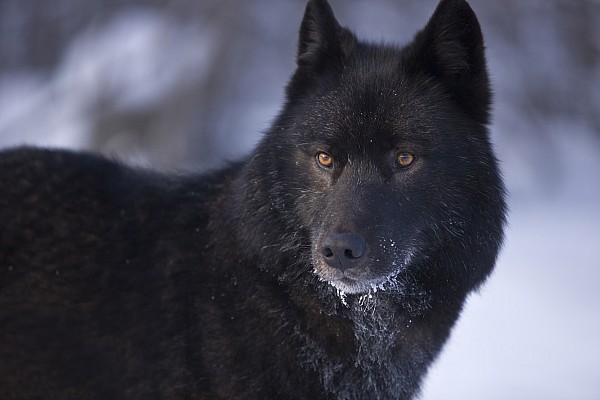
All black wolves that have been examined in modern times have been found to be dominant blacks. The dominant black mutation first originated in domestic dogs and was transmitted through crossbreeding between wolves and dogs. However, there is at least one record of a wolf that was carrying recessive black.
Recessive black is most commonly found in German and Belgian shepherds. It can also be found in pulik, Samoyeds, schipperkes. Shetland sheepdogs, and the so-called “American Eskimo dog,” which is actually an American variant of the German spitz.
It’s one of two ways that a dog can be solid black, but it’s far less common than dominant black.
The mutation that causes dominant black originated either in dogs or the wolf population that became dogs, because the mutation is older in domestic dog populations than in wolves. This black coloration wasthen transmitted to Italian and New World wolves through cross-breeding with domestic dogs. All wolves that have been examined in North America thus far have turned out to be dominant blacks, as have those in Italy.
However, there was at least one case of a wolf carrying recessive black in the literature.
The Soviet zoologist and dog expert N.A. Iljin carried out several experiments crossing various dogs with wolves. In 1941, he reported on the progeny of a male wolf that was bred to a female mongrel sheepdog. In the first litter, there were black and “zonar gray” (wild wolf gray puppies). If the dog in question were a dominant black, then the entire litter would have been black, but getting gray puppies suggested a very different conclusion.
After breeding from the offspring for several generations, Iljin discovered that the black was being inherited as a recessive allele, which means the dog in question was a recessive black– and the wolf was a carrier!
Now, results of Iljin’s study have been used to show that wolves carried recessive black from the beginning.
However, since the time of Iljin’s work, no one has found a recessive black wolf. The team of geneticists at UCLA have found only dominant black in wolves.
So it’s possible that this wolf was not actually “pure,” and at some point, one of its ancestors was a recessive black dog. I would not be surprised if someone had crossed a recessive black German shepherd into captive Russian wolves at some point. Iljin himself was very much into breeding German shepherds to wolves, and his studies on wolf and German shepherd morphology are pretty much classic literature for those interested in wolves and dogs.
So maybe recessive black did exist in certain Old World wolves from the beginning, but it’s just not been confirmed in the genetic literature in the same way that dominant black has.
I don’t know of another species besides Canis lupus that has two separate genetic variants for melanism. Coyotes have inherited dominant black from breeding with either dogs or wolves, and golden jackals and Ethiopian wolves could also inherit both types of melanism through similar hybridization.
So it’s very interesting that we have this one case of a wolf carrying recessive black, but we need more information to see where this color came from.




Don’t tell George.
And with dominant black, if one of the mating pair has one copy of the gene, statistically each puppy has a fifty percent chance of being black. If one of the mating pair has two copies of dominant black, the whole litter will be black.
I think Iljin was assuming that the bitch didn’t carry wolf gray, and he bred from the offspring up to an F2. That’s how he was sure that the black was recessive.
Iljin was a Mendelian. I can’t find what happened to him once the Soviet Union entered in the Lysenko clusterfuck.
If two non-black dogs produce black offspring it would have to be recessive.
(Or hidden by e/e but that is another story not involving these particular dogs.)
The gray pups from that breeding produced black puppies when bred together.
http://www.springerlink.com/content/rh57380733351510/
Belgians carry both the K dominant AND the kkaa recessive black. That’s one reason why it was so difficult, before the DNA info came out, to always know what might result. You sometimes had black/black yielding fawn and sometimes fawn/fawn yielding black. It’s entirely possible that kkaa recessive black is (or was) very rare in wolves. The various blog posts here on odd colored foxes, deer, even cats (none of which are the result of domestic dog genes) shows that if you “wait long enough” odd things show up. Given how many wolves were exterminated and how few have probably been tested with DNA to verify color genes, an absolute statement one way or the other is premature. The initial white tiger & white lion weren’t human creations, they just appeared as representatives of a very rare gene combination. It may be that recessive black has enough negatives to be deselected as a rule (there’s quite a lot of discussion on this in the black GSD, who are mostly recessive blacks). Or it may simply be that “we weren’t in the forest so we didn’t hear the tree fall”.
This is quite interesting information regarding the recessive black based on new genetic information. One can not be sure as attempts to digest the fire storm of new knowledge: What came first the chicken or the eggg?
Latest I have read states in this order a^y a^w a^t a (recessive black)
The dominant black would come from the K locus dominant. It is believed that the a^t is a mutation of the a^w (wild) and recessive a a more recent mutation?
Now what is more recent when we read this information? It was sstated tha a^y and a^w were not mutations? Know this will someday be very simple to understand
The problem with assuming the wolf had recessive black is he obtained black pups and black and tan pups. For the mutt female to be black, she would have had to have been aa and the wolf Aw/a.. leaving no room for At. Also, in his black x black F1 cross, 9 pups were indeterminant colored, out of 27 total (and 3 were in the black category as spotted.. no mention of black or black and tan). I wonder what they looked like to not be able to be classed as gray or black.. I wonder if some of the black and tan were really wolf gray, similar to sable GSDs, and skewed his classifications.
There are aw’s that look like they might be black and tans, but aren’t, like many schnauzers.
There also appears to be incomplete dominance between aw schnauzers and at schnauzers: http://www.katewerk.com/color/color2_pg1.html
Maybe something similar exists between the recessive black dog and an as yet unidentified sable variant in this particular wolf. It might explain why so many pups were hard to distinguish, and maybe the black and tans, weren’t at’s, but the heterozyous form between “ax” and a.
I think one possibility was he was looking at intensity of red and black, then misclassified them. He did speak about intensity in both colors, but if the “black and tan” were dark sables with intense red, whereas the ones with pale red were called sable, that might explain it. Looking at GSDs/CsVs, it seems viable to me. The dog introduced genes for red intensity into the cross, which muddled up calling the color of the normal Aw allele.
All should be Aw:


Variation in Aw in GSDs:
http://vonbauffin.webs.com/GSD%20Information.htm
Variation in CsV:
http://www.wolfdog.org/forum/showthread.php?t=3615
Plug ‘A SINE Insertion Causes the Black- and-Tan and Saddle Tan Phenotypes in Domestic Dogs’ into Google, it’s a free paper. Very interesting.
Doesn’t this paper discredit George’s theory that the agouti in dogs is very different from wolves?
No idea. I can’t actually make any sense of George’s theories. He is supposed to come and educate us on black wolves soon; I am waiting to see what his explanation is for the fact that there are still ‘regular’ wolves with all this dominant black floating around for so long. God forbid brindle got into the wolf population.
There is some evidence that horses have both recessive and dominant black, though the idea tends to generate a fair bit of controversy.
Oooooooh, ideas, scary! ::cue spooky music::: ;)
People are strange.
Well, part of the controversy around dominant black in horses is that the one paper published on it was possibly a result of mis-phenotyping. There were “black” and “near-black” (black with tan/red on muzzle/flank) both classified as black. Black x black = 9 black, black x bay = 7 black 5 near-black, black x chestnut = 10 black 6 near black. Near-black describes the color “seal brown” (or black and tan) in horses, which is dominant to black but recessive to bay.. so it is entirely possible he was still looking at the typical recessive black. Also, some of the foals were born looking like a typical bay then later darkened – which is generally attributed to seal brown.
In the case of seal brown, sometimes it is similar to a dark bay.. so if the bays were really seal brown, the breeding data fits perfectly with the horse producing either black or seal brown. In fact, the dam of the sire was “dark brown” and produced 1 black foal and 3 near-black foals.
Then again, seal brown isn’t published at all (so some controversy is there as well), and it’s possible Sponenberg has additional data supporting a dominant black. So dominant black in horses is definitely not clear-cut by any means.. All studies looking for E^D (which Sponenberg explained his population as) did not turn anything up. If it were the same gene as the K locus in dogs, that could explain it. Would be interesting to look into, by any means.. if the horses did not genotype as At (though I want to see that published, too!)
Yes, I didn’t mean to imply there was conspiracy-type controversy. It is really disagreement between academics, not the general horse owning and breeding public. I’ve been to seminars where the topic was discussed, and it mostly flew over people’s heads, or it just bored them. But inside the horse color research community, just as hmh said, there have been statements and positions on all three colors (black, supposed recessive black, and brown), but not enough published information.
I love that black wolf. He reminds me of my German shepherd who is black.
That is a very interesting couple of facts, I never knew that the black was a recessive gene! My Wolf Hybrid, Luna, used to only have a smidgen of black on her but has grown to have quite a bit of black throughout her coat as she grows.
In most wolves and dogs, it’s caused by a mutation that is inherited via a dominant black. Recessive black has only been found in this one wolf, and it’s found in only a handful of dog breeds. The dominant black in wolves originated in dogs first and then was transmitted into wolves through crossbreeding. Dogs have wolf genes, and wolves have dog genes. They’ve been interbreeding for thousands and thousands of years.
[…] another form, which is related to the sable coloration, that is inherited via a recessive allele. This recessive black may have been indicated in at least one Russian wolf, but all modern black wolves that have been examined thus far have turned out to be dominant blacks […]