The largest modern wolf on record was a Canis lupus occidentalis.
I remember receiving a book from a great uncle on Pleistocene mammals of North America. As a boy who was always fascinated with the large animals of East Africa that often appeared on nature documentaries, I was truly amazed that such large creatures once roamed my country. I was deeply impressed with the large carnivores, like the Smilodon species and the American lion (Panthrea leo atrox). But I am fundamentally a dog person, so my eye was particularly drawn to a large species of wolf that once roamed the Americas. At the time, I was reading Jack London’s Call of the Wild and White Fang, and wolves were my favorite wild animal. However, the name of the extinct species slipped my mind for many year. Then one day happened upon an article that speculated that a relict population of these big wolves could still exist.
Now I began to wonder, could such big wild dogs still exist in the world today? And if so, are they the same species or a close relative of the animal that graced my book on Pleistocene mammals? Well, I began to look at the facts. I plenty of good books on wolves gracing my bookshelf, and thus began a mini-research project. I found lots of interesting things about wolves and their close relatives, and I am offering you these findings as a sort of synthesis, combined with some of my other writings and findings on wolves and dogs that also talk about their evolution and natural history.
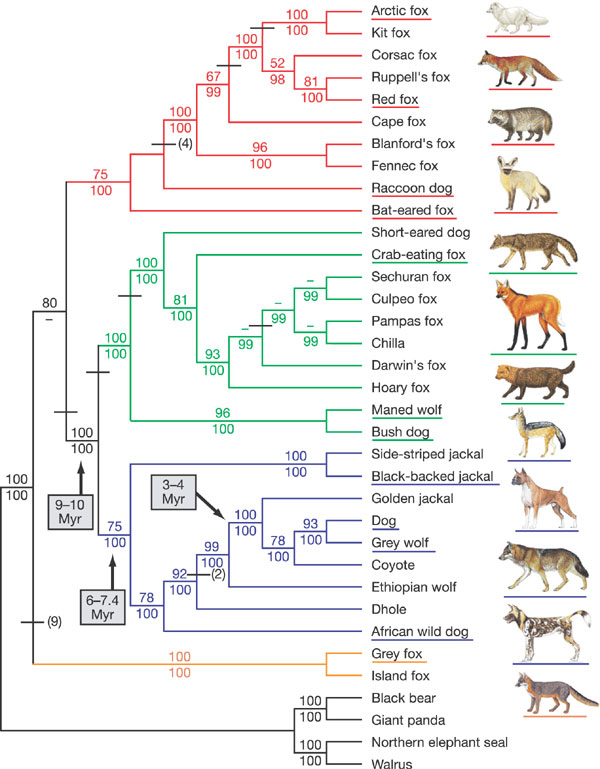
The modern wolf is believed to have evolved in Eurasia, most likely in India. However, its ancestors are believed to be a North American animal rather similar to the coyote. From that basic form, we have seen the development of all sorts of different themes and variations evolve.
The largest wolves in the world are of the Rocky Mountain/Mackenzie Valley subspecies (Canis lupus occidentalis). One of these animals was killed in Alaska that weighed 176 pounds. It was a fluke, of course, for this subspecies typically weighs between 100 and 140 pounds. These are big moose-killing wolves that have to have the large size to help bring down their fierce ungulate prey.
Now, domestic dogs do exceed this weight. The mastiff and St. Bernard sometimes weigh in excess of 200 pounds, and at least a few Newfoundlands and Great Danes [sic] have also reached this size.
Because we tend to associate wolves with these larger subspecies, it is easy to forget that many wolf subspecies are significantly smaller. In Wisconsin, it is estimated that the average dog wolf weighs 75 pounds, while the average female weighs 60 pounds. That means that the average wolf in those more southerly populations is about the size of a golden retrieve. However, because wolves have longer limbs in proportion to their body size, the wolves would be taller at the shoulder. The big wolves are limited to the northern reaches of their range.
However, during the Pleistocene, there was a large more southerly distributed species of wolf. Unlike the coyote and the modern wolf, this species also ranged into South America. Its size approached that of the Mackenzie valley wolf, often exceeding 150 pounds and occasionally as much as 175 pounds. The first specimen was discovered in 1854 at Evansville, Indiana, when a jaw bone of an ancient wolf was found in the Ohio River. The teeth on this wolf were larger than any known modern wolf, and the carnassials had a sharper slicing edge. This robust wolf was given the best name of virtually any extinct animal– the dire wolf (Canis dirus). It was this species that captured my imagination all of those years ago, when I first read about them in the book my great uncle gave me.
Since the discovery of the Evansville specimen, we have found out lots of interesting things about this species. Thousands of dire wolf remains have been found in the La Brea Tar Pits, and from their remains, we know that dire wolves had shorter legs than modern wolves. Their heads were larger, which means that dire wolf had a stronger bite than the modern wolves. Dog bite strength is strongly correlated with head size.
At one time it was believe that dire wolves were bone crushers, like hyenas, but more complete analysis of their jaw structure indicates that their jaws were more designed to kill and consume meat, like modern wolves and coyotes. The dire wolf is believed to be a large animal specialist, like the large occidentalis subspecies of Canis lupus. However, this wolf lived at a time when there were all sorts of huge megafauna in North America. This wolf most likely relied on these larger species for food. Think of the dire wolf as something like a naturally evolved mastiff-wolf hybrid that is even more powerful than those two modern animals. It was an animal that used its size and strength to bring down large prey. It was probably not a good courser.
About 16,000 years ago, the great megafauna of North America started to become extinct. The remaining prey species were mostly smaller animals that were much fleeter than the dire wolf could keep up with. The modern wolf lived in North America during the dire wolf’s reign, and it proved to be a better hunter of these smaller species. The dire wolf was able to hold on for a relatively long time, but the modern wolf was much better equipped to survive in this new world of fleet deer and swift jackrabbits. Officially, the dire wolf went extinct between 9,000 and 10,000 years ago.
It is possible that a relict population of dire wolves lived in the Ozarks of Arkansas up until 4,000 years ago, but officially, the species is extinct.
Or is it?
There is little documentation about how dire wolves lived with modern wolves. We do know that coyotes scavenged their kills, but at LaBrea Tar Pits, there are no modern wolves, just dire wolves. We do know that the genus Canis is plagued with infertility issues among species and this infertility among the species makes taxonomic issues very touchy. Just ask wolf experts what a red wolf is, and you’ll get lots of interesting answers.
It is possible that the dire wolf interbred with the modern wolf. I don’t think it was a very common occurrence, if it happened at all. I don’t think that the wolves of the Northern Rockies and Alaska are modern wolf/dire wolf hybrids. They are just big modern wolves that have evolved as moose killing specialists.
But there are reports of big, anomalous wolves. In Native American folklore, there are lots of stories about big wolves that are different from the wolves we see today. Two of these could be dire wolves or memories of the dire wolves that got passed through folklore.
The waheela is said to be a large heavily built wolf, but it is said to have longer hind legs than front legs. It is also not seen in packs. Because so many dire wolves were found at La Brea, it is assumed that they were pack hunters. The shunka warak’in is another wolf-like animal that is said to be larger than a typical wolf. This one also unusual legs, but this one has longer forelegs than hind legs. One of these was supposedly shot in Montana, and the animal was taxidermied. I’ve seen photos of the taxidermied speciemen. It looks like a poorly mounted wolf-dog hybrid. (And that’s another problem with “mystery dogs”– domestic dogs vary so much in appearance that crosses between domestic dogs and wild dogs and even just regular mutt dogs look can look like an unusual species.)
I think the shunka warak’in is an animal that actually existed. However, it existed in Central Asia and Siberia, which is the ancestral home for the Native Americans. In the Ioway language, shunka warak’in, means “carries off dogs.” I thought that was interesting. I had previously ignored the descriptions of the shunka warak’in’s unusual leg length. Then I read this article about how may have hyenas kept people out of the America for thousands of years. These hyenas were big creatures, and a major predator of humans. Humans occurred only south of where the hyenas were the major predator, effectively keeping humans out of Eastern Siberia, the Russian Far East, and Berginia.
What I found interesting, though, was the only record of humans during the hyena period in this part of Asia was the skull of a dog. The dog was too small to have survived in the wild, which is how we know it was a domestic animal. The dog was probably captured near a human camp. The hyenas then carried its body into a cave, where they tore it apart.
Now, these hyenas were in the same basic area where the people who became the Native Americans originally lived before they crossed the Bering Land Bridge. The stories of dog killing hyenas could have survived in the folklore of Native Americans through the generations. The description of the shunka warak’in’s leg lengths sound very much like that of a hyena.
Now, these two animals in the folklore are probably not dire wolves, but I have found one animal that sounds a bit like a dire wolf. The Ontario giant wolf is a described as a big, heavily built wolf that supposedly lives or lived around the Great Lakes region. However, it was a white animal. I don’t know whether the dire wolf was a white animal or not. However, a northern race of this animal could have evolved a white pelt.
However, it could also be that the Ontario white wolf was an Arctic wolf that wandered south after dispersing from its natal pack. Wolves have been know to travel up to 1,000 miles from their natal packs to start their own. The wolves of the High Arctic are big wolves, almost as large as the occidentalis subspecies. They are of a heavier built than the Eastern North American wolf (Canis lupus lycaon) and the Great Plains wolf (Canis lupus nublius), which are native to the region. If you were used to seeing these smaller races of wolf, encountering one of those big white wolves would be a shock. If you didn’t know they were the same species, then it is possible that you could think of them as some sort of giant wolf.
To be honest, I have not seen any accounts of large anomalous canids in North America that cannot be explained as subpecies of the common wolf, coyotes, hybrids between coyotes and wolves, or hybrids between dogs and wolves or dogs and coyotes. I think people fundamentally do not understand that wolves are very diverse species. If you think about it, domestic dogs are the result taking wolves and breeding them into every exaggerated shape imaginable. These exaggerations come from a species that has wide variations in its appearance in the wild. The biggest wolf on record was the aforementioned occidentalis specimen. The smallest was the extinct shamanu (C.l. hodophilax) of Japan, which was often as small as 15 pounds.
Further, coyotes also vary in appearance. There are black ones, red ones, gray ones, and even white ones. The biggest coyotes are nearly wolf-sized, weighing as much as 60 or 70 pounds. These are found in Eastern North America. The smallest coyotes are shamanu-sized creatures that live in Central America as far south as Panama.
Now, as I’ve said before some of the variation in wolves and coyotes comes from interbreeding with domestic dogs. Black coloration in North American and Italian wolves and in coyotes is now believed to come from interbreeding with domestic dogs. The gene that causes the black color evolved first in domestic dog populations. Wolves in Italy were discovered to have dewclaws on their hind legs. No other wolves had this feature. However, domestic dogs sometimes do have these dewclaws. When it was determined that this feature also evolved first in domestic dogs, scientists are now using the existence of these hind dewclaws as diagnostic feature of hybridization. The wolf researcher Adolph Murie speculated that the wide variation that existed in Alaskan wolves came from hybridization with domestic dogs. It is also likely that the Beasts of Gevaudan was a Dogue de Bordeaux or other mastiff-type crossed with a wolves. So when an unsual “wolf” is seen, one cannot discount the possibility that Fido might have had something to do with it.
As much as I would love for dire wolves to still exist in some form, I don’t seen any convincing evidence to suggest that they do. Their genes could exist in some population of modern wolves or maybe even coyotes, but those genes have not been found. (If someone could locate a pristine stample of dire wolf DNA, we could find answers to some of these questions).
There are interesing issues with classifying the genus Canis. The interfertility among most of the animals in that genus is but one of them. The other is that Canis lupus is historically a genetically diverse species. A study of the remains dogs and wolves from caves in Belgium suggests that the ancestral Canis lupus population was extremely genetically diverse. This means that modern wolf populations could have very unique genetics and still be of the same Canis lupus species.
This former genetic diversity is further added when some wolves were found in the Alaska permafrost. They resembled large modern wolves of the occidentalis subspecies, although they were quite bit more robust in appearance. When the jaw structures were examined, the wolves were found to have much more powerful jaws than any known population of wolves. Because this find was in Alaska, the animals were known not to be dire wolves. However, these wolves had such powerful builds and jaw that it is believed that they were capable of killing mammoth, even though they looked very much like modern wolves. When their DNA was sequenced, their DNA sequence that was found to match any extant wolf populations. What the scientists had found was a specialized population of wolves that evolved to hunt large prey species. Where these bone crushing wolves fit into the natural history of wolves is a very good question. Because these wolves lived 12,000 years ago, it is possible that one or two of these wolves lived into historic times. It’s also likely that the memory of wolves like this worked its way into Native American folklore and added to the stories about the waheela and shunka warak’in. Further, we know that wolves have the ability to evolve into rather robust forms, which could also be augmented with hybridization with massive domestic dogs.
The theory that the dire wolf still exists in some form sounds appealing. However, it is very unlikely. Instead, we have something even more amazing. It is this remarkable elasticity exhibited by wild dog to evolve into different shapes to exploit new niches in the ecosystem. This elasticity has been used in our selective breeding of domestic dogs to produce all manner of exotic shapes, some of which are now quite deleterious to the health of the dog. However, in the wild, this elasticity allowed the ancestral Canis to evolve into the little pot-licking black-backed jackals of Eastern and Southern Africa that evolved to snatch morsels of meat from the kills of the great carnivores, and this elasticity has allowed for the dire wolf to evolve into a predator that preyed on the megafauna, the equivalent of the lions and hyenas from which the black-backed jackal scavenges.
This elasticity is believed to come from tandem repeats in the dog’s DNA sequence. This genetic eccentricity has been as useful to dogs as our tool use and innovation has been to us. Dogs can simply evolve into new forms rather quickly. However, it also allows humans to totally mess up the domestic dog’s body structure, producing forms that are very unhealthy.
So it is unlikely that these mystery dogs of North America are extant dire wolves. I wish they were. I would love it if such unusual wolves still lived here. I do hold the possibility that their genes could be found in some North American wolf population, but I don’t think it is very likely. I think it is more likely that the unusual wolves found in Alaska might have some descendants in a population of modern wolves that have not had their DNA sequenced. I don’t have much hope for the dire wolf, even if one population could have survived 4,000 years ago.
Because if they still were around, we could write a heck of a Jack London novel about them!