
Cross fox
Contrary to what you might think of an animal with a name like “cross fox,” this animal is not a hybrid animal. It is a lesser known color phase of the red foxes (Vulpes vulpes). It is called a cross fox because it has a band of dark hair running down its back and another band running accross its shoulders. In the biblical sense, this forms a cross.
As far as I know this color variation appears only in North America. In my region, the most common color phase of this species is the typical red. There are a few cross foxes around, but next to zero melanistic foxes. Melanistic foxes with white hairs mixed are called silvers, but virtually none of these exist in my part of the world, except in captive fur-bearing population.
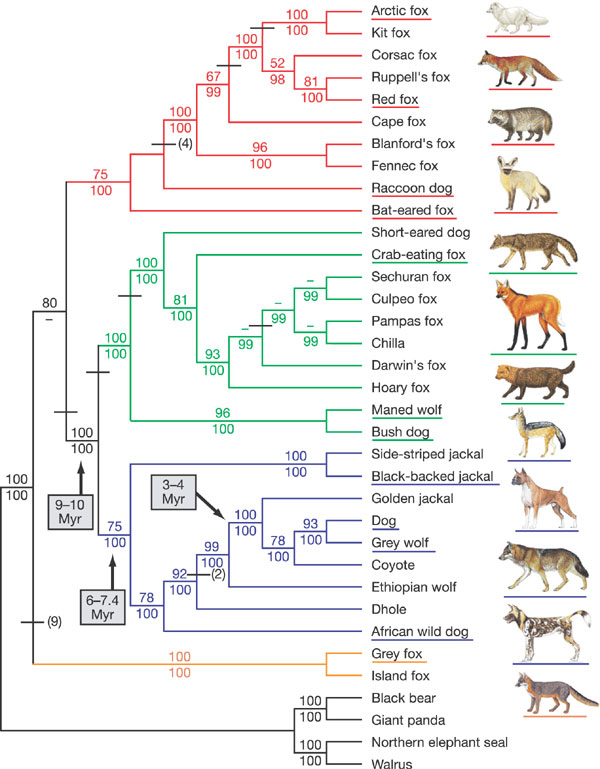
Now, contrary to popular belief, red foxes cannot hybridize with gray foxes. Reds can breed with silvers, because they are the same species. The gray fox (Urocyon cinereoargenteus) that ranges from southern Canada to Colombia and Venezuela is a very unusual animal. The genus Urocyon consists of the gray fox and the island fox of the Channel Islands of Southern California. This genus is sometimes considered the most primitive of all dogs, for both of these species retain the ability to climb trees. Indeed, they are very good climbers, almost as good at arboreal locomotion as any cat.
The cross fox is just an interesting coloration of the red fox. It is not a separate species or a hybrid. Unlike the gray fox, the red fox is not native to most of the Eastern US. Studies of that population confirm that this particular subspecies is almost identical to the red fox of Britain. This finding makes sense, considering that we have records of introductions from Europe during the eighteenth century.
The Eastern subspecies is Vulpes vulpes fulva. All other subpecies are considered native. The other subspecies tend to have a higher proportion of melanistic and cross individuals, both of which are virtually unknown in European populations. It is thought that the melanistic foxes were killed off in Europe, leaving only red ones to breed. (However, a melanistic one did appear last year in England.)
Now, it’s very interesting that the red fox comes in some many colors. A wide range of coloration matches the varied habitat of this species. Currently, it is the most widespread of all wild carnivores. It is found throughout Eurasia (including Japan), most of North America, and North Africa. It has been introduced to Australia, where it is has proven to be a terrible introduced species, killing off lots of small marsupials and ground nesting birds.





This summer I saw a red fox of the silver-phase. It was actually pitch black (we still call them silver despite this). The only thing not black on it was the white tip of the tail. It was a stunning anima, I regret not having been able to photograph it.
I’ve never seen a wild black or silver fox. Where I live, they are all English imported animals that have adapted to this continent.
I saw this animal at the northern tip of Yukon territory (Canada).
Yes it is most true that the European strand is very much dominated by the “Red” phenotype.
Even in canada, researchers that have looked into the color phases of historical harvests of red foxes have seen novel phenotypes such as cross and silver decline over the mid-20th century. In all eastern Canada, Silver foxes and cross foxes have basically dissapeared from the gene pool from what I’ve read.
A large part of North America now seems to be dominated by this European/British strand.
Cheers!
The fulva subspecies is derived from British red foxes. In most of the eastern US, the red fox is not a native animal.