
Another decomposing animal has brought about some wild speculation.
From the Toronto Star:
A snaggle-toothed, furry creature with a bald face and a rat’s tale has mystified natives in northern Ontario, but they have a name and a history for it.
“The elders used to see it a long time ago,” the manager of Sam’s Store in Big Trout Lake told the Star on Friday.
“No one has seen one for 40 years or so. The elders have a word for it: omajinaakoos. In English, it means ‘the ugly one’.”
Two Health Canada nurses training at the Kitchenuhmaykoosib Band reserve south of Hudson’s Bay said their dog Sam hauled out the 30-centimetre creature it found in early May floating face down near the causeway on the reserve, band spokesman Darryl Sainnawap told the Star.
“It looks like a mixed breed of an otter and a beaver,” he said. “We’re just as curious as everyone to find out what it is.”
One band member, 65-year-old John McKay, said he remembered his grandfather talking about such a creature that “feeds on beavers and otters.” Sainnawap’s 80-year-old grandfather had never seen anything like it, though.
Other elders “think it could be a messenger for bad news,” he said. “We’ll see.”
Well, I hate to shut everyone down here, but I know what this animal is.
It’s nothing really spectacular.
It is a mink.
This is what mink look like when they are alive:
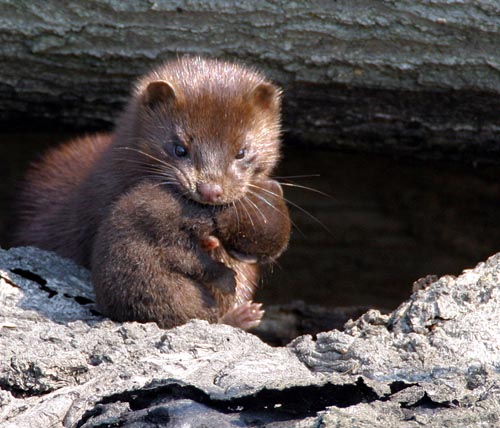
The creature and this mother mink have the same fur color and the same head shape. Otters really don’t have that same head shape or fur color, and the size of the animal, which is about a foot in length, sounds consistent with a mink.
The fact that a dog found this animal in creek is further evidence that this animal is indeed a mink. Mink prefer to travel along waterways. One of their favorite prey species is the muskrat, but they will also fish.
However, they are not always found near water. They have been known to travel some distance to raid chicken coops. (Which are not chicken coups. I can’t imagine what would happen if we had a chicken coup.)
Decomposition and hair loss on any animal that is normally furred tends to set the imagination off. The Montauk Monster and the various dead, hairless canids that have been called “chupacabras” are testament to this phenomenon.
But just because something has no hair doesn’t mean that it’s anything special. I suppose some of this comes from our own anthropocentrism. Hairlessness is a defining feature of our species, and when we see another mammal without hair, it sparks something in our imaginations. We just aren’t that accustomed to seeing other bald mammals.
***
Of all the weird hairless animals that have sparked wild speculation, my favorite is Gollum or the Cerro Azul monster from panama.
What was this creature? An alien? A goat-human hybrid?
Nope. It was a dead Bradypus.
Update: This is now the number one referrer to the blog.





Alert Geraldo!
Sadly shows that the idea that somehow Amerindians are all “knowledgeable about nature” is hooey. And it also shows that Amerindians are no better (or worse) than the rest of us in terms of making up a “just so” story to explain things rather than just fess up: “hell if I know”.
Most people are so disconnected with real nature that they would probably have difficulty identifying the less common animals even without decomposition. It’s easy to poke fun at ignorance — but I suspect that the average urban kid can accurately identify a type of car fairly easily. That they might not be able to distinguish a Holstein from a Jersey as easily as they do a Volkswagon from a Prius is simply because they encounter far more of the latter than the former. It matters more to be able to identify what “you” see in “your” environment than what’s in someone elses’. And unfortunately, rural or wild things are pretty much “someone else’s”.
Peggy Richter
Well, it is possible that they were doing an old trick that we West Virginia yokels do:
Tell one big whopper of a story to an outsider.
I wonder what the “rat’s tale” was…
don’t they have a proofreader at this newspaper??
I suspect that the Native Americans were pulling someone’s leg.