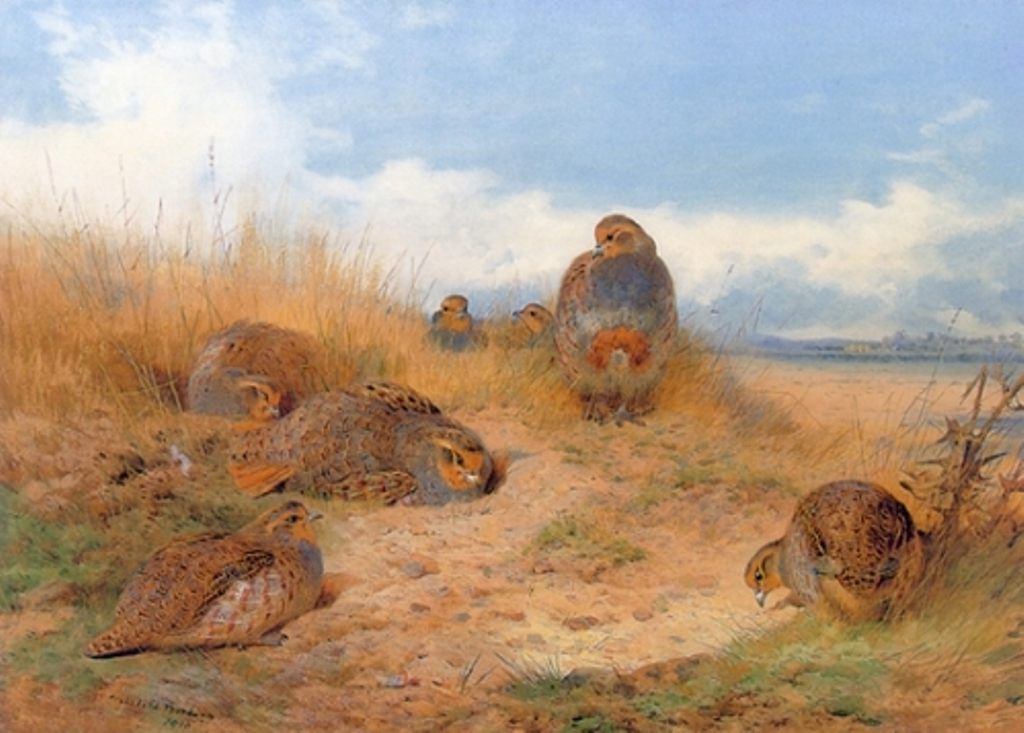
"Covey of Grey Partridge" by Archibald Thorburn.
From Sport in the Highlands and Lowlands of Scotland with Rod and Gun (1884) by Tom Speedy:
When shooting either in a turnip or potato field, care should be taken not to fire at too long ranges. Where this is disregarded, many of the birds which have been winged become “runners,” and, in the absence of suitable and experienced dogs, will very often be lost. This, it is unnecessary to say, is most irritating to true sportsmen. We have ever laid it down as a rule, that we would rather, even at the loss of a little time, bag a bird of this description than a brace which might subsequently be obtained during the time spent in recovering the “runner.”
It is almost impossible to pick up “runners” in rank turnips without the assistance of a retriever; for although a pointer may “road” them up (and point at them), they often slip oft* again and escape. With a retriever it is very different, the bird being picked up with all despatch.
There are few things more interesting to sportsmen than to watch the movements of a retriever tracking a winged partridge; how he will dodge about among the turnip-drills, running straight up one at full speed,and on his nearing the bird—by its crossing into another drill—he will overrun the scent. If up to his work, he will instantly retrace his steps, until, again picking up the scent, he, with unerring certainty, discovers the whereabouts of the object of his search.
Retrievers, like other dogs, must belong to a good breed to be truly useful in their work. When this is wanting, no amount of training, or even practice, will make up for the lack of this essential element. Again, when the breed is all that can be desired, training, in many cases, will be very little required in so far as the “roading” and picking up of wounded birds are concerned. As to the general behaviour of the dog— viz., remaining quiet, keeping to heel until told to go, &c.—training is absolutely necessary. In the absence of these qualities, a retriever is often a source of annoyance, as it necessarily demands the attention of the keeper when his mind should be otherwise occupied.
It is surprising how quickly a well-bred retriever will apprehend what is expected of it. There is no class of hunting dogs in which the instinct is more powerful, sometimes approaching almost to intelligence, and in which it is more early developed.
The best performance we ever saw among partridges was by a retriever bitch, nine months old. We were hunting in a field of ” rank ” turnips—and only on one former occasion had she been out among the partridges. On the pointer finding birds, a covey rose; four birds dropped to the guns, and, strange to say, three were”runners.” We let the bitch loose as an experiment, and were alike surprised and gratified with the result. Keeping the pointers “down,” we told her to “seek dead.” She had seen the birds fall, and at once ran to the right place and picked up the dead one. Being directed to seek again, she got on the track of one of the ” runners,” and stuck to it till she succeeded in catching it. In like manner, the other two were recovered, though one of them had crossed and recrossed several times into an adjoining field (pg. 269-271).
A nine-month-old bitch performed as amazingly as any adult dog, chasing after the running birds. Retrieving and questing after birds was not something her handlers trained her for. She already had those abilities. She just had to be put into the proper context to do so, as well as teach her some proper manners so that she wouldn’t be a nuisance or put herself in harm’s way.
Such dogs are and were the result of intense selective breeding for the instinct. Speedy is very clear that these dogs didn’t learn how to retrieve. They learned how to behave properly, but the retrieving part was always natural, carefully cultivated through selective breeding.
(However, just because a dog has natural retrieving behavior does not mean that it cannot learn the full predatory sequence. The tendency to show the behavior is genetic, but the context in which the behavior is used is learned through training.)
The golden retriever was developed for this kind of hunting, which is why they tend to excel at upland game hunting.
But there was always an emphasis on biddablity and natural instinct.
I think this is the way retrievers ought to be: Good nose, good sense, and strong retrieving instinct.
Dogs that could catch the wounded birds as they worked their way through the tangles of turnips and potatoes.
***
Grey or gray partridge is the same bird we North Americans call “Huns” or “Hungarian partridge.”