• Home
  • About
  • Become my Patreon
  • Contact
  • Facebook

Canis lupus hominis

The Retriever, Dog, & Wildlife Blog

Feeds:
« Raccoon and horse are friends
Black Retriever with Pheasant, 1831 »

The Species Status of Darwin’s Fox

May 25, 2011 by retrieverman

The red wolf controversy may be the best known of all canid taxonomy debates. Wolf taxonomy in general is quite contentious. Not only have “Eastern wolves” and “red wolves” been proposed as distinct species, some populations of the pallipes wolf in India and the some of the wolves of the Himalayas have, too. These two species were declared based upon mitchondrial DNA evidence. However, these animals are virtually indistinguishable from other pallipes wolves, which are the larger subspecies that is found from the Levant to the Indian subcontinent. It is likely a source for the domestic dog, and and the recent genome-wide study of wolf populations found that the Indian wolf fit within the Southwest Asian (SWA) group.

But wolves are unusually widespread and an unusually genetically diverse species. As a species, they are actually not endangered. They are merely endangered within certain parts of their range, and certain species, like the Mexican wolf, which has unjustly played second fiddle to the “red wolf” in North American wolf conservation circles, is quite endangered.

But what about a species whose range is confined only to a tiny archipelago and to an area that just happened to be declared a national park?

Such is the case of the Darwin’s fox (Lycalopex fulvipes) of Chile.

For decades its exact species status was highly contentious.

This fox is actually not a true fox at all. There are no true vulpine foxes in the whole of South America. What exists instead are various smaller canids that actually share closer evolutionary linkage to the true dogs in the genera Canis, Cuon, and Lycaon. Various genus names have been proposed for these “foxes,” including Pseudalopex, which means “false fox.” The current name is Lycalopex, which is a combination of the Greek words for wolf (“lycaon”) and fox (“alopex’). Literally, it means “wolf fox,” which is a much better reflection of their taxonomic status.

Everyone knew that the Darwin’s fox was one of these foxes, but whether it was a unique species or not was quite contentious.

Charles Darwin collected the first specimen in 1834, when he dispatched one on San Pedro Island in the Chiloé Archipelago.

He was able to make his kill by sneaking up on one and hitting it in the head with a geological hammer.

These foxes are quite opportunistic, and because they suffered very little predation on their island homeland, they became very unwary creatures. However, other species of South American “false fox” have these same traits; both the chilla (L. griseus) and the culpeo (L. culpaeus) have been known to beg for food from people in broad daylight. This trait was shared by the extinct Falkland Island’s wolf, which was thought to be one of these foxes, and one of the original genus names that was proposed for them was Dusicyon, meaning “foolish dog.” It’s very foolish to let an English seminary dropout sneak up on you and hit you with a hammer!

The scientific community eventually came to regard the Darwin’s fox as a subspecies the chilla. The chilla is sometimes called the South American gray fox, a name that should be dropped immediately for a very simple reason:  the Urocyon gray fox of North and Central America also ranges into Colombia and Venezuela. The Urocyon gray fox isn’t a true fox either, but it is quite different from both South American foxes. It represents a unique evolutionary lineage of wild dog that is not closely related to any other extant species– even though it looks very similar to the vulpine or true foxes. (Its only other living relative is the other “fox” in the genus Urocyon, the island fox of the California’s Channel Islands (U. littoralis).

One of the reasons why it was regarded as subspecies of the chilla is that it was believed to be found only on the Chiloé Archipelago. Island subspecies are often quite different from their mainland forms, and the darker colored fox on the islands was believed to be nothing more than a variation of the lighter gray chilla.

This darker coat led to the discrediting of the the possibility that this fox was the same as the Chilla.  In 1943, Wilfred Osgood thought the Darwin’s fox’s pelt was closer in terms of its color and characteristics to the Sechuran fox (L. sechurae) of the Peruvian and Ecuadorian deserts. In 1995, Christopher Yahnke confirmed this finding.

Around that same time, a dark colored population foxes that had been previous identified as chillas in Chile’s Nahuelbuta National Park on the Chilean mainland was determined to be the same thing as the Darwin’s foxes of the Chiloé. The fact that these two foxes were very similar suggested that the differences between the chilla and Darwin’s fox could not be ascribed to the peculiarities of unique insular evolution.

In 1996, Yahnke and Robert Wayne of UCLA compared mtDNA sequences from the Darwin’s foxes, the culpeos, and the chillas. It was instantly apparent that the mtDNA sequences of the Darwin’s fox were quite different from the chilla and the culpeo, which meant that the Darwin’s fox was truly a unique species after all.

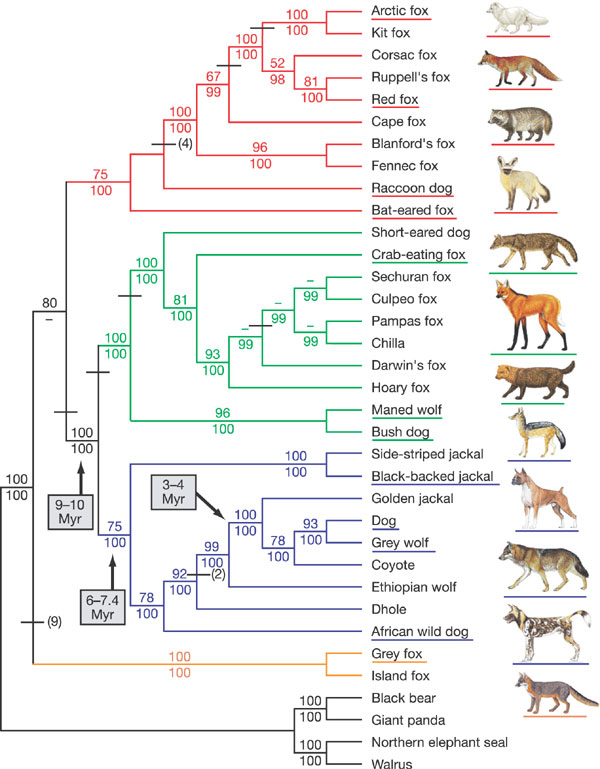
The exact location of the Darwin’s fox within the dog family was not fully established until 2005, when the dog genomic sequence was released. Using SNP analysis, the researchers were able to reconstruct the entire dog family phylogenetic tree. The Darwin’s fox was found to be an older species than all of the Lycalopex species, except the hoary fox of Brazil.

Thus, Darwin’s fox is the oldest species of “fox” in the Southern Cone. It likely was once quite widespread in this region, but it evolved to live in the temperate forests that once dominated the landscape. These forests have disappeared, both through the forces of various periods of climate change and human deforestation, leaving only a relict population on the mainland. The Nahuelbuta population consists of only around 50 individuals, while the insular population is about 200-250 foxes, so these unique wild dogs are quite critically endangered.

The story of the Darwin’s fox tells us how important it is to get taxonomy right.

If we had continued to assume that the Darwin’s fox was nothing more than a dark chilla, then it could have become extinct without anyone understanding exactly what it was.

It reminds me very much of the situation that exists with wolves. Because so much of the paradigms of the conservation and scientific community have wrapped themselves into the red wolf and Eastern wolf hypotheses, valuable resources have gone into trying to preserve proposed species that may not be unique at all.

Those resources could have gone into Mexican wolf conservation– and Mexican wolf reintroduction has had many problems. Right now, the Mexican wolf recovery program is on the chopping block. It could probably use some of the money and personnel that has already been allocated to the red wolf recovery program, which is mostly concerned with trapping coyotes in red wolf range– to keep the red wolf pure! Of course, it’s now been revealed through a genome-wide analysis that the red wolf is actually a coyote with some wolf ancestry. It just has a bit more wolf in it than the typical Northeastern coyote. Coyotes are not endangered anywhere.

But because we got the taxonomy wrong, we have spent all of this time, money, and effort into conserving the red wolf, instead of the Mexican wolf. Granted, the politics for red wolf reintroduction was better. That part of Eastern North Carolina in which red wolves were released is not major cattle or sheep farming country, but the regions where Mexican wolves were reintroduced are. Further, the actual habitat chosen for Mexican wolf reintroduction wasn’t ideal wolf territory either– and it may have been outside the Mexican wolf’s historic range.

From this analysis, it is now obvious that we should have been much more worried about Mexican wolves than the so-called red wolf.

It would have been a shame if we had not examined the Darwin’s fox’s genetics. Pelage color and morphological analysis take one only so far.

But you can’t argue with DNA.

The Darwin’s fox is an ancient South American “wolf fox” that is native to the Southern Cone, and now it’s now restricted to a very narrow range. It is a living fossil of sorts, a claim that was once made about the red wolf.

But the Darwin’s fox is the real McCoy.

Posted in Uncategorized, wild dogs, wildlife | Tagged Darwin's fox | 3 Comments

3 Responses

  1. on May 25, 2011 at 11:55 am M.R.S.

    It seems that “species” of many animals may be determined by relatively minor variances in size, coat type, color, skull shape, or dentition….yet the hundreds of dog “breeds” that may have extremely larger variances in those same characteristics are all lumped under the same designation.

    Do the “lumpers” and the “splitters” among taxonomists have an explanation?


    • on May 25, 2011 at 6:02 pm retrieverman

      Here’s a very good discussion– from a splitter: http://scienceblogs.com/tetrapodzoology/2010/03/laissez-fair_lumping.php


  2. on May 25, 2011 at 2:57 pm Jess

    “But you can’t argue with DNA.”

    They still try, though.


Comments are closed.

  • Nature Blog Network
  • Like on Facebook

    The Retriever, Dog, and Wildlife Blog

    Promote Your Page Too
  • Blog Stats

    • 5,469,675 hits
  • Retrieverman’s Twitter

    • RT @RichardDawkins: Burn one Quran and millions of exact copies remain available to read. But each Assyrian or Buddhist statue smashed is u… 3 days ago
    • World’s most notorious Islamic creationist busts a move wp.me/phvWb-7vw 3 days ago
    • RT @lalodagach: @JaclynGlenn, perfectly stated... #atheism #atheist #islam http://t.co/UnWSIaihXt 4 days ago
    • World's leading Islamic creationist busts some moves: youtube.com/watch?v=VDYRQy… 4 days ago
    • @BronwenDickey Not a bad idea. 4 days ago
  • Community

  • Google rank

    Check Google Page Rank
  • Archives

    • March 2015
    • February 2015
    • January 2015
    • December 2014
    • November 2014
    • October 2014
    • September 2014
    • August 2014
    • July 2014
    • June 2014
    • May 2014
    • April 2014
    • March 2014
    • February 2014
    • January 2014
    • December 2013
    • November 2013
    • October 2013
    • September 2013
    • August 2013
    • July 2013
    • June 2013
    • May 2013
    • April 2013
    • March 2013
    • February 2013
    • January 2013
    • December 2012
    • November 2012
    • October 2012
    • September 2012
    • August 2012
    • July 2012
    • June 2012
    • May 2012
    • April 2012
    • March 2012
    • February 2012
    • January 2012
    • December 2011
    • November 2011
    • October 2011
    • September 2011
    • August 2011
    • July 2011
    • June 2011
    • May 2011
    • April 2011
    • March 2011
    • February 2011
    • January 2011
    • December 2010
    • November 2010
    • October 2010
    • September 2010
    • August 2010
    • July 2010
    • June 2010
    • May 2010
    • April 2010
    • March 2010
    • February 2010
    • January 2010
    • December 2009
    • November 2009
    • October 2009
    • September 2009
    • August 2009
    • July 2009
    • June 2009
    • May 2009
    • April 2009
    • March 2009
    • February 2009
    • January 2009
    • December 2008
    • November 2008
    • October 2008
    • September 2008
    • August 2008
    • July 2008
  • Recent Comments

    retrieverman on Rottweilers are not bulld…
    Earth Whisperer Cons… on World’s most notorious I…
    Jen Robinson on Rottweilers are not bulld…
    Nuthatch working at… on Bird buffet
    retrieverman on Rottweilers are not bulld…
  • Meta

    • WordPress.com
  • Pages

    • About
    • Become my Patreon
    • Contact
    • Facebook
  • e college finder

    Online Colleges
    Online Colleges
  • Email Me

    retrieverman1[at]yahoo.com
  • Art

    • Conservation Photojournalism
    • Demon Puppy
    • Historical Hound
    • LolaDot Photography
    • Lucinda Coldrey
  • Blogroll

    • 2dogcrazy
    • Academy for Dog Trainers (Jean Donaldson)
    • Action for Sighthound Adoption and Protection
    • Agile Gold
    • Allie Chronicles
    • Almost Heaven
    • Alpine Publications
    • American Barbet
    • Ann and I
    • Ask Dr. Yin
    • Azawakh Idi! Idi! Idi!
    • B-More Bulldogs
    • Birdchick
    • Blacksheep Cardigans
    • Border (Collie) Wars
    • Born-to-Track News & Views
    • Brad Anderson
    • Bronwen Dickey
    • Camera Trap Codger
    • Caninest
    • Cao Preto
    • Chathamhill Dogs
    • Code Name: Farm Collie
    • Cold Wet Nose
    • Confessions of a Canine Junkie
    • Conservation Photojournalism
    • Crappy Taxidermy
    • Demon Puppy
    • DesertWindhounds
    • Dinsdale Photoblog
    • Djinn34
    • Dobermann Daze
    • Dog Breeds of the World
    • Dog Bytes
    • Dog Politics (UK)
    • Dog Spelled Foward
    • Dogs and Wolves (Elaine Chaika)
    • Dogs Don't Look Both Ways
    • Dogs, dogs, and more dogs
    • Dogsnhorses
    • Dogstar Academy
    • DogTime Blogs
    • Durrell Wildlife Trust Blog
    • Ella Bay Forever
    • Fallowfen Gundog Blog
    • FirstDogCharlie
    • For the Pits
    • Frogdog Blog
    • FromZooMy
    • Full Cry
    • Gamebird Litter
    • Glencuan Pointers
    • Gold Dog History
    • Golden Obsessions
    • Golden Retriever Comunidad
    • Grey's Days
    • Guiding Golden
    • Gundogdoc’s Blog
    • Happy Doggie Blog
    • Hemmingford Dog Blog
    • Historical Hound
    • Hoof & Paw
    • HT Training
    • Ian Dunbar
    • James Marchington
    • Julie Zickefoose
    • K-9 Solutions Dog Training Blog
    • KC Dog Blog
    • Kennel Jacklaine's
    • Leah DVM
    • Lehrhund
    • Lumi and Laddie
    • Lurchers, Terriers, and Ferrets
    • Musings of a Biologist and Dog Lover
    • My three pups
    • Mystery of My Hairless Chihuahua
    • National Lacy Dog Association
    • No Kill blog
    • Novaforesta Barbets
    • Olduvai George
    • One Nation Under Dog
    • One Pibble's Wish
    • Online Dog Training
    • Out Walking the Dog
    • Pedigree Dogs Exposed Blog
    • Penin kulmilla
    • Pippa's Blog
    • Pitter Patter
    • Pointing Dog Blog
    • Prick Eared
    • Rainwolves Weblog
    • Raising Maple–A Murray River Curly Coated Retriever
    • Rat Hunters
    • Rat Hunters
    • Responsible Dog
    • Retriever History
    • Samuel's Blog
    • Save the Pit Bull, Save the World
    • Scott Shalaway
    • Sherlock and Noah
    • Sixteen Paws
    • Smart Dogs
    • Stephen Bodio’s Querencia
    • Steve Dale's Pet World
    • Sugar The Golden Retriever
    • Swamp Dogs
    • Tails of Gold
    • Tattoos and Terriers
    • Techichi.org
    • The Bark Blog
    • The Calmo Dog Blog
    • The Cooper Project
    • The Daily Coyote
    • The Life of Jalo
    • The Other End of the Leash
    • The Poodle (and Dog) Blog
    • The Public Domain Kennel Club
    • Totally Dogs
    • Turid Rugaas
    • Tyson the Pit Bull
    • Utah Neff
    • Welcome to Chelsea’s World
    • Working Cocker Spaniels
    • YesBiscuit!
  • Dog links

    • Apso Rescue- Colorado
    • Ariosa Spanish water dogs
    • Back to Basics to Improve the Breeding Selection Process by Robert Milner
    • Bi-Mar Pomeranians
    • Collie Family Tree
    • Dog +R/-P Resource Page
    • Dog Breeds of the World
    • Dog Phylogenetic Tree
    • Dog School Tv
    • Evolution of the German Shepherd in 30 Generations
    • Flat-coat Library
    • Golden Retriever Club of America's National Health Survey
    • Golden Retriever Rescue in Nebraska
    • Gundogz
    • Gyldenpels
    • HeatherWeb
    • Huggable Goldendoodles
    • Inbreeding as a way to select against genetic disorders?
    • Is the Closed Registry System Doomed?
    • Krassesrudel
    • Louter Creek Red Hunting Poodles
    • Mac Barwick's Bloodhound History
    • Martin's Goldens
    • Newfie World
    • Old Time Farm Shepherd
    • Robert Milner’s Retriever Training Site
    • Some Practical Solutions to Some Welfare Problems in Dog Breeding
    • Telescope: Farley Mowat–CBC Archives (Features St. John's water dogs)
    • The "Blue Collar" Retriever
    • The "Ideal" Golden Retriever: How Do You Find Such an Animal?
    • The Bark
    • The Chinese Crested Shrine
    • The Honey Wolf
    • The Truth about Fox Pens
    • Things to consider before getting a Field Trial Golden Retriever
    • Tuska Homma Catahoulas
    • UK Golden Retriever Health Survey
    • Using 'Dominance' To Explain Dog Behavior Is Old Hat
    • What's wrong with using 'dominance' to explain the behaviour of dogs?
    • Zomarick Golden retrievers
  • Must Reads

    • Border Wars Inbred Mistakes Posts
    • How to breed dogs with stronger immune systems?
    • MHC, DLA, WTF?
  • Other Links

    • The Heck Cattle of Devon
  • politics

    • Ed Schultz
    • Gerry Spence
    • Huffington Post
    • Kicking Ass
    • Of Principalities and Powers
    • Shannyn Moore
    • Thom Hartmann
    • West Virginia Blue
  • Poodle and Water Dog History

    • History of Newfoundland Dogs
    • History of the Buccleuch Labrador
    • Origin of the Cao de Castro Laboreiro
    • Poodle History-Ship's Dogs
  • Reminder for me

    • Reminder
  • Zoology

    • Centre for Fortean Zoology
    • Ella Bay Forever
    • NatureBreak.org
  • Subscribe to Retrieverman's Weblog by Email
  • Revolver map

    Map

  • Top Posts

    • The surprising long life of the dog who played Hooch
  • Blog Catalog Member

    Cats, Dogs and Other Pet Blogs - BlogCatalog Blog Directory
  • SiteCounter


  • Donate to this blog

  • Top 50 Northwest Dog Blogs

    top 50 dog blogs
  • Top Dog

    Top Dog Blog
  • This work is licensed under a Creative Commons Attribution 3.0 Unported License.

Blog at WordPress.com.

The MistyLook Theme.


Follow

Build a website with WordPress.com
%d bloggers like this: