
From Science Daily:
How quickly can new species arise? In as little as 6,000 years, according to a study of Australian sea stars.
“That’s unbelievably fast compared to most organisms,” said Rick Grosberg, professor of evolution and ecology at UC Davis and coauthor on the paper published July 18 in the journal Proceedings of the Royal Society B.
Grosberg is interested in how new species arise in the ocean. On land, groups of plants and animals can be physically isolated by mountains or rivers and then diverge until they can no longer interbreed even if they meet again. But how does this isolation happen in the wide-open ocean?
Grosberg and colleagues studied two closely related “cushion stars,” Cryptasperina pentagona and C. hystera, living on the Australian coast. The animals are identical in appearance but live in different regions: Hystera occurs on a few beaches and islands at the far southern end of the range of pentagona.
And their sex lives are very, very different. Pentagona has male and female individuals that release sperm and eggs into the water where they fertilize, grow into larvae and float around in the plankton for a few months before settling down and developing into adult sea stars.
Hystera are hermaphrodites that brood their young internally and give birth to miniature sea stars ready to grow to adulthood.
“It’s as dramatic a difference in life history as in any group of organisms,” Grosberg said.
The researchers looked at the diversity in DNA sequences from sea stars of both species and estimated the length of time since the species diverged.
The results show that the species separated about 6,000 to 22,000 years ago. That rules out some ways new species could evolve. For example, they clearly did not diverge slowly with genetic changes over a long period of time, but were isolated quickly.
Over the last 11,000 years, the boundary between cold and warm water in the Coral Sea has fluctuated north and south. A small population of the ancestral sea stars, perhaps even one individual, might have colonized a remote area at the southern end of the range then been isolated by one of these changes in ocean currents.
This is actually a pretty amazing discovery.
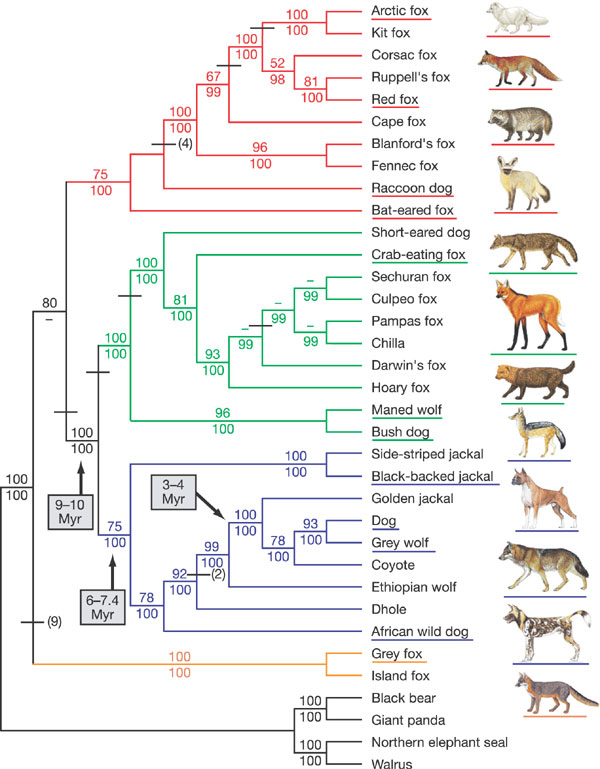
According to analysis revealed from sequencing the dog genome, domestic dogs diverged from wolves about 27,000 years ago. The two populations are not reproductively isolated, and it is probably not wise to consider them separate species. Dogs can still interbreed with coyotes, golden jackals, and Ethiopian wolves, which is pretty amazing. Dogs and Ethiopian wolves last shared a comm ancestor 3-4 million years ago.
Polar bears and brown bears have continued to exchange genes throughout warming periods, but it was recently revealed that their lineages diverged 4 to 5 million years ago.
Now, we have two species of sea star that are reproductively isolated from each other, but they only diverged from each other 6,000 to 22,000 years ago.
The reason for this reproductive isolation has much more to do with the novel reproduction that hystera has evolved, which is not something one sees in vertebrates.
I bet that if hystera had no evolved this particular reproductive system, the two species would be able to interbreed.
Evolution can take some very bizarre turns. It has no direction.
But it can happen very rapidly.





I seem to remember the late great biogeographer / plant taxonomist
A.H. Gentry concluding that along the Andes Cordiliera, the average lifetime of a species is on the order of 10,000 yrs. I may be remembering the numbers wrong, and Gentry may have been wrong, but I’d be surprised if the concept is wrong. Sometimes evolution is very rapid. During times/sites of rapid speciation, 10,000 is not a long time, in evolutionary terms. It’s dynamic, though. Species lifetime may decline in periods/locations of rapid evolution.
I used to keep lake malawi cichlids. One species was isolated in one african lake and it evolved to fill every possible niche within that tiny enclosed world – and they are so beautiful.
Those cichlids from the African Great Lakes are some of the most rapidly speciating organisms ever discovered.
{What a great article you have written|Such a perfect story you have wrote|Perfect article you wrote}. {I love african cichlids|african cichlids are my favorite fish| I have 3 tanks of african cichlids}. {I also breed african cichlids| I have a african cichlid group you should join| I have a facebook group on african cichlid breeding you should join}.