
The likely ancestor of all extant species of Canis and probably the dhole and African wild dog is featured in this print.
The smaller canid featured here is Eucyon, a type of canid that lived in North America during the Late Miocene (10-5 million years ago). Eucyon is both the genus and common name for these canids, which weighed about 20 pounds.
Eucyon means “original dog,” and it believed that all the extant Canis and possible Canis species evolved from some sort Eucyon species around 6 million years ago.
The oldest extant Canis species is the black-backed jackal (C. meslmelas) of Southern and East Africa. Mitochondrial DNA studies suggest that it split off the Canis lineage between 2.5 and 4.5 million years ago.
I have seen depictions of Eucyons that show them looking a lot like black-backed jackals.
However, black-backed jackals are still quite derived from this ancestor, and from my reading of the literature, this depiction is more accurate. The morphology of this animal is believed to have been very similar to a crab-eating fox, which isn’t actually a fox.
For most of the dog family’s history on this planet,North America was the main center for their evolution. Canis came from North America and then spread throughout Eurasia and Africa. The dire wolf eventually colonized South America, and then through the domestic dog, the genus eventually spread virtually every else.
Yes. Dogs are much more American than any of us African great apes!





raccoon dogs are the oldest living dog species on this earth,,,,from my understanding,,,,paita
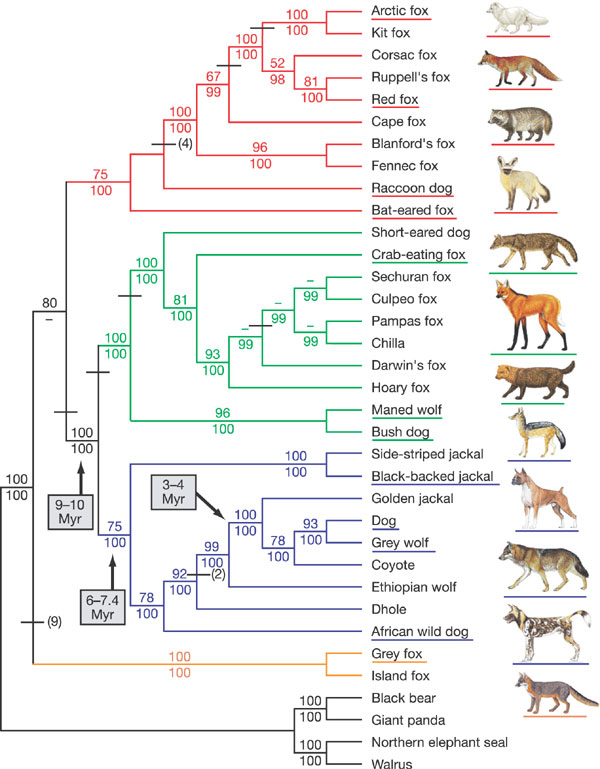
Actually, genomic evidence shows that the oldest species of dog is the gray fox, which shouldn’t even be called a fox.
There is a phylogenetic tree of the extant dog species that was drawn from sequencing the domestic dog’s genome: http://www.nature.com/nature/journal/v438/n7069/images/nature04338-f10.2.jpg
p.s. how do I leave a picture of them via attachment,or anyone else can,,,,look up raccoon dogs,,,noo there not a dog who hunts raccoons,,,sorry alot of people think this,,it is literally called,,,,a raccoon dog,,,,paita
There are coonhounds, which are called “coon dogs” in many areas.
I know the species you’re talking about.
You’re talking about Nyctereutes procyonoides–a species that has been discussed in this Blog before. (I have a shopka made from the pelt of one–bought it in the Urals.)
“Dogs are much more American than any of us African great apes!”
Yep, and yet we ended up evolving in symbiosis. As you know, I’ve often questioned our species’ taxonomic designator–Homo sapiens–since we so seldom show signs of wisdom. A much more accurate moniker might be Homo canis–recognizing the major role that dogs have played in the development of our species and its cultures.
I agree; people would not have evolved into people had it not been for our symbiosis with dogs.
This is another graphic tool that might have to be changed once the characterization of the Dingo genome is done. Will it turn out to be unique enough to have its own entry here, or will it end up falling under the ‘Dog” entry? Stay tuned for our next exciting exchange.
Oops, posted this in the wrong spot, it belongs w/ Scottie’s ref to the phylogenetic tree.
Interesting stuff, quick question.
Were direwolfs simply too big and slow to run down ”normal” prey which lead to their extinction?
Adam
It was so specialized to hunting megafauna, that when that megafauna became extint, it was not fast enough to hunt deer and elk like modern wolves are.
I suspect that its caloric needs were relatively high as well so it would have had to make kills more often, once the true megafauna were gone.
εύ in Greek does not mean “original”, but “good”.
Scientists actually do bastardize a lot of Greek, less so with Latin:
http://www.prehistoric-wildlife.com/species/e/eucyon.html
Eu normally means it’s a Greek loanword meaning good, but I don’t know why this animal is listed as “original dog.”
indeed I noticed that with some Greek words … very interesting as one can spend hours figuring out the true meaning of things.
one explanation could be that “eu” was used as in ‘proper’, the first species to resemble a dog proper, therefore the original ancestor of canis.
“eu” can also take the meaning of good-looking. So, eucyon = a more good – looking species that its predecessors ? (while lepto – as in leptocyon – means fine).
An amusing case is the Dusicyon which is explained as “the foolish dog” but it doesn’t mean that at all in Greek. I take it that dusi is a loan of the Greek δυσι- or, more properly, δυς – (so dyscyon would have been more correct) which means bad or ugly. Not foolish by any stretch of the imagination ….
I’d guess that biologists aren’t required to also be good linguists? ;^)