From the BBC’s Planet Earth series:
This is pretty famous footage, but I noticed in the sequence something that is worth exploring from evolutionary perspective.
Notice that when the fur seal catches the penguin, it uses a vigorous shaking motion to complete the dispatch.
It doesn’t kill the penguin quickly. In fact, the seal had tried to rip out its throat, that would be a much quicker way to kill the prey.
However, its very likely that the seal cannot make a choice as to the best way to kill the penguin.
Its killing motor pattern is likely inherited, and anyone who has a dog can recognize the sequence. Give a dog a toy to play with, and they very often exhibit a vigorous shaking pattern as they play with the object.
It’s a motor pattern that has to be trained out of most retrievers, but as a type, they tend to exhibit this motor pattern less often than other dogs, though there is quite a bit of variation within individuals.
In my short time with Pavel, the West Siberian laika, I noticed that his shaking motor pattern was quite vigorous compared to Miley’s. That’s because Pavel’s ancestors have never really been expected to bring prey to hand alive, while Miley’s certainly were. Indeed, Pavel’s ancestors had to kill sable and other fur-bearers and fight off bears and wolverines. Miley’s most immediate ancestors came from genteel shooting estates from Great Britain, where the biggest predatory mammal is the Eurasian badger.
This motor pattern is instinctive in dogs. It does serve a purpose whenever one sees a dog catch a smaller mammal or a bird. A few vigorous shakes usually breaks the neck of the quarry, and it then can be eaten.
This same motor pattern also exists in bears, and when one reads of a grizzly bear attack, the victims often experience violent shaking in the bear’s jaws.
Because this behavior exists in dogs and bears, one can see why the Antarctic fur seals engage in it.
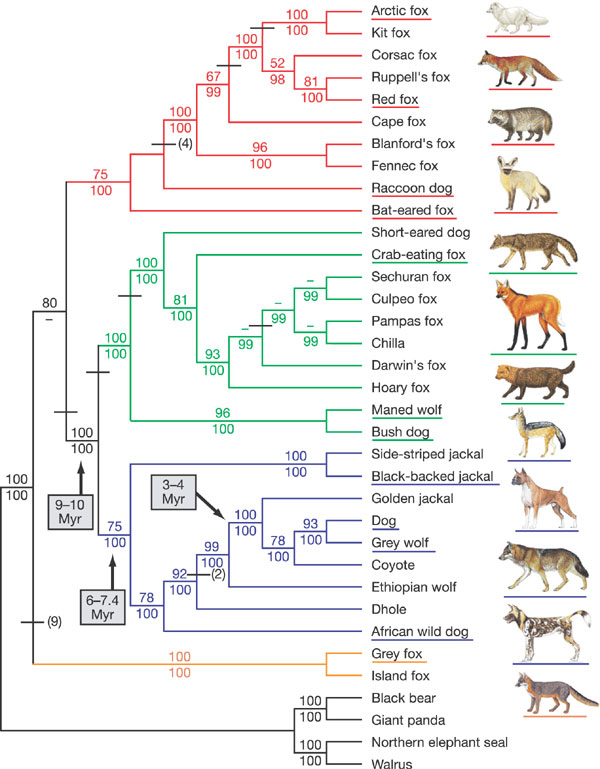
Within Carnivora, there are two major suborders– Feliformia and Caniformia. Bears, dogs, and seals (including true seals, the walrus, and the fur seal and seal lion family) form a clade.
That means they all share a common ancestor about 40 million years ago.
At that time, the dog and bear lineages diverged.
And then about 23 million years ago, the bear and seal, sea lion and fur seal, and walrus lineages diverged. Bears as we know them now didn’t evolve until about 20 million years ago, and the ancestor of the seals and other marine Carnivorans was actually something like an otter.
Fur seals are actually sea lion species, and Antarctic fur seals live almost exclusively on krill. They’ve likely been living on krill for thousands of years, and their ancestors have been living a marine existence for millions of years.
If this shaking motor pattern in Antarctic fur seals is inherited, as I think it likely is, then dog breeders who want to breed it out might have a task on their hands.
For thousands and thousands of generations, these seals have not needed this shaking behavior in order to survive, but when they engage in something similar to the predation of their terrestrial ancestors, they engage it.
I would like to see some comparative studies of this shaking motor pattern in different fur seal and sea lion population in order to see if this behavior actually is inherited.
But if it is, it is a wonderful example of an historical legacy.
A wonderful little piece of evidence for evolution.





I wonder if this would change if they had to live off penguins for several generations? Atm the penguin is just an occasional meal so effective killing isn’t really important. If the seals had to eat penguin to survive would the shake/kill disappear?
Adam
If they had to live on nothing but penguins, it definitely would change.
Apparently Leopard Seals seals shake Penguins right out of their hides*. Could Fur Seals be heading in the same direction?
(*See: http://www.coolantarctica.com/gallery/seals/antarctica_seals19.htm)
The shake and toss also disorients the prey, so that even if it does not sustain a broken neck, the predator has bought a few more seconds during which it has an opportunity to attack again, while the prey is still recovering its orientation.
Cats, weasels, and most other carnivores usually shake their prey too, and often toss it into the air in such a way that it flips several times, especially prey smaller than themselves that might easily escape if the first bite doesn’t kill it. The prey shake is fairly universal among carnivores & the reason it has survived in so many diverse creatures for so long is that it’s such an efficient predatory technique. If the prey animal’s neck is broken, it can’t fight back and potentially injure or kill the predator. If the prey’s neck isn’t broken right away, the few seconds of disorientation gives the predator a chance to safely get a better killing bite so that it hasn’t expended a lot of energy for no meal.
I’ve noticed that when a canid shakes a prey animal it serves two purposes. First the whiplash effect stuns the prey into submission, and secondly, the shaking keeps the prey animal’s teeth away from the predator.
I once had Blanco, a huge (130 lb.) malamute-shepherd cross who could kill the largest raccoons or woodchucks with ease. When he grabbed one of these animals, which can do considerable damage to a dog in a short amount of time, he would shake it powerfully, centrifugal force keeping the prey’s jaws away from his face. Once the prey was stunned, he would drop it, and then crush its rib cage by biting. It always seemed to be this crushing bite that actually killed the animal, though smaller animals such as muskrats were usually killed by the shaking alone.
All my dogs, whether my Irish wolfhounds, wolfhound-malamute crosses, malamute-wolf crosses, or my little Patterdale terrier kill their prey (mainly squirrels and rats or the occasional raccoon or opossum foolish enough to try to raid my pigeon lofts) this way: stun with fierce shaking, and then kill with a rib cage crushing bite.
You can see from the video that these seals are very ineffective predators of penguins, and it almost looks more like misdirected territorial aggression than true predator/prey behavior. Also, a seal would probably have to literally shake a penguin out of its hide, much like I believe orcas do seals, before it could eat one. If fur seals fed upon penguins with any regularity this would encourage whatever shaking behavior they inherited from a more terrestrial ancestor to continue, though now serving more than the original purpose.
Chickens also shake any lizard/small snake/mouse they catch.. Yes,chickens are predators. Too many people think they’re vegitarian.
I’ve noticed that when my chickens peck and shake a small snake or something too large to swallow like a big grasshopper, it appears to be part of the eating process. They’re trying to break off pieces small enough to swallow rather than actually kill their prey (though the effect is usually the same). They do the same thing with a leaf of lettuce too large to swallow whole. When my free-ranging American Game Bantam or Sumatra hens attack something like a rat or larger snake in defense of their chicks they grab it with their bills, lift it as far off the ground as they can, and jump into the air and kick it with their feet (which would also bring their spurs into play if they were roosters). So the ‘peck and shake’ behavior seen in chickens may be a different set of inherited instincts than the ‘grab and shake’ kill technique found in mammalian predators.
The kill-shake is still in retrievers — they just know when to use it, or not. A friend’s Golden was seen to dispatch an ornery possum with a single toss of her head; and one of mine killed a deluded groundhog that burrowed into the Golden’s pen. Not a mark on the ‘chuck when we found it, just a broken neck. Same Goldens retrieved birds as gently as anyone could have asked.
Agreed. My first Lab, when I lived in Central Pennsylvania, was skilled at killing ground hogs by shaking. Once she killed 16 in a single day. Most were small, but there were a few big old males. The kill took her only a few seconds, and she never got bitten. She never broke the skin, and often proudly carried one home. My present Labbies shake gophers (California pocket gopher)…but no instant kill. I think the gopher is too small, and too quick swiveling its head around and biting them, so they can’t get the right grasp on the neck.
A friend of mine who has a wolf-malamute from my weight-pulling line recently let her out of her big yard for a run before bringing her into the house for the night. She ran off into the darkness, and shortly returned with a dead opossum in her mouth. She dropped it at my friend’s feet as if giving him a gift, and he put her in the house. He then took a shovel and carried the dead opossum out to his blacktop driveway where he left it for disposal the next day.
The next morning he was confused to find the opossum gone, and asked me what I thought could have carried it off. I asked him if he thought the opossum could have just been “playing ‘possum”. A little confused, he said he’d never thought of that.
That makes me wonder what the true state of an opossum killed by the single toss of a golden retriever’s head might actually have been. Opossum are quite tough and can take a beating; but when people or dogs mistakenly think an opossum is dead, that opossum often lives to see another day. :)
The ‘possum I mentioned yesterday was most certifiably dead and not “playing possum”, although we are familiar with that behavior. A few years ago, one of my Goldens presented me with a limp body; she dropped it on command, and we studied the furry carcass for signs of life. One beady eye opened cautiously, saw us and slammed shut. I picked it up on a shovel and tossed it over the fence. A short time later, it had disappeared.
This same Golden also liked to catch and retrieve snakes, which I duly accepted and returned to the environment. She never harmed them, Fortunately, none were venomous!
Your story reminds me of a shepherd I had who would kill every possum she could find. She would even climb into low branches of trees to get her possums. She never put a mark on them but by the time she finished shaking them and then judiciously crunching them, they were as dead as dead gets. They felt like furry, usually somewhat wet, bags of jello.
Whatever the reason for the shaking, it clearly has one or more evolutionary advantages.
It does seem to be hard wired in doemstic dogs, I often retrain dogs who hunt/kill inappopriate prey items, often these prey items are quite large (deer or sheep) however there owners often describe the dog as using the head shake when it got to grips with the prey and not tearing the throat.
Not always though, some dogs seem to have a natural throat tear with large prey. Also the more experienced dogs often learn the throat tear.
I find this sort of predatory behaviour relatively easy to fix, in that I teach the dog not to run afetr the prey animal so the dog simply never gets close enough to kill it!
I suspect if I was training dogs to retrieve stuff without the shake it would take longer as the behaviour is more installed. Obviously breeds selected to not have this trait would be better.
Adam
Additional point, there does seem to be breed differances with the shake v tear method of killing.
Adam
that’s exactly the technique used by our shihtzu to punish her collection of squeaky toys.