
When it comes to predators, we like to think that it’s the large predators that dominate the landscape.
And where they still exist, they are quite impressive.
But the world that now exists is not necessarily friendly to these larger meat-eaters. Indeed, if you look up the population stats of virtually every terrestrial carnivoran that weighs over 100 pounds, you will find that almost all of them are in decline.
The world is so much nicer for the little ones.
Where once the Holarctic wolf pretty much ran over the entire Holarctic, the most common wild dog roaming its former range is the red fox*,
Red foxes, unlike wolves, really do well in a world dominated by modern civilization. A red fox can be a bit of a problem with poultry, and they do take a few lambs. But unless you have sheep or free range poultry, the worst red foxes can do to you is give your dog mange.
Wolves need large game meat in their diet. There is no way of getting around it. They have to kill large ungulates to survive, and we humans value our domestic ungulates almost beyond all reason.
To be able to kill such large quarry, wolves have evolved fairly large size, which varies with the subspecies, powerful jaws, and fairly large brains that require consuming lots of red meat to maintain.
Even when meat is easily accessible, wolves have ways of maintaining their populations. They live in territories. They have social suppression of estrus and behavioral mechanisms that prevent every bitch wolf from producing a litter every season.
Red foxes don’t rely upon meat alone. They are quite omnivorous, consuming everything from fruit to earthworms, but they can do very well without ever killing anything larger than a rabbit.
The fortunes of these two species have sort of been a yin and yang. As our species has become more technologically advanced, we’ve been able to push wolves out of the best possible habitat, and we’ve created a paradise for red foxes, where there are plenty of rodents and lots of garbage to sustain them. And we’ve killed off all the things that like to kill them, like wolves.
The red fox is what we would call the quintessential mesopredator. A mesopredator is an animal that hunts for much of its food, but in “normal” circumstances, it has to worry about larger predators killing it. Because of ti has had to worry about predation from other predators, this species will tend to have reproductive capabilities that are far greater than any of its larger enemies.
So when you remove the larger predator, the smaller predator’s population expands unchecked, causing knock-off effects in the ecosystem, where the small quarry that the mesopredator hunts winds up with much more pressure than it normally would have.
So in the case of red foxes, ground-nesting birds would be the ones to experience distress.
This is called “mesopredator release.” and it’s an idea that ecologists are studying with more and more interest.
In the Old World, the red fox and the wolf are in a dualistic, mutually exclusive situation.
In North America, the fall the wolf has not been followed by dualism.
It’s been followed by synthesis.
When Europeans came into this continent, there were plenty of wolves and plenty of coyotes. We killed both without every really paying attention to what we were looking at, and because we weren’t paying attention, it’s actually pretty hard to estimate where coyotes were originally found.
Generally, it’s believed they lived in the Western half of the continent, from the Prairie Provinces of Canada to about Nicaragua.
We killed the coyotes the same way we killed wolves. We used all sorts poisons, traps, and hunting dogs, Wolf numbers fell in the Lower 48.
Coyote numbers expanded.
The reason why is that coyotes are a mesopredator. Coyotes evolved on this continent with all sorts of really impressive carnivorans, including things like American lions, Smilodon cats, jaguars, and dire wolves. Like the red fox of the Old World, it had to be able to rebuild its numbers fairly quickly
So when coyotes were taken with the wolves, the wolves’ social behavior and reproductive physiology prevented them from recovering. And the coyotes were able replace those missing numbers rapidly, and because they no longer had to worry about wolves, they were able to expand into new territories. Their range today includes every province in Canada, including Prince Edward Island and the island of Newfoundland. They are found in all the states of the United States but Hawaii– they just can’t swim that well. And they are from from Alaska to Panama– almost the entire North American continent.
The story of coyotes appears to follow that of the red fox, but there is a twist.
Coyotes come from a lineage of dogs in which nearly every species has been seen engaging in cooperative hunting behavior. Because they are larger than red foxes, they can take fairly large prey if they work together.
But they don’t actually have to do this in order to survive. They can live nicely on rabbits and rodents. They’ll happily eat garbage with the raccoons and eat fallen apples in abandoned orchards.
And they are just the right size that they don’t have to kill large ungulates to survive, but they are also of the right size where they could hunt ungulates if they wanted to.
They are also just the right size to where most other predators won’t kill them. It’s true that cougars do kill coyotes, but in most of the US and Canada, they are the top dog. They only predators they would have are people.
Evolution also gave coyotes an advantage that red foxes never could have experienced. Coyotes have not lost chemical interfertility with wolves or domestic dogs (domesticated wolves). This means that some coyote populations have been able access some new characteristics that aid them in this new lifestyle. Coyotes hybridized with wolves in Eastern Canada, which gave them larger jaws and teeth to assist in the pursuit of deer, and domestic dogs have introduced all sorts of weird phenotypes– and maybe some new immune system genes too..
A true generalist sort of canid has taken over North America.
This development should not be a surprise. More derived and specialized forms tend to be more vulnerable then primitive generalists.
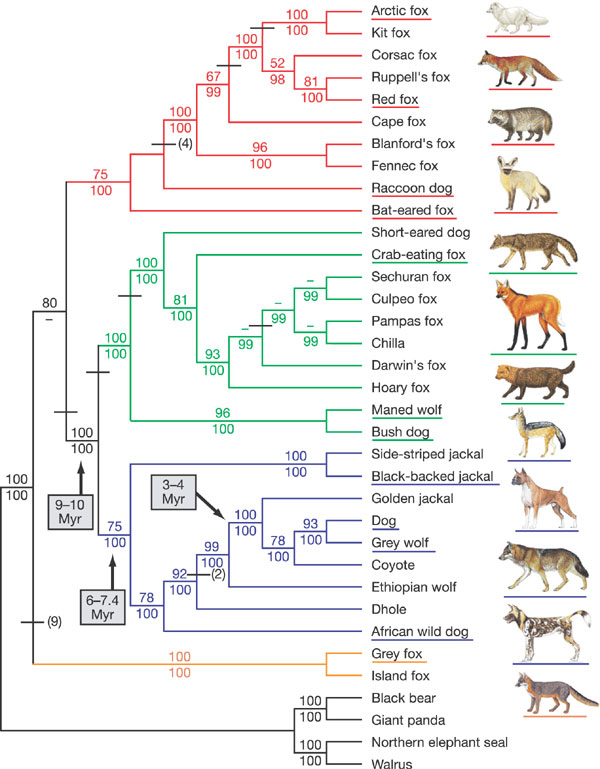
And the best way to think of coyotes is they represent a primitive lineage of wolf. The ancestor of all wolves was something like a coyote that wound up developing specializations for hunting large game in cooperative family units.
But the coyote in North America retained the basic “template” that allowed Canis dogs to spread throughout the Old World.
And as we’re now seeing, this template– with a few tweaks introduced through hybridization– has produced a species that can thrive in just about every environment that can found on this continent.
Including major urban centers, like New York, Los Angeles, and Chicago.
The North American superwolf is not a giant fell beast of the Pleistocene.
It’s the mid-sized dog that lurks in the shadows, living by its wits and keen senses and its most catholic diet.
It is wolf enough to hunt large quarry and fox enough to eat mice.





Nice one.
The picture looks manipulated to me. The face looks smaller than it should be judging from the size of the head and ears.
That said, once humans become extinct and most dogs die out with them, and the Eastern coyote population stabilizes into a new species, what should this new canid species be called? Neither fully Canis latrans nor Canis lupus, as a survivor I suggest the name Canis supervivens.
We have coyotes in the city of Providence, as well as raccoons. Providence has one of the densest populations in the country, but it also has some extant woodlands & cemeteries, so wild animals exist here, as well as in the rural areas. One of my dogs got skunked in my back yard, which was very small, and the coyotes feast on domestic cats let out for the night. They also kill pupppies and small dogs.