“The worst cross the author ever made was with Zelstone. Although not a large dog, he was said to be a pure bred Newfoundland. He was a flat-coated retriever Champion, and may have been himself a good worker ; but he ruined the working qualities of the descendants of Jenny above mentioned, and brought the author’s strain of them to an end. Consequently, it is suggested that the Newfoundland is the type to breed out of the flat coats. ”
–George Teasdale Teasedale-Buckell, The Complete English Shot (1907)
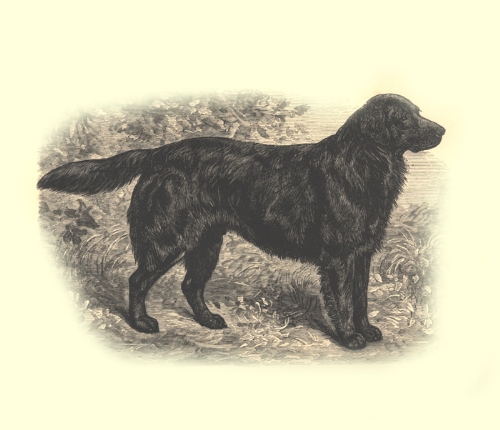
Zelstone
“Zelstone” also appears in the Guisachan kennel records as an outcross, although he’s listed as Labrador in those documents. However, this description makes sense because Labrador and Newfoundland for this type of dog were often used interchangeably. Interestingly, a dog of this breeding could also be called a flat-coat or wavy coat at this time and used in breeding with retrievers. The registries were that open in those days.
Below is a depiction of a St. John’s water dog with long hair and retrievery features. This dog was listed as a Labrador, despite its long hair. Again, this classification is in keeping with the interchangeable terms of Labrador and Newfoundland, as well as the fact that dogs called Labradors or Newfoundlands could also be called wavy-coated or flat-coated retrievers. This dog is similar to Zelstone, but it has much more coat, which one would not expect. All St. John’s water dogs are supposedly short-haired, like a Labrador, or so the Labrador historians would have us believe. Of course, this assertion is nonsense.

Zelstone, however, does not appear to be as cumbersome as the author suggests his progeny were. This dog actually looks like a nice, big retriever with good working conformation, especially if I were interested in using this dog for retrieving big birds from cold water. Perhaps it is Zelstone’s influence that turned out a large number of big red dogs that lived at Guisachan during the 1880’s and 1890’s. It is possibly that he was carrying genes for even more cobby and coarse dogs than one would have expected.
You can see them in this photograph of Guisachan’s retrievers and pointers :

The Tweedmouth retrievers are on the left, with one light colored one lying in the middle. The dog you can see most clearly is on the far left, and it looks like a red Newf. Dogs of this type can be seen in the US pet golden population, such as this heroic one.
But these big dogs were soon bred out, as Mr. Teasdale-Buckell hoped. The dogs were too heavy to be useful in field trials, which were gaining in popularilty. The lightly built, newly standardized flat-coat would dominate retriever trials for nearly a quarter century. These dogs would provide the basis of the golden retriever breed when it was separated from the flat-coat.
Unfortunately, the big dogs have made a reappearance. First they popped up in the Lab, and have now become common in the golden. A friend of mine has a golden that is 30 inches at the shoulder and 125 pounds. (Yes, he has bad hips). He was not selected for this size, either, for his sire was only 75 or 80 poundsand 25 inches at the shoulder, and his dam was the same size, which is a bit big for a golden bitch but not giant.
These big, blocky goldens are throwbacks to Zelstone. A dog that early retriever fanciers may have loved for his working ability but later cursed when he introduced too much lumber and size into his progeny.




[…] retriever was recognized as a separate variety of retriever. Mr. Shirley is also the owner of Zelstone, a dog that was probably a purebred St. John’s water dog but was registered as a flat-coat or […]
[…] were called Newfoundlands. Some of the smaller dogs had long hair as you can see in my post about Zelstone, who was a long-haired St. John’s water dog that is called a “Newfoundland” in […]
[…] Ignoring that the very light color is really a recent phenomenon, I still would have nothing against them. My problems with these strains is that they have very poor working conformation. Although I have said it before, none of the serious early trialers of flat-coated/golden retrievers (which were the same breed) wanted a lot of cobbiness or lumber in the dogs. Mrs. Charlesworth, one of the founders of the breed and breeder of the Noranby dogs, purposefully bred out lumber in her dogs, even refusing to breed from Noranby Tweedlum because he was too light in color and too coarsely built, even though he was an excellent gun dog. At that time, they were all learning from what happened when Zelstone became a major sire in the breed. Zelstone introduced a great deal of lumber into the dogs. He was a good gun dog, but his progeny were not. (You can read more about this founding sire of both flat-coats and goldens here.) […]
My dog looks just like a flat-coated retriever. She is a Golden-Newf. There was a picture in a book about dogs and in the section on Golden Retrievers it showed a black Flat-coated Retriever(The Ultimate Dog Book, by David Taylor). We thought our dog looks very much like that dog too. Our dog has beautiful. I use to breed Golden Retrievers and lost my oldest and was very attached, so I went with something a little different. Our Black Golden-Newf seems to have all the good qualities from both breeds. I had a feeling that the newfoundland was in there somewhere long ago, when I saw a picture of the black Flat-coated Retriever. I am very interested in the back round of these dogs. Thank you for sharing this information.
When I made that post, I should have pointed out that the terms “Newfoundland” and “Labrador” were widely interchangeable when Zelstone lived. We know nothing of his pedigree, but we do know that the Duke of Buccleuch, one of the founders of the Labrador retriever, was importing dogs from Newfoundland at this time (1880’s). He may have passed up a long-haired St. John’s water dog in the imports and sold it to dealers who then sold him to Sewallis Shirley, one of the founders of the flat-coat as a show dog and founding president of the Kennel Club (of Great Britain). Zelstone may have had characteristics of both the short-haired “Newfoundland” or St. John’s water dog and may have had gene that were from the larger Newfoundland in him as well. I do know that a friend of ours has a field golden that he uses as a hunting dog and for stud. The dog is a classic field type– 75 pounds, red, with very moderate bone and modest feathering. Several of his puppies, however, have matured rather large, even out of normal sized dams. One I know is 30 inches at the shoulder and weighs 125 pounds! This particular dog is too big to be a useful grouse dog, which he isn’t, but it shows that the Newfoundland-type has always been there. This is the largest golden I’ve ever seen. He looks just like a giant version of his sire. As near as I can tell, he’s purebred.
[…] perhaps the result of breeding short and long-haired dogs of this type together. (See my post on Zelstone to see two St. John’s water dog’s with long […]
[…] about Zelstone and why flat-coats and goldens, which are both descended from him, originally had the bone bred […]
[…] the big Newfoundlands were also used as retrievers. The most enigmatic dog of this type was Zelstone, who may have been Newfoundland or St. John’s water dog but was registered as a wavy or […]
Zelstone himself was not used in the Tweedmouth breeding program. Related dogs Ch. Moonstone and Tracer were used. Moonstone sired a litter out of Guinea in 1885, and Tracer was bred to Gill for a litter in 1887.
Tracer x Gill produced 10 black pups. One, Queenie, was bred to Nous II (Jack x Zoe) and in 1889 produced Prim and Rose, the last two yellow retrievers listed in the Guisachan record book.
Tracer was his son, from my understanding. I’ve done more research on this post.
Zelstone was derived from an import. He was probably half St. John’s water dog or the big Newfoundland.
One cannot also discount the Tweed Water for adding blood.
Moonstone carried the gene for red to yellow.
When he was bred to his dam (named “Think”), there was a reddish gold puppy produced named Foxcote.
I believe that’s why Tracer was used. Tracer was Moonstone’s full brother, and there was hope that he might introduce be a way of introducing newer blood and increasing the chance of producing the gold color.
It’s interesting that some of these dogs including “Nous” all have names relating to their intelligence.
Part of the pedigree is here: http://www.countrysportsandcountrylife.com/sections/gundogs/GoldenRetriever.htm
Moonstone was very important in the development of the flat-coat. The Marjoribankses were breeding the best stock they could find into their lines– even if the dogs were black.
The lines that are black wavy-coats are mostly S.E. Shirley’s breeding.
That’s the founding president of the KC.
It has been scientifically proven and DNA checked that Labs carry a recessive gene for long hair aand even a short hair lab has a 50% chance to pass on a long coat gene to its litter.
It does exist, but it very rare. Almost no Labs carry it.
https://retrieverman.net/2011/08/03/do-labradors-come-in-long-hair/