These are sphynx kittens. It only through looking at hairless domestic cat kittens that once gets an idea of how large cat eyes are. They bulge out quite a bit through their sealed lids.
Posted in West Virginia, tagged agrarian economy, industrial middle class, industrialism, postwar economic boom on December 23, 2010 |
7 Comments »
One the features that Miley and I pass regularly on our walks is the bizarre forest junkyard. It is really strange to come across several rusting old cars in the middle of maturing hardwood forest.
In the late 60’s or early 70’s, some guy parked in the middle of what was then a disused pasture that local family had used for generation to graze their dairy cattle. With no cattle being turned out onto the property, he found it a good place to abandon them.
And when pastures are no longer grazed or mowed, the forest gradually returned. Decade after decade, the shrubs have given away to saplings and saplings have grown into tall trees, choking out the undergrowth and leaving the rusty artifacts displayed upon the forest floor.
These old cars remind that things are always changing.
Their final resting place was once a vibrant pasture for dairy cattle. At one time, the agrarian economy flourished here. Big farm families manged to eke out an existence on ridgetop farms, cutting hay with scythes and pitching into stacks. They were all locavores, canning the produce from their gardens and butchering their own cattle and hogs for meat.
But more efficient agricultural practices and the development of the interstate highway system put an end to that agrarianism. It became cheaper to buy food with origins in Iowa or California than to raise one’s own food on these little ridgetop farms.
And the call of industry lured so many farm family away from those ridges. The postwar economic boom meant that the factories needed more workers. And the unionized auto plants were the ticket out of poverty in the hill and into the growing industrial middle class.
It was in that period after the war that West Virginia’s population dropped. Everyone ran to places like Cleveland or Detroit, where the wages and benefits were good. And the supermarkets kept you fed.
As the farmers left, the vast array of pastures and cornfields that had been cleaved from that ancient forest in the eighteen and nineteenth centuries began to return to its original condition. The forests began to work their way back in.
Of course, things have a way of changing back. The census data was released this week, and Michigan was the only state that had a decline in population over the past decade. Michigan– the place were most of these cars were likely made and the place where so many poor families from the hills found their way to the American dream.
But just as these cars have rusted away into the forest, that industrial middle class has also fallen away. No longer can a poor boy from West Virginia run off to Detroit and seek his fortune in the auto plants.
These cars stand as a remind of what once was. There were once farmers who pastured their stock on the rugged ridges of West Vrginia, and there was once a burgeoning industrial middle class in the United States.
Both of those things have disappeared, as these car surely will as they sit deep in the woods through each passing decade.
These old cars tell us what once was.
Like monuments to their era, the cars take us back to a time so different from now.
Technology and trade take us down different paths, and how humans relate to the landscape changes with each new advancement.
As we continue on into an uncertain future, perhaps it is time to stop and think about the old cars for a bit. What story do they have to tell?
Evolution is a scientific theory. (What a scientific theory is. Evolution is not ‘just a theory” in the more common usage of the term).
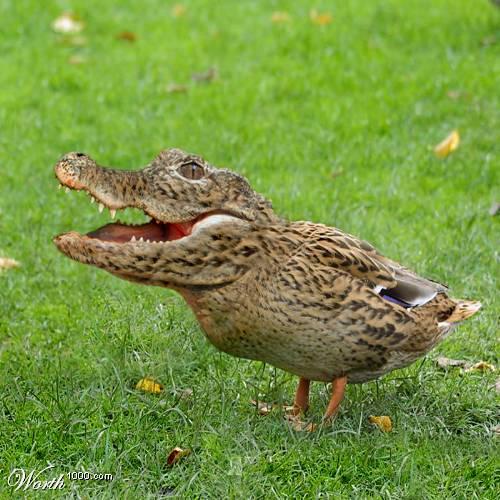
Do I have to explain why the crocoduck thing is such a red herring?
But I will have to say that some state senator in Oklahoma thinks this is valid evidence against evolution. He calls it a “phyla cross-over.” I believe this is a rectally derived term, which makes him sound a whole lot smarter than he actually is.
If one gets a good look at the crocoduck, I can say they made an error there. The crocodile head isn’t a crocodile. It is either an alligator or a caiman.
These dogs look nothing like anything I’ve seen or heard claimed to be Newfoundland dog or St. John’s water dog. The one on the right is the same color as a Landseer Newfoundland or a border collie.
They appear to have some Nordic extraction. Richard Lawrence, writing in The Complete Farrier and British Sportsman(1816), believed the ancestral water dogs were derived from the Greenland dog:
From which the water-spaniel originates, is a large animal, but not of general use. These dogs are exceedingly singular in their appearance, and have probably derived their origin from the Greenland-dog, blended with some particular English race. They are of different colours, but of the same shape and formation. The jet black, with white feet, stand the highest in estimation. The head is rather round, the nose short, the ears long, broad, and pendulous; the eyes full, and lively; the neck thick, and short; the shoulders broad; the legs straight; the hind-quarters round and firm; the pasterns strong, and dew-clawed; and the fore-feet long, but round, with the hair in natural short curls. During his puppyhood, this dog displays a strong inclination to be busy; he takes delight in removing shoes, boots, mops, brooms, pattens, &c. At this time he should be taught to fetch and carry sticks, or any other article which he is capable of retaining: also, to bring sticks, &c. out of waters of every depth and description. Instances are numerous of money, gloves, handkerchiefs, &c. being deposited under stones, or in hollow trees before dogs of this description, and after walking a mile or two, they have been ordered to return for the articles, and have faithfully brought them back (405).
Maybe not the Greenland dog, but the so-called Labrador husky, the indigenous sled dog of Labrador, or the Qimmiq (Canadian Eskimo dog) could have been a source for this conformation.
Collie-types could have also helped produce dogs like these.
This depiction just shows how diverse the greater Newfoundland/St. John’s water dog type was on its ancestral island. It was a true landrace in every sense of the word.