Posted in domestic animals, wildlife, tagged golden hamster, Romanian hamster, Syrian hamster on January 25, 2015 |
2 Comments »
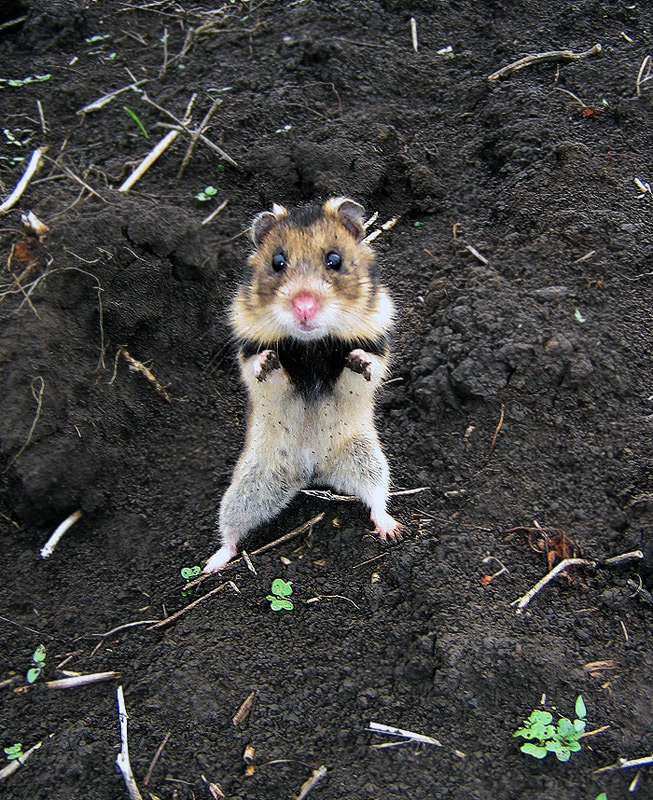
This fell-looking beast is a Romanian hamster (Mesocricetus newtoni). It’s a close relative of the golden hamster (Mesocricetus auratus) that we know so well from the pet trade. They are in the same genus, and they have been hybridized in captivity.
This species is found in southern Romania and Bulgaria and is found in uncultivated grassland. The golden or Syrian hamster is found almost exclusively in wheatfields in northern Syria and southern Turkey. It has even been suggested that the golden hamster has evolved to live in cultivated fields in much the same way domestic animals have evolved to live with us.
Of course, we really don’t know. Golden hamsters are quite uncommon in the wild, and they were when they were first described to science in the 1930’s.
It may be that there is something with modern agricultural practices that makes these hamsters incompatible with agriculture.
So here we have two species evolving to live very different lives. One is a creature of the cultivated field, while the other is that of the wild grassland.
Strangely, we know next to nothing about the golden hamster in the wild, and it happens to be located in area that I would not recommend anyone visiting right now– for any reason. You might get carried away and lose your head!
But the Romanian species can be studied now. There were attempts to make it a model laboratory animal like its Syrian cousin, but it proved harder to breed. We might be able to get some insights about wild hamster behavior from this species, even though it’s not at all the same animal as the familiar pet.
The golden hamster, by contrast, was very easy to breed in captivity, even though it’s an unusually inbred population. With the exception of some strains that were founded by wild-caught individuals in the 1990’s, all of the golden hamsters available at pet shops are derived from three survivors of a litter captured at Aleppo in 1930.
These animals appear to be super-domesticated, but as someone who used to breed hamsters, I can tell you they aren’t that far removed from wild animals. They readily escape their enclosures, and I never had one that didn’t bite me at least once.
Because of the geopolitical issues in the golden hamster’s range, it is very unlikely that we’re going to get new hamster blood or garner more knowledge about their behavior in the wild– at least in the near future.
There are so many questions, but maybe through the study of the European cousin, we might get some answers.
And some more questions to ask.