Feeds:

Archive for the ‘Extinct’ Category

Thylacine pelt?

Here’s story that is right out of Antiques Road Show:

Bill Warren of Fallbrook, California, purchased a unusual pelt for $5.

After doing some research online, he thinks it is a thylacine pelt, which isvalued at around $70,000.

But he can’t sell it out of state because of federal law that bans he sale of endangered species.

Which is very strange, because this species is “officially extinct.”

The original owner purchased the skin 30 years ago in Boston, but no one had really thought it might be something unique.

However, I hate to be a naysayer here, but Loren Coleman  at Cryptomundo thinks we should another possiblity– the zebra duiker:

Zebra duikers are small antelopes native to Liberia and Cote d’Ivoire in West Africa.

Liberia historically has had close connections to the US. 1822. the American Colonization Society brought free African Americans to Liberia to settle in West Africa. Although Liberia has been a free nation since 1847, it has always had close connections to the United States.

It would make sense that a skin of a zebra duiker would make it to Boston. Boston is a major port, and its community would have included various sorts of people who would have traveled to Liberia, be they industrialists, missionaries, or just good, old-fashioned academics.

It would make more sense that a zebra duiker pelt would be in Boston garage sale than a thylacine.

Anyway, we won’t know until more sophisticated analysis of the pelt is performed.

But my hunch is it is a zebra duiker.

Read Full Post »

In Prehistoric Colorado, Pig Eats You

Source

This animal has the perfect Hollywood name– “Teminator pig.”

I can see a bad movie made about these animals.

Maybe they aren’t extinct after all…

It’s even scarier than giant carnivorous rabbits.

Read Full Post »

A horse with claws

Moropus elatus

The animal in question is Moropus elatus.

It was an odd-toed ungulate (the order Perissodactyla). It was related to horses, rhinos, and tapirs.

But  unlike those animals, Moropus had claws:

Moropus was part of a family of odd-toed ungulates called Chalicotheres (“gravel beasts”).

They could use their claws to grab foliage and bring it closer to their mouths.

Morupus did not have the most extreme feet in its family.

Some members actually walked on their knuckles in a very gorilla-like manner.

They could use these specialized hands to grab branches in a very similar fashion to the way pandas grip bamboo.

Read Full Post »

Extinct wild dog

Can you ID it?

Epicyon.

Read Full Post »

Another breed with lots of symbolism

Farewell to the Highlands, farewell to the North,
The birth-place of Valour, the country of Worth;
Wherever I wander, wherever I rove,
The hills of the Highlands for ever I love.

My heart’s in the Highlands, my heart is not here;
My heart’s in the Highlands a-chasing the deer;
A-chasing the wild-deer, and following the roe,
My heart’s in the Highlands wherever I go.

Farewell to the mountains high covered with snow;
Farewell to the straths and green valleys below;
Farewell to the forests and wild-hanging woods;
Farewell to the torrents and loud-pouring floods.

My heart’s in the Highlands, my heart is not here;
My heart’s in the Highlands a-chasing the deer;
A-chasing the wild-deer, and following the roe,
My heart’s in the Highlands wherever I go.

–Robert Burns “My Heart’s in the Highlands.”

In the early to mid-nineteenth century, Scotland experienced a kind of land rush.  As the clan system fell apart, many Scottish tenant farmers were driven off the land. Many moved to other parts of the empire, especially Canada.  Scotland was thought of as a backward place. Then Sir Walter Scott gave it a total image makeover. It became a place of where Britain’s former wildness held on. Totally enthralled by Romanticism, various people of the upper classes sought out estates in the highlands, where they could spend their days basking in Scotland’s former glory. Never mind that the Highlands were not always such an empty, desolate place.  They were now.

Scotland itself does not have a national dog in the same way that England does. It is true that most people associate the collie with the Scottish agricultural scene. If I were to ask you about a breed that came from Scotland, I bet you’d think of the rough collie.

However, the collie was a commoner’s dog. It was the animal that the tenant farmers, or crofters, kept to maintain the flocks that belonged to the clan chieftains.  The height of its glory came a little later. By the end of the nineteenth century, the collie became the Scottish dog.

But during this earlier period, I’ll submit that the dog that most symbolized what Scotland represented to these moneyed Romantics was the Scottish deerhound.

After all, most of these people had come to Scotland to set up estates for outdoor sport. Shooting grouse on the moors certainly was the main activity for many estates. Remember that the golden retriever was developed to work the grouse moors.

However, the real sport of a proper Scottish noble was deer stalking. Deer stalking is to Scotland what foxhunting was to England.

Scotland is still known for its large herds of red deer.  To hunt such an animal, one needed a good, stout coursing dog.

And Scotland already had one. Its “rough-haired greyhound” had been coursing deer and wolves for centuries. The legendary last wolf of Scotland was said to have been killed in 1743 by a hunter named MacQueen. MacQueen’s dogs caught the wolf. Although the one that first gripped the creature was his longdog (probably a greyhound/deerhound cross), we can imagine that some of his hounds were “pure” Scottish deerhounds.

Killing off the wolf meant that the wild country had finally been tamed for more civilized pursuits. However, it was still wilder than England or Wales (or anywhere in Ireland.)

And to purchase an estate was to bask in that former glory.

To stalk deer was to bask in the former glory of the Scottish clan chieftains.

This symbolism explains why there are so many paintings of Scottish deerhounds. One of the photos of Nous, the foundational stud dog of the Guisachan line, also includes a deerhound. There is also this painting of Robin, one of Lord Ilchester’s dogs from the Guisachan line, that also included the deerhound.

If one wants to really see the extent of the deerhound’s popularity on those estates, one merely has to go to Google images and search “deerhound paintings.”

The volume is quite high. One can find so many depictions of deerhounds, including portraits of those that are in the now defunct fawn coloration.

Because the deer on these Highland estates were hunted with firearms, one wonders what utility a coursing dog could actually have.

Stonehenge grouped the deerhound with the retrievers. The reason for this classification is that when shot, the deer stalker would send his deerhounds after their quarry, and, in a similar fashion to a retriever, they would catch it.

That is not the most efficient way to hunt deer with firearms. If one knows anything about hunting deer, the absolute worst thing one can do if you wound one is to make it run. A mortally wounded deer will literally run and run until it collapses. For proper Victorians with a strong sense of sportsmanship, I doubt that this was ever the preferred way to hunt deer.

The more expedient way to hunt them was and is to shoot them and then track them. A dog could be used in this case, and the bloodhound would have been perfect for it. The bloodhound was common enough on these Scottish estates for that very purpose.

However, it had none of the symbolism and romance of the deerhound.

The deerhound’s symbol as the dog of the clan chieftains meant that no Highland estate was complete without one. Guisachan had its share of deerhounds.

Deerhounds are pretty docile dogs, as one could expect from any British sighthound. They also like to lie around the house in very regal positions.

Such animals would have been perfect for these nobles, who were very image conscious. The dogs become fixtures of the house as much as anything else.

One never needed to use the dogs to bring down deer. One merely needed to have them.

The images of Scotland and its deerhounds that were so popularized by Sir Walter Scott were very potent symbols. Those symbols meant that people would buy land in Scotland and own a dog whose job had essentially been ended with the advent of accurate firearms.

Of course, deerhounds proved to be excellent coursing dogs. They proved to be excellent hunting dogs on the American frontier, in the Australian outback, and in the wilds of Africa.

But as deer stalkers in the Scottish Highlands, their original utility shifted. They became symbolic of the Scotland that lived in the imaginations of certain wealthy people.

The deerhound became mythic.

And when those symbols no longer sustained it, the population of deerhounds crashed.  The dogs still exist, and some still hunt quarry today.

But these animals are very rare.

It is actually quite a shame for the deerhound breed is known for its docile nature and its high adaptability to urban life.

But most people have never even heard of them.

The dog no longer has symbolism.

Scotland has had moments of nationalism in recent years. There have been swells of support for the Scottish nation to have its independence from the United Kingdom (and thus make what I would call the “Untied Kingdom.”)

I have seen no moves by those advocates of Scottish independence to use the deerhound as symbol. I would have thought they would have, simply because of the breed’s connection with Scottish history and culture.

Maybe the similarities between this breed and the Irish wolfhound, which is erroneously called the national dog of Ireland, prevent them from using this breed as a symbol. Maybe its connection with the nobility prevent the animal from being used as a popular symbol. Or perhaps because it was used to dispatch deer and wolves that an animal rights-conscious polity cannot use them in this fashion. (I seriously doubt that England could ever use the foxhound as a national symbol for this very purpose.)

The deerhound looms so large in Scotland’s history that I cannot think of a single breed that represents that nation so well. It is the dog that coursed the Scottish red deer that Robert Burns wrote about stalking in his poems. It is the dog that the clan chieftains kept and celebrated through the centuries. It is truly the dog of Caledonia.

Our species organizes the world through symbols. This has affected the evolution of so many dogs, for even without consciously thinking it, we allow allow dogs to represent things.

The fate of the deerhound shows that we still have to be careful about how we choose those symbols. At some point, the symbols may no longer sustain the breed or type.

And that’s when breeds become stagnant, then rare, and then extinct.

The dogs that will last through the ages are those that can be redefined through different symbols. That is the trick for preventing breed and type extinction.

Read Full Post »

Leviathan lived

Canst thou draw out leviathan with an hook? or his tongue with a cord which thou lettest down?

Job 41:1

We all know about sperm whales. They are creatures that pop up in our legends and myths. They have appeared in great works of literature, and we already have a popular concept of what these animals are.

There are three modern species.

The cachalot or the common sperm whale (Physeter macrocephalus) is the one most think of when considering these toothed whales. It is a relatively large whale, reaching lengths in excess of 65 feet. It is known for having the largest brain of any living mammal, and it is also known diving to great depths to grapple with giant squid, its main prey source.

The common sperm whale is the largest predator on earth. The great rorquals, such as the fin and blue whale, are quite a bit larger, but they are not considered true predators. They are filter feeders, who rely upon the baleen in their mouths to strain out tiny fish and krill for sustenance.

The cachalot has large, pointed teeth, which the whalers once collected and used to make scrimshaw.  The whales were killed for their blubber, which was used to make train oil.

In the heads of these whales is an organ that produces a white, waxy substance. When the whalers would kill one of these whales, they would come across this substance and assumed that it was the whale’s semen. The term for this substance is spermaceti (“sperm of the whale”) because this really poor understanding of whale anatomy. It was later found to have several industrial properties. It could be used to make candles and industrial lubricants. It could also be used to make cosmetics, ointments, and cerates.

It was a wonder of a substance for its time.

We also know sperm whales from Herman Melville’s Moby Dick, which is partly based upon a true story of a bull sperm whale that rammed a whaling ship in the South Pacific.  Bulls are known to be quite protective of their cows, and it is not an urban legend that they might ram a ship to in defense of their females.

Such was the fate of the whaler known as The Essex. It was sunk when a bull sperm whale rammed it, and the whalers had to escape in their smaller whale chasing boats across the South Pacific.  A really good account can be found in this book. Let’s just say that the story includes cannibalism, including sucking the marrow out of another human’s bones.

Herman Melville liked the story so much that he used part of it as the basis for his narrative. Of course, Melville would have heard other stories of bull sperm whales whose aggression towards whalers had become something of legend. (One of these was called “Mocha Dick,”  if that means anything.)

Most people are familiar with this sperm whale.

However, there are two other species that are quite a bit smaller. These are the two whales in the genus Kogia– the dwarf and the pygmy sperm whales. They are significantly smaller than the cachalot. They are both dolphin-sized creatures.  Like the common sperm whale, both of these creatures have spermaceti organs in their heads. Both also carry a reddish substance in their intestines. If they are spooked, they will release that substance. It is thought to be used in the same way as the octopus’s ink. The predator becomes confounded in the substance, allowing the little whale to escape.

I had an encounter with a dead pygmy sperm whale that washed up on the beach on the Outer Banks of North Carolina. I had been walking on the beach that morning, as was my normal custom. I saw this pinkish thing off in the distance, and people were stopping to look at it.

I thought nothing of it. I just kept on walking. I didn’t think anything of it. I generally keep my eyes on the birds that frequent the shore, and occasionally, I look out to see if any dolphins or porpoises are swimming just beyond the waves.

When I got closer, I realized it was a whale, and not only that, I knew what it was.

It was dead, but it had not been dead long enough to really start decaying. I could  clearly see its pink belly and blue-gray skin. I could see its brown eyes and its “false gills” behind its head. It had a gash on top of its head. It was likely the result of a run in with a boat propeller. Its hooked teeth were visible in its tiny lower jaw.

With teeth like that, it looked like some kind of monster.

A small crowd began to appear around the corpse.  Vultures of curiosity, I suppose.

I wish I hadn’t answered the question of its identity from someone standing nearby. As soon as my mouth opened, I appeared to be an expert. I am not one. I am not a marine biologist. (The scene was somewhat reminiscent of this).

But I saw my first sperm whale that day.

It wasn’t a big one, but it was something I had only read about or seen on television.

I suppose running into a putrid specimen on a hot, humid beach in North Carolina isn’t quite the same as seeing a real live one.

But it’s close.

Now, those were the facts I knew about sperm whales. They are pretty much just strange toothed whales.

Well, it turns out that there was one a large sperm whale that didn’t use its massive teeth and jaws to hunt squid.

There was once a real Leviathan.

The discovery was released yesterday in the journal Nature.

Fossilized jaws and most of a skull were found in the Peruvian desert. Also found were some massive teeth.

The researchers, who were led by Dr. Christian de Muizon, realized they had discovered something unusual. They had discovered a predatory form of sperm whale that did not live mostly on giant squid.

Even though it was about the same size as the modern sperm whale, this creature was like a giant orca; for instead of eating giant squid, its diet most likely consisted of other marine mammals, including other whales.

This whale was dated to 12 million years ago, and although it may be a bit speculative, it suggests that the common sperm whales evolved from a group of giant predatory whales that later became more specialized as the ecology changed.

It is now believed that 12 million years ago, the oceans were full of large prey species. It would have had to have been to support super predators like this whale and the Megalodon shark, which is also believed to have preyed on whales. Creatures like that need a lot of food sources that are the size of whales, and the oceans must have been beaten to a froth with the number of whale species that once lived there.

As the oceans lost their ability to support these large animals, the Megalodon became extinct and the big sperm whales evolved in to giant squid hunters.

The name for this newly discovered whale is quite literary. Its name is Leviathan melvillei. Leviathan– for the sea creature that is mentioned in the Book of Job.  Melvillei– for the author who created the image of  the fierce sperm whale in the public consciousness.

In fact,  I don’t think I’ve  come across a better scientific name than this one.

But I don’t think I’d want to draw out that creature with a hook.

I don’t think I’d like to meet it unless I was really well-armed.

Read Full Post »

The mystery cat

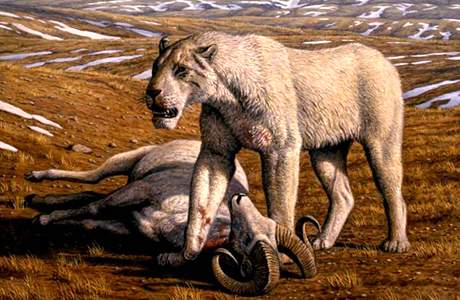
The answer to the question is Homotherium serum. It is also known as the “scimitar cat.”

Source.

It is not a Smilodon or an American lion (Panthera leo atrox).

The genera Smilodon and Homotherium are relatively closely related. They both are in the subfamily Machairodontinae.

Machairodonts were in the cat family. They were not pantherine cats, like tigers, lions, leopards, and jaguars. They were in their own subfamily.

It is incorrect to call members of the Smilodon genus “saber-toothed tigers,” even though that’s what the Flintstones called them.

You can tell that this particular cat is a Homotherium because of its prey. Dall sheep have always occurred in the northwestern part of the continent. Smilodon fatalis, a contemporary of both ancient Dall sheep and Homotherium serum, existed only the southern part of the North American continent. The two animals likely had an overlapping range, but they may or may not have been direct competitors. It is believed that the Homotheriums serum was a creature of higher latitudes and higher altitudes than Smilodon fatalis, kind of like how the modern bobcat inhabits warmer areas than the Canada lynx.

One of the hallmarks of Homotherium is that the forelegs are longer than the hind legs. It was also at least partially plantigrade, which is unlike any modern cat species.

The other identifying feature of this cat is the deepened lower jaw. Lions, including cave and American lions, and tigers don’t have this feature.

The Homotherium cats lasted until about 10,000 years ago in North America.

Traditionally, the cats are believed to have lasted in Eurasia until 30,000 years ago, but there is some evidence that they lasted in Britain until as recently as 11,000 to 13,000 years ago. (There is also a remarkable figurine in that post! It may give us some idea about what these cats looked like!)

Here’s a more modern depiction of the species– minus the deepened lower jaw and the partially plantigrade feet:

So it’s not an American lion or a Smilodon.

It’s a scimitar cat.

Read Full Post »

« Newer Posts

Follow