From RockDoctor07
Cannibalism is very rare in dogs. In fact, the old saying “dog eat dog” comes from the fact that it has to be very bad before a dog will eat another dog. When my grandpa was trapping foxes, he told me that dogs wouldn’t even eat the carcasses of the skinned red and gray foxes. Dogs really have some sort of issues about eating each other.
Wolves don’t seem to have that problem.
I think that this may have something to do with our centuries long persecution of the wolf, which has left us only with rather psychotic, low serotonin animals in the wolf population. We have selected for this behavior, not nature.
If wolves had always had this behavior, then we would’ve never been able to domestic dogs, even if we accept that dogs descend from wolves that scavenged off of people. Modern wolves that scavenge off of people are quite dangerous. In fact, the only well-documented fatality that seems to come from wolves in North America is from habituated “garbage wolves.” I doubt that ancient humans would’ve put up with aggressive garbage wolves near their settlements. In fact, if they had possessed this temperament from the beginning, I think that wolves probably would have never been allowed near camps at all. In modern wolves, when they lose their fear of people, they don’t become dogs. They become dangerous.
That’s why I think we do need balanced management approaches toward wolves. I don’t think it does us any good to romanticize them. Making them into Disney animals probably saved them from extinction, and that was useful in the mid-twentieth century. But now that they are coming back, there are going to be conflicts between wolves and people.
The one I see that is much more of a problem relationship between wolves and people is that wolves almost always kill dogs that they encounter. Perhaps wolves were less likely to do so in the past, because there are accounts of wolves and dogs sharing bison carcasses in the Old West. Lewis and Clark’s Newfoundland, “Seaman,” wandered freely through wolf country (where there were lots and lots of wolves), and not once was he attacked. This tells me that something has changed in wolves, and we had better adjust our thinking about this animal if it is ever to continue to exist.
I think killing them off in the early days of settlement in this country was a major mistake. We should have imported livestock guardian animals, including dogs, to protect our flocks. But that’s not the custom of our first settlers, who really didn’t have big livestock guardian dogs to do the work. Plus, there was a deep fear of wolves. I think that the various methods we used to kill the wolf-poisoning, hounding, shooting, clubbing, knifing, etc– had a profound effect upon wolf evolution. They turned an animal that was easily domesticated, even by people with very little technology, into an animal that is at best almost paranoid in its fear of people and at its worst dangerous to humans, livestock, and dogs.
I do find it interesting that the dog, which was the main target of the wolf’s attack, fought back so well. Normally, a dog, even a great big one, won’t last very long against a wolf.
Wolves are vital part of the ecosystem, and they should be allowed to exist. However, I don’t think we can just let them roam all over the continent as they once did, for this is no longer a continent of long-reaching wilderness. And the wolves aren’t sweet golden retrievers.
*Note: As per the death of the Canadian student, the exact animal involved in killing is still being debated. I do not wish to debate the specifics of it, simply because each side has well-qualified experts arguing about it. An inquest in Canada ruled that it was wolves who killed him, but there are still experts who claim it was a black bear. But wolves have killed people, as have dogs. It’s just it’s far more common for dogs to do so.





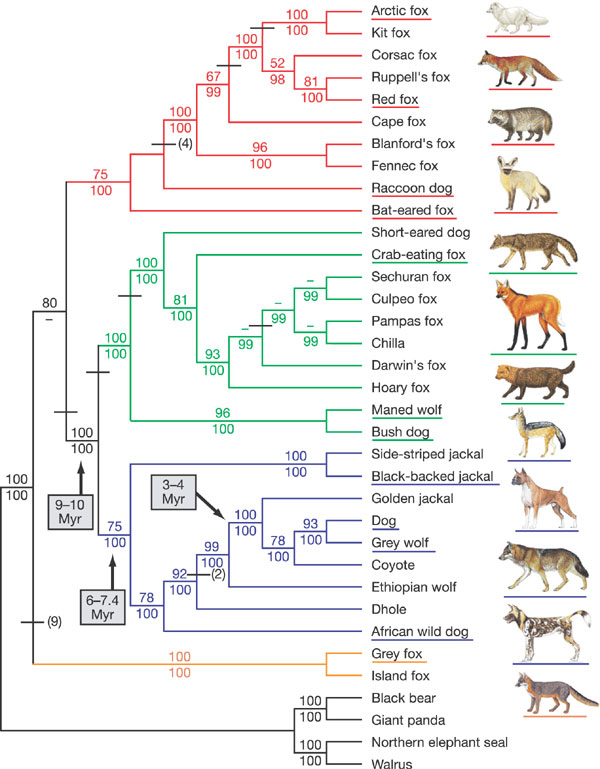
Well, If Like the Fox study, through selective breeding you can eventually get a fox that acts more like a friendly dog and even has characteristic faults that make it more dog-like…. IE; curved tails, shortened snouts, floppy ears and different colorations then the same holds true of the Wolf… and if we can accept this, then essentially the modern Wolf, Fox, or Coyote is now what we call a “dog” and the old world wolf is now the low seratonin leftovers like we see today.
So really our dogs are the modern wolf.
If we bred dogs by breeding only the most fearful and nervous ones, we would have a similar situation.
In the Old World Wolf, it’s possible that the lack of prey could be driving them the other way. The Italian wolves live on garbage, as do large populations of feral dogs. However, it’s really hard to see whether this low serotonin level comes from an adaptation to garbage eating or if it comes from crossing with dogs.
I’m not saying that ancient wolves were as tame as dogs. I’m merely saying that they were probably as tame as the foxes that live in Denali. They can feed themselves, hunt, and fight each other, but they aren’t so nervous that they have to move their dens as soon as they smell people. The modern wolf is an animal that I don’t think ancient man would ever be able to domesticate. You have to remove them from their dens by the 19th or 21st day, or they never imprint on people. Modern humans can feed them puppy milk replacer. Ancients had nothing to feed them with. My guess is the original wolf had a longer critical period for imprinting. Dogs have a 12 to 16 week critical period. And the length of the period is thought to have something to do with that selection for flight distance (i.e., selecting for serotonin high serotonin levels.)