Feeds:

Archive for March, 2009

If kennel clubs are really about breed preservation…

How can we say that kennel clubs have preserved golden retrievers, when they once looked like these dogs:

The second dog from the right is Ch. Noranby Diana. You'll never see a dog like her in the British show ring for goldens today.

The second dog from the right is Ch. Noranby Diana. You'll never see a dog like her in the British show ring for goldens today.

Now look like this:
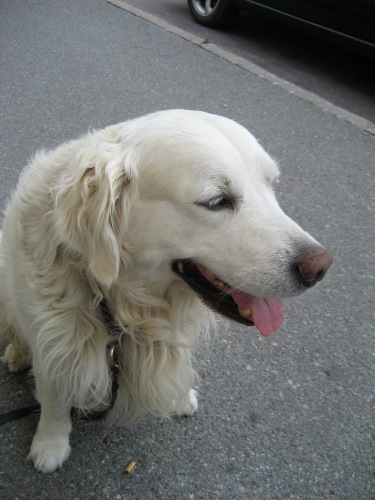
European-type golden retriever.

European-type golden retriever.

Or this? :

show-golden

American show golden.

The answer is dog shows and kennel clubs are not about preserving breeds. Some breed clubs, like the one for the flat-coated retriever in this country, are very concerned about making sure their dogs still have functional conformation and don’t have wide swings and divergences from the original functional type.

In the show-ring, the golden shifted from being a functional retriever to being an art piece. These dogs are an accumulation of silly standard revisions and the accumulation of  “fancy points” in the breed.

Someone in Britain started breeding the very light colors. I still have yet to find who that was. In the 1936 standard revision for the KC, the golden received a two inch height reduction at the shoulder– 20 1/2 inches– and the color was changed to allow cream. My guess is the original intent was the allow for cream shadings on a light gold dog.

However, that’s not how judges interpreted it, and by the late 1950’s, very light colored dogs began to appear in the bloodline. These dogs were also quite heavily built, which one would expect from a standard that had a height reduction and no adjustment for weight.

In North America, the breed ring began to favor dogs with lots of feathering. As late as ten years ago, most American goldens had functional conformation, except that they had too much feathering. All I have to do to explain the golden’s need for a reduction in feathering are the words of the great retriever man James Lamb Free when he said the golden swimming with that much hair was “like [a person] going swimming in a coonskin coat.”

Now you can still find goldens that are built nicely and resemble the old type.

red-golden-with-tennis-ball

But now, most people think such a dog is a “setter-golden mix” or a “puppy mill” golden. Why? Because goldens are supposed to be “red.”

The truth is they are all “red,” even the palest “white” ones. The gene that makes that coloration is the recessive red to yellow color (e/e). The darkest dogs on that spectrum are mahogany, and Irish setters are that color, too.

mahogany-golden-ii

The only problem with these “old-fashioned” or “working-bred” dogs is that they don’t have much genetic diversity. Try to find a golden from these lines that doesn’t have this dog in its pedigree:  AFC Holway Barty.

Barty is the Wiston Cap of working golden retrievers in this country.

It is very hard to find a border collie of trial stock in any part of the world that doesn’t have Wiston Cap in its pedigree. He and Barty were what we would call most-used sires.

With goldens, it is a bit better. However, most European working lines are also partially derived from Holway dogs, so you have real problem in trying to increase genetic diversity.

Because of this problem, some breeders, like this one in Sweden, are crossing with the “fancy” dogs. Her F1 cross with these dogs produces puppies with rather difficult to predict working characteristics. She calls these her “lost generation.” (BTW, she is a bit wrong about calling the show dogs the “old-fashioned” type. The “old fashioned” type is working type.)

So here is the problem with working golden retrievers: we have a narrow gene pool but to broaden it we have to breed away from the original, more athletic type to include dogs that are slower on both the land and the water and very often don’t have retrieving instinct.

And that’s why I say the golden retriever is very much in trouble.

I wish we could go back to the dogs that lived 15 years, retrieved from land and water as well as any Lab, and never thought of biting anyone. But in order to go back to that time, we are going to have to some reform of our canine institutions. And the breed is going to have to lose some of its popularity so it can be rehabilitated.

Read Full Post »

Walker coonhounds

This is from KYAfield

This is a good intro to how the coonhounds work. I should point out here that “coon” is short for raccoon and is not meant to be the derogatory racial slur. The term is sometimes used in that way.

I have a hard time determining whether a Walker hound is a foxhound or a coonhound by looking at it. They both descend from the Walker strain of foxhound that was developed by Thomas Walker, who imported foxhounds to Virginia in 1742. He was the second person to import foxhounds to the New World.

My grandfather had Walker foxhounds, which are a very important strain of American foxhound. However,  in my part of the world, “fox chasing” is not nearly as a common as hunting raccoons, so the treeing Walker coonhound is now more common. They are derived from the same stock, but they’ve since diverged into these specialized breeds.

In Britain, there are two other derivatives of this basic type of large scenthound that have  also diverged into specialized strains. Everyone knows about the English foxhound, but not everyone knows about the trailhound. In the eighteenth century, different owners would argue about the speed of their foxhound packs. They began to breed dogs solely for their speed, and these strains evolved into the trailhound.

So out of this basic strain of English pack hound, four basic breeds developed, each for its different hunting style. The various strains of American foxhound were bred to hunt independently, and some also hunt at night. Some dogs also were used to hunt gray foxes, which climb trees, and certain foxhounds were able to “tree” gray foxes. From these treeing Walker foxhounds, came the treeing Walker coonhounds, which always hunt at night and always must tree their prey. In Britain, the dogs were bred to hunt in tightly controlled packs that were followed on horseback. The English foxhound is generally a more biddable dog than his American relatives. However, the trailhound dogs that evolved from English foxhound racing are much faster than the others.

We started out with one basic breed of large scenthound, and now we have four. Different hunting conditions molded these four breeds out of one.

Read Full Post »

The golden retriever's popularity would shoot up if the president chose one, and that would be a bad thing!

The golden retriever's popularity would shoot up if the president chose one, and that would be a bad thing!

Everyone has an opinion on which breed the president should get. Representative Steve Kagen says that Obama should get a golden retriever and shave it.

The allergist turned Democratic congressman rightly points out that there is no such thing as a hypoallergenic dog. However, I think he’s wrong to make this joke:  “There is a hypoallergenic dog. It’s called a cat.”

To be honest, I know more people who are allergic to cats than people who are allergic to dogs. If someone is allergic to dogs, well, there’s a chance they could also be allergic to cats.

Shaving might reduce allergens. Remember, though, that people aren’t really allergic to the hair. They are allergic to the dander and saliva. Goldens have very oily coats that seem to collect dander and saliva. That’s why they are usually not recommended for people with allergies.

However, it is a very bad thing to do for a golden retriever.  I have had bad experiences with clipped goldens getting both hot spots and sunburn from clippings, and I’ve read that other skin conditions can be aggravated if a golden is clipped. Goldens are skin problem prone– part of it is diet and the other part of it is that they do really poorly in warm humid climates. They are designed for a cold, wet climate, and that oily thick coat protects their sensitive skin as well as keeping them warm and dry.

That’s why I suggest that goldens kept in hot climates should have access to wading pools with ice water in them. It is a far better alternative to shaving them. If you do so because you wanted a short-haired dog, the short-haired alternative to the golden exists. It is called Labrador.

So while a clipped golden might be nice for someone with allergies, it really isn’t the best alternative for a dog breed well-known for its sensitive skin.

Now, I also think the president should steer clear of the golden retriever. In fact, it has nothing to do with the fact that they are “hyperallergenic” breed. It has to do with the reality of the golden retriever’s situation. It is too popular. If this president picks this breed, the golden retriever’s popularity will shoot through the roof.

This is not a good thing. The breed is suffering from a variety of genetic disorders anad an aggression epidemic. It is also losing its desirable qualities, which were that it was a universally easily trained breed with very low aggression towards people and other dogs. As late as ten years ago, it was listed by Dr. Bruce Fogle as “tend[ing] to live the longest of all retrievers.”

What the golden needs is a popularity drop, like the chow chow and rough collie experienced. The chow chow’s surly temperament has been mellowed. Rough collies now exist that have intelligence and gentle temperaments. But when these breeds were extremely popular, both were well-known for their occasional aggression and “stupidity.” Today, both of these breeds have been largely rehabilitated.

And that’s what the golden retriever now needs. If Obama picks one, the golden will fall apart. It won’t fall apart as fast a the Portuguese water dog would, but it is in such a bad state right now that it definitely doesn’t need a popularity boost. The golden never could sustain itself at the Labrador’s current level of popularity. They simply do not have the gene pool. And I’m afraid if the golden got chosen that it could be as popular as the Labrador is right now, perhaps even surpassing it.

For the sake of the breed, Mr. President, don’t get a golden retriever.

Read Full Post »

Petland accused of selling puppy mill dogs

puppiessave

When I was growing up, I spent a lot of time in Petland. I have always been fascinated with animals of all sorts, and the local store had a wide variety of animals. I bought my first goldfish there. I also bought crickets to feed my pet anoles and wild-caught northern fence lizards. I was like going to the zoo in the middle of a shopping mall, and as someone who has always hated going to shopping malls and always loved going to the zoo, the store was my little respite.

The truth is I did not know much about the sordid background of pet stores and puppy mills. I just wanted a few minutes away from my parents who wanted to spend more time buying clothes. (Yes, I hate shopping.)

But I never thought about the puppies that Petland sold. I always remember that they were very well-groomed and held in glass-fronted cages with grating on the bottom. They were taken out of the cages several times a day to let them play. I thought they had all come from local breeders.

Of course, they probably didn’t. They very likely came from commercial breeders.who mass produce all sorts of dogs without any careful regard to their health and temperament. You know–what we usually call puppy mills.

The HSUS is suing on behalf of people who purchased puppies from Petland, which told them that the puppies came from the best dog breeders who ensured that the dogs were healthy.

In reality, most Petland pups come from the Hunte Corporation, which is major commercial breeding and dog dealing firm in Missouri. This corporation is to domestic dogs what factory farm enterprises are for hogs. Now, we can debate the ethics of factory farming, but the average person isn’t going to live with the hogs produced in this manner. The average person’s interaction with factory farming is consuming the pork produced in this manner.

The average puppy buyer expects a much more from the dogs he or she purchases. People make dogs part of their families. They bond to them strongly, and they will spend as much money as they can to help their “fur kids” get through any medical issues.

Puppy mills can never produce the quality dogs that everyone wants. Mass farming might get us meat on the table. It won’t get you the dog you want, for it is impossible to mass-produce healthy purebred dogs. There are too many inherited conditions that must be screened for, and to screen for all of them is very cost prohibitive, even for a single breed. Further, to ensure quality puppies, a breeder must assess the quality of the adult breeding stock, which takes even more time than is cost-effective.

The HSUS is suing for the cost of the veterinary care that these puppies received, and it is also suing to force new standards for commercial breeders.  I don’t know how successful this suit will be. But here’s a rule everyone should follow:  Never purchase anything from a pet store that sells live domestic dogs or cats. This is the only way to stop the barbaric practice of puppy mills and mass production.  Also, never go to someone who is selling five or six breeds, and never buy a puppy without getting health information on the parents. It is best if you can see one or more of the parents, but if you can’t see at least one of them (and get information on the other), you can bet that this is a puppy mill front of some sort.

Link to AP story on the lawsuit.

Read Full Post »

Melanistic red fox in sighted in Britain

silver-fox

Last September, a melanistic red fox was spotted in Britain. The article is here.

There  are a few inaccuries in the article. The first of these is that black or silver foxes in Europe are extremely uncommon and probably always were. It is an interesting theory that the silvers/blacks were all killed off because of hunting.  I just think the genes that cause that coloration have always been rare in Europe. I don’t know whether

Virtually all silver foxes descend from North American populations. In fact, I’ll go as far as to suggest that all silver foxes or melanistic foxes in captivity are descended from North American populations.

And these populations are native.

Native?

Well, where I live, there are no native red foxes. If you live in the US east of the Mississippi, except northernmost New England and Upstate New York, the red foxes are descended from English imports. This map of red fox subspecies in North America is really good. Number 6 is the subspecies that is descended from imported foxes. All of the rest are native.

However, in other parts of North America, including virtually all of Canada, red foxes are native. And in parts of the Maritimes, black foxes, were more common than reds. These foxes were in demand for the fur trade.

It was in the province of Prince Edward Island that the silver fox was developed as a fur farm animal. The island had a large number of melanistic foxes that sometimes had silver hairs. These foxes were captured and bred as domestic animals, although the truly domesticated strain that we often talk about was started in the Soviet Union in the 1950’s. They were selected for the silver coloration over the solid black coloration. I am uncertain whet ther PEI foxes were native to that province, which is an island, or whether they were introduced from the mainland. However, coyotes live on PEI. These coyotes walked across the ice in the Northumberland Strait to get there. It would make sense that red foxes would be able to do the same thing.

Silver foxes and black foxes are uncommon in Europe. They are also uncommon among British red fox descendants in the US. I’ve never seen a wild silver fox. Some fool tried to turn some farm strain foxes loose here, but they did not last. Even “undomesticated” strains that have been propagated in captivity for generations cannot make it in the wild.

(This is something that needs to be considered about all sorts of carnivores currently bred in captivity. I seriously doubt  that we are going to save the tiger by breeding them for generations in captivity.)

Read Full Post »

The National Dog of Ireland

kerry-blue-terrier

There is no true official dog of Ireland, but there are two that are often claimed to be the official dogs of that country. One is the Irish wolfhound, a dog that is a recreation of a great wolf-coursing sighthound-mastiff that is often credited for ridding Ireland of its wolves.

The other is one more traditional dog of the Irish Republicans is the Irish blue terrier. Note that I said “Irish blue terrier.” We have long called this breed the Kerry blue terrier, but the breed’s origins, while in the southwest of Ireland, are in County Tipperary in the town of Carrick-on-Suir. Some English dog fancier misheard the name “Carrick” as “Kerry,” and thus, the breed got this name.

Michael Collins had a famous Irish blue named “Convict 224,” and many Republicans had this same breed, many with radical names as befitting that time in history.

Collins introduced a bill that would have made the Irish blue terrier the official breed, but Collins was killed in an ambush before the bill could ever be enacted.

The Irish wolfhound is still bandied about as the official breed of Ireland, but the official dog of the Irish Republic is the Irish blue terrier.

Read Full Post »

In the FCI Countries, the Landseer is a separate breed from the Newfoundland

A painting of a Landseer by Landseer

A painting of a Landseer by Landseer

One of the rather interesting aspects of looking into dogs is how unusual some of these distinctions can be. Most dog fanciers are splitters rather than lumpers when it comes to their peculiar taxonomy.

No better example of this tendency to split apart gene pools is the tradition of the FCI to regard the Landseer Newfoundland as its own distinct breed. In Canada, the US, and the UK, this is just a color variety of Newfoundland.

The Landseer dogs are named for Sir Edwin Landseer, who portrayed many of these black and white animals in his work. In the nineteenth century, the black and white varieties were far more common among Newfoundland dogs that were living in the United States and Europe.

Custer captured a black and white Newfoundland during the Peninsula Campaigin in 1862. This dog had been accompanying a Confederate company.

custers-newfoundland

These dogs were much closer in build and appearance to retrievers, although these dogs were often considerably larger. In  Europe, the bigger the Newfoundland the better, so most Europeans knew the Newfoundland as a giant, black and white dog.

I should note here that even the larger strain of Newfoundland was used as a gundog. They can be taught to retrieve, although their modern variant is a rather slow swimmer. In nineteenth and eighteenth century texts, any dog that swam and came from Newfoundland was either called  a Newfoundland or Labrador. Different people had different names for the various strains imported from the island of Newfoundland, so it gets rather confusing to determine which strain writers are referring to. As a result, I tend to think of them as starting out as variants of the same basic Landrace that later evolved into separate breeds. This is a bit of heresy, because almost all texts talk about the two different strains endemic to the island. However, I think the tendency to see differences is a bit misleading. These dogs evolved out a diverse soup imported European dogs, and the fact that some of the large ones could also be used for hauling carts and the smaller ones were good at retrieving shot birds and seals is what actually led to their separation. In Europe, they were interbred, and both strains played a role in developing the retrievers.

So in the nineteenth century, the term Newfoundland could either refer to the St. John’s water dog (the one that looks a lot like a retriever) or the big Newfoundland, which was almost always black and white and was not as exaggerated as the modern breed is. It is likely that interbreeding between the types and selective breeding resulted in a third type of dog, the largely solid colored Newfoundland. Emily Dickinson had one of these dog, a brown/liver/ “bronze” dog named “Carlo.” The royal family also had a solid black Newfoundland named “Nero” in the 1860’s.  It is this type of dog that became more and more popular in Europe and in the United States. There became a tendency to breed for more strongly molosser features in these dogs than in the strains that produced the Landseer, and as a result, the Newfoundland became a sort of mastiff-retriever, which is basically what it was before, except that it now possessed a bit more mastiff in its background and behavior.

When the Newfoundland became rather unpopular towards the beginning of the twentieth century, the Landseer dogs nearly disappeared. After World War II, when the population really dropped off, the breed was revitalized through imported Newfoundlands from Switzerland and Italy. Most of these dogs were of the solid colored and heavier variety.

However, in Europe a few of these lighter-built, “old-fashioned,”  black and white dogs still existed and were bred in separate gene pool. These dogs looked like the old retriever-type Newfoundlands of the nineteenth century, and these dogs were called Landseers.  Today, in the FCI countries, Landseer are lightly-built black and white Newfoundlands. They are not as lightly-built as they once were, but they are not the big-boned Newfoundlands that currently exist in the breed.

This is a modern FCI Landseer.

This is a modern FCI Landseer.

Now, in the countries where this breed is a color variety of the Newfoundland, the dogs have to be bred back to solid black dogs to retain type. Breeding Landseers with typical modern Newfoundland conformation together for several generations will very often lead to dogs that have FCI Landseer conformation.

A modern Newfoundland with Landseer coloration.

A modern Newfoundland with Landseer coloration.

So when British and North American dog fanciers say Landseer, they actually refer to a modern Newfoundland that is black and white. When FCI dog fanciers say Landseer, they mean the lightly-built dog that represented the large Newfoundland breed in the eighteenth and nineteenth centuries.

Read Full Post »

« Newer Posts - Older Posts »

Follow