I need a basenji. It would be the perfect excuse for me to leave my cell phone turned off at home!
If there is such a thing as antithesis to a golden retriever, the basenji would be it!
Posted in Absolute Piffle, dog breeds, tagged basenji on July 24, 2010 | 2 Comments »
I need a basenji. It would be the perfect excuse for me to leave my cell phone turned off at home!
If there is such a thing as antithesis to a golden retriever, the basenji would be it!
Posted in Identify the species on July 23, 2010 | 7 Comments »
Posted in Retriever history on July 23, 2010 | 5 Comments »

Here is a description of several types of retrievers in The National Geographic Society’s The Book of Dogs: An Intimate Study of Mankind’s Best Friend:
Many breeds of dogs have been trained to find and bring in game which has been shot, but retrievers, as their name implies, are bred specially for that purpose. English sportsmen had for some time been experimenting with different breeds in an effort to find a dog exactly suited for retrieving game, when, about the middle of the last century, there was introduced from Labrador a hardy, black-coated, small-eared, medium-sized dog, which seemed to answer the purpose. He was a typical water dog and not subject to ear canker, which so often develops in spaniels used to retrieve waterfowl. [This is a description of the St. John’s water dog from Newfoundland.]
This Labrador dog [St. John’s water dog], crossed probably with the English setter, and perhaps with other breeds, produced the retriever, which may be either black or liver brown.
In size about like a pointer, covered all over with a coat of tight, curly hair, Astrakhan-like, except for his smooth head and face, he is a curious-looking dog. He is a capable and teachable creature, however, and makes a capital assistant in the duck-blind or as a gun-dog, where birds are the quarry.
The curly retriever may be either coal black or dark liver brown. He should weigh about 65 to 80 pounds.
There is also a smooth [flat-coated] retriever, which is much like the curly in form and size, but has straight hair.
The Labrador retrieve is shorter of leg than the other types and generally more solidly built. It is generally some shade of brown [incorrect, as you already know], and none of the retrievers should show more than a trace of white on the chest. All have smaller ears than the pointer or setter, and the curly type carries his close to the head.
The original “Labrador,” or something very like, still exists under the same name, as a distinct and recognized breed. He has all the good qualities of both of these highly intelligent parents.
Some of this language is confusing.
You’ll note that golden retrievers were not mentioned, even though they were a distinct breed from the flat-coat in 1919. They simply were not well-known outside of Britain or Canada.
The text also plays loose with the terms “Labrador dog” (meaning St. John’s water dog) and the Labrador retriever.
The St. John’s water dog existed until at least the late 70’s. It looked very much like a Labrador, but it had white markings on its chest. It was almost always black, but liver forms did occur.
My own view is that it was derived from poodle-type water dogs from Iberia, France, and the British Isles that evolved a more otter-like coat through cross-breeding with Portuguese mastiffs (possibly the Cao de Castro Laboreiro), various curs and collie-types, spaniels, setters, possibly pointers and Native American dogs, including the canoe dogs and the Labrador husky.
Natural selection would have demanded for a smooth coated dog that could withstand very cold water helped the breed evolve its coat, which is now one of the Labrador’s most distinguishing features. Very shaggy dogs would not be able to swim as fast to keep up with the fishing boats or retrieve lines or nets in a very efficient manner.
From the depictions I’ve seen, at least some of the earlier St. John’s water dogs were feathered. These dogs were probably always a liability, and because smooth-coated dogs can have feathered offspring, it was likely that dogs of this coat type popped up time and again. These puppies were then sold off to England, where they could be a ship’s mascot or work as retrievers on estates.
And that would explain why the wavy-coated retriever (the ancestor of the golden and flat-coat) was so common in England. The feathered form of the St. John’s water dog crossed with setters and some collie-type shepherds would have created a dog very similar to a wavy-coated retriever.
I don’t know where the authors get the notion that the Labrador retriever was always some shade of brown. That sounds more like a flight of fancy to me.
The Labrador (as in the dogs descended from the Buccleuch line) was not a very common breed at this time, which sounds bizarre to us. The Lab is the most common purebred dog in this country. Everyone has an idea what it is.
But it’s very likely the authors had never seen one. The most common color in Labradors is and always has been black. White markings from its Newfoundland ancestor still pop up time and again, but in those days, black was the color for the Labrador.
However, the text does get the curly and of the black and liver wavy-coats pretty close to accurate. One must remember that these were the only two recognized forms of retriever for many decades. They were the first two forms that were recognized by the Kennel Club.
The wavy-coated form became recognized early on in the British trial circuit, and it was heavily promoted by the founding president of the Kennel Club, Sewallis Shirley.
As a result of this prominence, if you were to ask someone in the late nineteenth or early twentieth centuries what a retriever was, they would explain that it was a black dog with long hair that was about the size of a pointer or setter.
Today, we think all retrievers are Labradors or goldens.
If I say something like “Nova Scotia duck-tolling retriever,” I get looks as if we have made something up.
And to mention the Norfolk retriever is even more confusing. No can say what that breed was, and all we know about now is that it is extinct. My view is that it was a derivative of the English water spaniel crossed with a St. John’s water dog.
But the truth is we just don’t know.
And no, it was not a Norfolk spaniel. That was breed that got absorbed into the English springer spaniel. There is some evidence that the Norfolk spaniel actually was developed in Shropshire, which is nowhere near Norfolk.
The Norfolk retriever worked the Norfolk Brecks and marshes.
It existed until at least the First World War, but the breed didn’t even make National Geographic’s book on dogs from that time period.
Retriever history is actually among the easiest of dog histories to explore. The dogs were almost universally owned by nobles, and their pedigrees were often well-kept.
But even at that, it is very easy to get confused. Labrador and Newfoundland mean different dogs for different authors. Retriever can also mean water spaniel, and water spaniel can also mean English rough water dog, which was a poodle-type water dog.
I barely can touch the nuances of such things in a single post on this blog, and I am sure that the National Geographic Society’s authors could barely grasp this in their encyclopedic book on dogs.
It is that deep. It is that confusing.
But that’s why I love it so much.
Posted in animal welfare, dog breeding, dog domestication, purebred dogs, tagged basenji, closed registry, domestic dogs, Norwegian lundehund, purebred dogs, the dog fancy on July 23, 2010 | 5 Comments »

If one looks at the basenji, one sees what should be a tough little dog, free of exaggeration in conformation or type. It looks like it had been entirely selected by the processes of natural selection.
Although capable of barking, it very rarely does so, and when it does, it is just a short little woof. In this regard, it is very much like the wolf or the dingo. The bitches have one heat cycle per year.
It is almost like a wild animal, so one would think that there wouldn’t have been a healthier breed to own.
Unfortunately, all that you have just read is nothing more than an appeal to nature fallacy. All the natural appearances are superficial.
Basenjis in the West are just like any other breed of dog. They have a limited number of foundational sires, and when one gets involved in producing quality dogs for the show ring, the tendency is to use just a few members of the population to produce offspring. With a closed studbook, all sorts of new hereditary problems began to surface.
But unlike other breeds of dog, the basenji started out with a very small population in the West. Just 18 or 19 dogs founded the original basenji population. That is a pathetically small number on which to found an entire breed.
By the late 1980’s, basenjis were in a lot of trouble. In 1989, Dr. Russell Brown of Virginia Commonwealth University sent a letter to the AKC Board explaining why the basenji needed to have its studbook reopened.
The AKC eventually opened the studbook to allow new blood to be imported from the Congo. This is actually where the brindle coloration that has popped up in the basenji came from.
It is often mentioned that basenjis are quite common in Africa. One must be careful with such assertions, because basenjis have peculiar traits that are actually not that common in the African pariah dog population. This needs to be repeated, for there are assumptions that just about African village dog with prick ears and a curled tail is a basenji.
It ain’t so.
This is not a contrived breed. It’s not like the West Highland white terrier, the golden retriever, and the Norfolk terrier, which have all been separated from their closest relatives on what amounts to little more than superficial reasons.
This is an actual landrace that is native to Central Africa. It may superficially resemble other pariah dogs that are found in other parts of Africa.
But those dogs bark a lot and the bitches have two heat cycles per year. From what I’ve seen, most of these dogs really don’t have the curled tails of the show basenji or even loosely curled tails that one sometimes sees on African basenjis.
Any population of dogs that rarely barks and has but one heat cycle per year is clearly different from other dogs, no matter how one looks at it. These dogs are physically and behaviorally unique.
To rejuvenate the bloodline, African dogs indeed were allowed in. These dogs had the same traits that we associate with dogs of this type, and some of the health problems are indeed being mitigated.
But what the basenji story actually tells us is what happens when we allow just a tiny population of dogs to found a breed and then close off the studbook.
Basenjis were nearly ruined through such an extreme genetic bottleneck. They may yet be redeemed through these African imports. I certainly hope so, for the basenji is such a unique dog that I think it is very much worth preserving.
Its unique characteristics give us insight into what the early dogs might have been like. The inheritance of its barklessness was actually tested by Fuller and Scott, when they crossed basenjis with cocker spaniels. It turned out that barking was a dominant trait, but the number of barks that a basenji/cocker will give is still somewhat lower than that of a pure cocker. That study suggested that the constant barking trait that so characterizes other dogs could have easily been transmitted through the populations of domestic dogs very early on.
And all of these genetic disorders certainly do give us something else to examine.
The African dogs lived very well for thousands of years. They evolved to fit a particular task and a particular climate. But when our dog culture picked them up, things just didn’t turn out that well.
Maybe the future will be better for these African “barkless dogs.” But we have to be very careful about these registries. We don’t need to ensure the genetic viability and general health of all of these dogs. We have to start thinking in such a way for all of these dog breeds.
If we don’t, the potential exists for even more problems like the basenji was facing in the 1980’s. In fact, this potential is almost a certainty if we don’t starting thinking differently.
Dogs are organisms, but our cultural backage winds up having major effects upon them, whether we like it or not. Our inability to understand them as organism with need for sustainable gene pools is a major problem for the long term viability of the domesticated form of C. lupus.
If we could just start thinking this way, maybe we could have a better future for dogs.
But we have to change our dog culture, and that is going to take time.
***
Basenjis are hardly the most extreme case. The Norwegian lundehunds (the polydactyl puffin hunting dogs) are derived from just six dogs that survived a distemper outbreak that happened during the Second World War. All of these dogs have the genetics to develop an extremely debilitating set of digestive disorders called lundehund gastroenteropathy in which digestive bacteria grow out of control, preventing the dogs from deriving nutrients from food. Some dogs never develop symptoms, but others eat and eat and never get enough nutrients.
Open registries are not the solution for all problems solving dogs. Lots of things have to be done to solve these problems. Opening registries alone will not save them in the end. However, if we don’t open them, we will be doing very little to solve the macro-level problems that are making breed after breed less healthy.
The registry issue is systemic, which means that it is sometimes harder for people to understand. It is also the biggest sacred cow in the fancy– purity for purity’s sake. To even suggest that this problem is the greater systemic problem in dogs is a great heresy.
But not everyone in the fancy is entirely in love with it. I think the number of people who love dogs as dogs in the fancy is much larger than you might assume from reading this blog or others.
Within the fancy itself, there are people who want something better and who are articulating it and pushing for it.
Bit by bit, change will come.
For those of you who want a better future for dogs, please know that you’re not alone. It’s starting to happen.
In the public consciousness, the AKC doesn’t mean what it once it did. When people think AKC, they think of unhealthy purebred dogs. It doesn’t mean golden. It means gilded.
That’s a major branding problem.
It’s one I’m sure the AKC doesn’t want to have.
It’s also why the AKC is losing out market share the paper mill registries. If the AKC is just a paper mill, then why can’t Jim Bob down the road start his own?
In the end, we have no quality control or consumer protection institution for dogs in the United States.
We are lost.
We have to do this research for ourselves, which, thanks to Google, means that it isn’t as hard as it once was.
But I still think we need some kind of body, even at the breed and function-based level, to have some sort of regulating or quality control influence over breeders. I’m not in favor of new laws. I’m in favor of a better system in which dog people regulate themselves.
We need an open registry system, but we don’t need one in which people are inclined to do crazy crosses just for the hell of it.
And that’s my dilemma.
***
In case you were getting ready to dispute me on whether basenjis can bark:
I wonder whether living around “normal” dogs has any effect on that behavior. I remember reading about some wild-caught wolves that were kept in a kennel with lots of barking domestic dogs. The younger wolves in the pack started barking like dogs.
Barking does have a learned component to it. I knew a Dalmatian that joined a household that included a mongrel beagle. This beagle had a tendency to great everyone with a baying howl.
After about two weeks, the Dalmatian was trying to make that noise– very unsuccessfully.
Maybe some basenjis are learning let loose a few barks here and there just to fit in.
Posted in history, West Virginia, tagged Knight of the Golden Horseshoe, Matewan, West Virginia on July 22, 2010 | 5 Comments »
If you are interested in labor history or in West Virginia history in general, this is a good film. I don’t know how long it will be on youtube, so enjoy it while it’s there.
This is true story, and it does have a lot of violence in it. Just a warning.
***
Unionizing the coal mines of Southern West Virginia was a truly bloody affair, and it something that was taught to every child in West Virginia’s schools until recently.
Now, you just learn that the Battle of Point Pleasant–a battle in Lord Dunmore’s War– was the first battle of the American Revolution.
Talk about screwy. The people who fought in Lord Dumnore’s War were fighting for Lord Dunmore, the colonial governor of Virginia. They were fighting for the crown, not against it! That particular war was about driving the Shawnee and Mingo across the Ohio, opening up Trans-Allegheny Virginia for more European settlement.
I have learned a bunch of interesting and probably untrue facts about West Virginia.
And as I’ve mentioned, my knowledge of West Virginia history, geography, and government got me knighted. Yes, I’m a Knight of the Golden Horseshoe. This award is given to eighth-graders who score high enough on a test that is given every year.
In eighth grade, students are required to spend a semester studying West Virginia, which is taught in that “everything about West Virginia is awesome” sort of mindset. This test is the crowing achievement of any student who has taken that course.
The name for the award is derived from an expedition that Alexander Spotswood, then Virginia’s Royal Governor, led across the Blue Ridge in 1716. They made it to the Shenandoah River, which I should mention, isn’t a major river in West Virginia. It is a major river in Virginia that happens to empty into the Potomac at Harpers Ferry, which means it courses through only the eastern tip of West Virginia. The Blue Ridge Mountains are just to the East of the Shenandoah River.
So you know what that means?
John Denver was not well-versed in geography!
When Spotswood’s expedition reached the Shenandoah, they celebrated, and then went back home to Williamsburg. Spotswood gave the members of his party small gold stickpins made in the shape of horseshoes.
For some reason, West Virginia decided to use this as a honor for its students who did well on that test.
All I can say is John Denver never would have earned one.
Posted in Bush dogs, dog domestication, wild dogs, wildlife, tagged bush dog, South American wild dogs, vinegar dog, wild dogs on July 21, 2010 | 6 Comments »
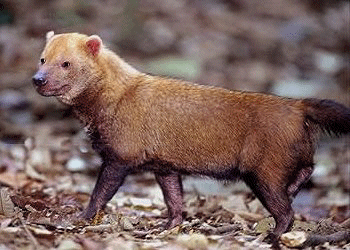
Click here to see the video.
Bush dogs (Speothos venaticus) are the smallest of the pack-hunting canids.
They live in South America at pretty low densities. They are widespread on that continent, but they are not that common anywhere
Yes, I know they look like the cross between an otter and a fox.
And they are famous for doing handstands to mark their territory.
But beyond that, they also have been kept as semi-domesticated animals by several indigenous groups. They have never reached the level of the domesticated culpeo, but they have been kept as pets.
It’s not something I recommend, but it is worth considering when we talk about dog domestication.
It is likely that any number of wild dog species have been kept as pets, but only one (C. lupus) has managed to be so successful.
The vast range of C. lupus may have played some role in it, and the fact that C. lupus is a large carnivore that can both hunt the same prey that people were hunting and protect against intruders, including other large predators that might prey upon humans.
However, we have to consider these potential domestications in order to understand how man and C. lupus became attached to each other in this way.
Posted in wildlife, tagged Peter Matthiessen, Wildlife in America on July 19, 2010 | 1 Comment »
This one is better than the one I posted a while back.
As I’ve mentioned before, I have an old edition of Wildlife in America, which I received as a Christmas present a few years ago.
This interview has several parts, so click into youtube to watch the rest.
« Newer Posts - Older Posts »


 | M.R.S. on The morel of the story… |
 | Will and Eko on It’s spring time in West… |
 | Labrador Retriever I… on Merritt Clifton: German Shephe… |
 | Myra on Merritt Clifton: German Shephe… |
| M.R.S. on Merritt Clifton: German Shephe… |





