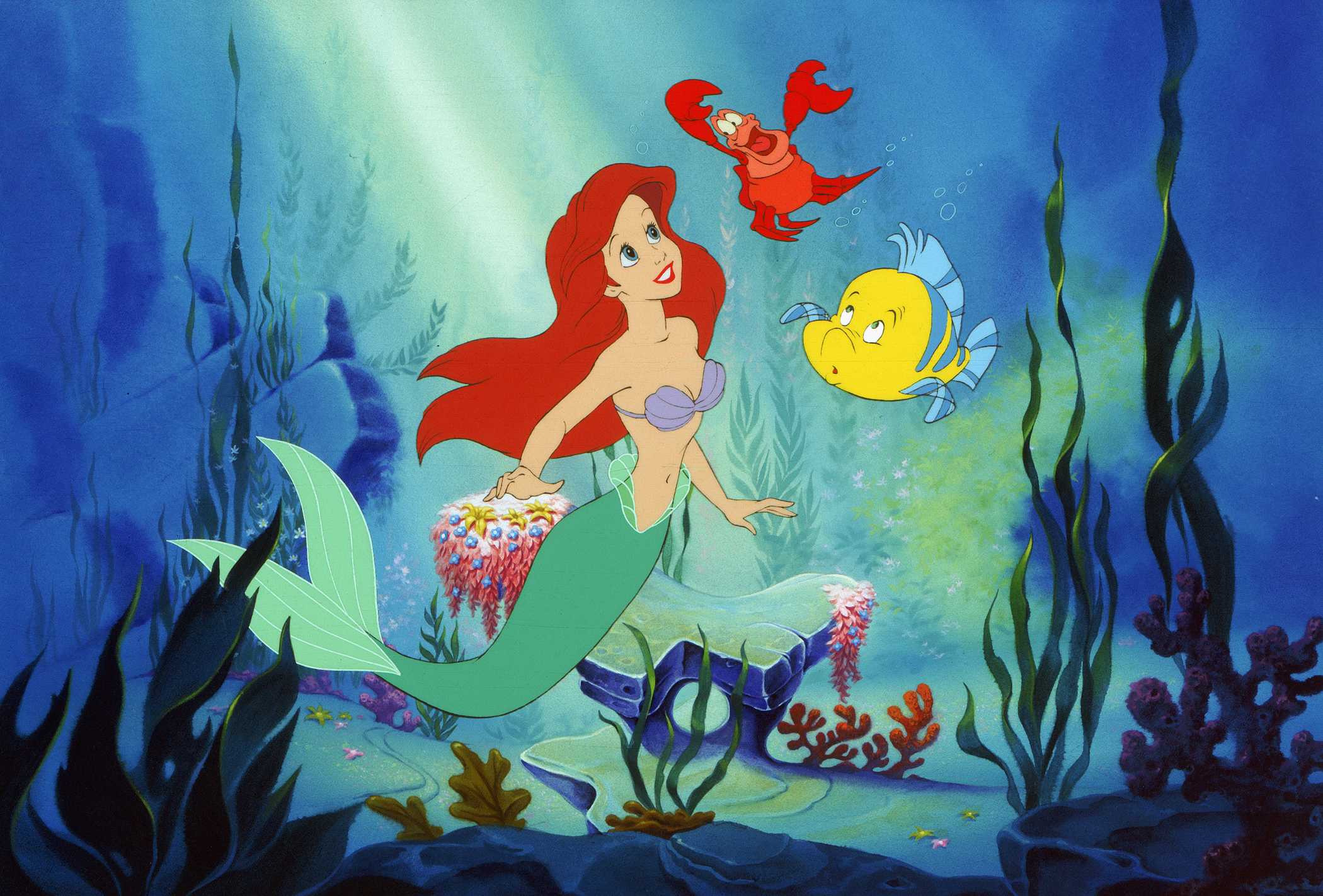
Unfortunately, mermaids like Ariel aren’t real.
But I still hold out hope for talking crabs with Jamaican accents.
Mermaids are real.
Yes.
You heard me right.
Now, before you call me a kook, give me a second to explain myself.
Mermaids that look like hot chicks with fish tails don’t exist.
I can say this with confidence.
Yes. I know about the Animal Planet mockumentary that fooled so many earlier this year. The film made the claim that the US government had discovered a mermaid body, and it posited that mermaids were a type of hominid or humanoid that evolved to live in the sea and have a close relationship with dolphins. It rehashed the much ballyhooed “aquatic ape hypothesis,” which is generally not well accepted by any anthropologists, paleontologists, or other experts in human evolution.
It was so well made that people actually believed that the US government had discovered mermaids– and (of course) was involved in some sort of cover-up.
Apparently, enough people had annoyed NOAA officials about the mermaid body that the agency was forced to issue an official statement in which it was clearly asserted that “[n]o evidence of aquatic humanoids has ever been found.” NOAA initially denied that the statement had nothing to do with the mockumentary, which came out in late May.
But when Animal Planet re-aired the film this weekend, NOAA instantly put out the same official statement.
So yes, a major agency of the US government was being influenced by a fantasy film.
Or rather, there are enough people who believed this mockumentary to elicit a response from the federal government.
So mermaids of the Hans Christian Andersen and Disney type don’t exist.
And the Animal Planet “aquatic ape” derivatives don’t either.
But mermaids do exist.
There have been many accounts of mermaids throughout history. Almost all of the claims for their existence come from either West Africa, the Indian Ocean, or the South Pacific– as well as the Caribbean, the Amazon Basin, and the Atlantic Coast of North America from North Carolina to Brazil.
Perhaps the first credible account of a mermaid comes from 1717. Two Dutch colonial officials wrote about the natural history of what is now Indonesia, and in the text, they mention a creature called the “See-wyf.” The authors describe a capture of one of these creatures and how it survived in a vat of water for over four days:
See-wyf. A monster resembling a Siren, caught near the island of Borne, or Boeren, [Borneo]in the Department of Amboine [Ambon Island]. It was 59 inches long, and in proportion as an eel. It lived on land, in a vat full of water, during four days, seven hours. From time to time it uttered little cries like those of a mouse. It would not eat, though it was offered small fish, shells, crabs, lobsters, &c. After its death, some excrement was discovered in the vat, like the secretion of a cat. The copy from which I have taken the representation for this work is thus coloured: hair, the hue of kelp; body, olive tint; webbed olive between the fingers, which have each four joints; the fringe round the waist orange, with a blue border; the fins green, face slate-grey; a delicate row of pink hairs runs the length of the tail [Source].
Much of this description seems to be pointing an animal very different from our conventional concept of a mermaid.
It’s not a beautiful animal that even remotely resembles a beautiful woman.
The mention of the animal being similar to a “siren” is some indication of its identity.
Sirens were the beautiful women whose song beguiled ships to their doom in Greek mythology, but the term is also used to refer to dugongs.
The text of this book was written in Dutch but then was published in French, so it is very likely that the French translators were unaware that siren could refer to this sort of animal. And the publishers had a creature like a mermaid depicted in the book, which makes things more confusing.
Nowhere in the text is there any mention of the creature looking like a woman with a fish’s tail.
This animal sounds like a baby dugong.
Referring to dugongs and manatees as sirens is an old tradition.
Westerners first encountered dugongs when they began exploring the Red Sea and Indian Ocean.
One of the weird features of a female dugong is that her genitalia resembles that of woman, and if you’re a randy sailor who has been sailing for month and months away from female company, this feature is going to be the one that gets the most attention. Men don’t often think with their brains.
And why these animals got called sirens or mermaids.

Dugongs are the real mermaids.
The see-wyf in the vat was very likely a baby dugong. Baby dugongs do make whistling cries when they are away from their mothers.
As a baby of that age, it would have only wanted to drink its mother’s milk, and it wouldn’t want to eat seafood at any age.
So it was not a good situation at all.
We’ve known about the identity of mermaids for a very long time.
They are quite real.
In the Indian and Pacific Oceans, as well as the Red Sea, the mermaids are dugongs.
In West Africa and the Americas, the mermaids are manatees.
They may not be as fanciful as “The Little Mermaid,” but these animals are pretty interesting in their own right.






Many years ago I attended a GIS conference in Jacksonville, FL. When not at the conference, I, as usual when traveling on business, checked out the natural attractions of the area. The waterways, although many are man-made canals, of J-ville were the most prominent of these.
In those waterways were manatees, whose siren songs–plaintive and haunting–could be heard all over the city. Those songs were at least as beautiful as those of whales and represented a first-hand experience as opposed to a recording. I’ll never forget them.
I can definitely see why these animals are called sirenians.
I live in Jacksonville, Fl (born and raised) I have seen manatees on multiple occasions I have never head them make a sound other than a puffing noise when the take in air with their nostrils
Manatees don’t make any noises, as far as I know.
Dugongs make several noises.
There are a lot of differences between dugongs and the three manatee species. Dugongs are much faster swimmers than manatees, and the males have tusks. Females sometimes do. Manatees do not. Manatees have to go to fresh water every day to drink, and dugongs do not.
I know sometimes people in town will run hoses into water for the manatees to drink out of, I don’t know if that is good for the manatees or not. My grandmother had a condo on the St.John’s river and they were not an uncommon sight.I remember some of our backwoods relatives really freakingout on first seeing them WHAT IS THAT THING?
Well then the locals were pulling my leg big time (certainly not impossible or improbable.) Something in the water was calling–it was plain as day and very plaintive–it was unusual enough to cause me (and my business associates) to ask around, and the response we got back, from museum staff and others, was universally “manatees”. Can you offer an alternative source? I’m certainly open to other possibilities.
I guess I was wrong.
Manatees do make some noises: http://asadl.org/jasa/resource/1/jasman/v115/i1/p422_s1?isAuthorized=no
http://www.ehow.com/how-does_4566910_manatees-communicate.html
I’ve never heard of them making any noises.
Sin embargo todos somos acuáticos antes de nacer ¿?
Decir también que las sirenas de la antigua Grecia se ven representadas mitad ave rapaz y mitad humano.
¿Los esqueletos se parecen a mujer y no a hombre? ¿Por qué ese caracter machista?, en los esqueletos escasamente se aprecia la pelvis, por lo tanto no se asemeja a las caderas de mujer ¿?.
Los esqueletos son realmente impresionantes:lacienciaysusdemonios.com/…/erase-una-vez-1-los-sirenios-el-manati…
Saludos.
Note, also, the brachycephalic, large headed fish in the cartoon. Of course, fish don’t breathe through their noses, so a brachy fish wouldn’t suffer as a brachy dog does. But the cartoon fish was drawn that way to be ‘cute’, for much the same reasons that pugs were bred into their present shape and form. You can find evolution of Disney characters, most famously, Mickey Mouse, that parallel the changing shapes and proportions of show dogs. See, eg. http://www.mesacc.edu/dept/d10/asb/origins/selection/mickey3.html (which should have acknowledged SG Gould, who published on the subject a couple decades earlier . . . for more, Google ‘evolution, Mickey Mouse).
While I’m no fan of dog shows, I think they are only a proximal cause for many unhealthy trend. Mass media and popular fashion, a la Disney, sit behind the scenes as the ultimate cause.
on another tack, you mention mockumentary– that’s one of the things that drives me nuts with even so called “science” channels (discovery, Nat geo, even occasionally the BBC) — when they ran the several series “prehistoric zoo” with an actual biologist pretending to “capture” a dinosaur or other extinct animal or interacting with one, I think it did a great disservice. Yes, it was entertaining. But it gives a wrong impression to many people, who find it hard to distinguish between a documentary with Nigel Marven interacting with an Anaconda and one with him interacting with a mastadon. After all, they may never have seen the former as a live animal if they don’t go to zoos. I’d much rather that such series make it clear what is real and what isn’t. The animal documentaries morphed into “walking with dinosaurs” — about real animals that no longer existed and then into “possible” animals (cryptozoology) like a possible surviving ivory bill, and thence into the highly popular “mythic” animal stage. They’ve even had one on dragons.
I agree the stuff that is blatantly made up (the one about dragons and the time travel show) should be on the science-fiction network not the science channels.
[…] This baby dugong looks very much like the description of the See-wyf of Borneo. […]