Feeds:

Archive for January, 2015

Are Dalmatians actually Flemish?

As I have noted several times on the blog, I have seen no convincing evidence that Dalmatians are from Croatia. Almost all the evidence I’ve seen points to them being unusual offshoots of the pointer/setter/HPR family.  At first, I thought Dalmatians were the creation of British nobles from the eighteenth century.

However, I’ve come across some interesting paintings by Frans Snyders,  Flemish painter from the late sixteenth and early seventeenth centuries. These paintings show a dog that looks a lot like a Dalmatian.

snyders dogs fighting dalmatian

snynders boar hunt dalmatian

Now, one must be careful before jumping to conclusions about these dogs. After all the dog below the “Dalmatian” in the second painting looks a lot like a golden retriever cross.

So maybe Dalmatians were derived from pointer-type dogs that got used to hunt big game in the Low Countries. This part of the world was dominated by Spanish Empire for a time, and it would have made sense that Spanish pointing-type dogs would have made an appearance there.

Seeing as virtually every strain of continental pointer is used to do boar hunting, it would make sense that this Flemish breed would have a similar use.

So maybe these dogs are the first Dalmatians.

Who really knows?


Read Full Post »

Classic retriever photo from a classic book

golden retriever and grouse

This is the photo from the cover of James Lamb Free’s Training Your Retriever. The book is a classic treatise on training retrievers for North American waterfowl trials with some discussion training them to hunt pheasants.

It does not show you how to use a golden retriever to hunt ruffed grouse. I considered it false advertising!


Read Full Post »

Visiting raccoon

raccoon visitor

A raccoon came by to inspect my new trail camera set-up.

I took the squirrel head and guts and buried them six inches deep. Then I piled some logs on top of the burial site. I topped it off with a bit of red fox urine to make it really interesting.

The location is just off a well-worn game trail. I’m not really trying to get raccoons on the camera, but once they start coming the more wary carnivorans should come soon.

That’s the hope anyway.

Read Full Post »

The last duck

Ivan was found dead, possibly of a heart attack.

ivan

All of the mallard derivatives have succumbed to predators.

New ducks next spring, though.


Read Full Post »

Old opossum

old opossom

I get opossums on the trail camera fairly regularly, and because I find them somewhat less interesting than other animals, I usually don’t post their photos on here.

This one, however, is kind of interesting because it has the features of a very mature individual. Now, keep in mind that Virginia opossums don’t live very long, even though they are about the size of a domestic cat. In captivity, their record longevity is a measly four years.

But this individual is at least on its second year.  The frostbitten ears suggest that it has survived more than couple of very hard freezes.

As opossums mature, they get a lumpy head profile.  When they are younger, they have a more collie- or borzoi-like head, but as they get up in years, this starts to change.

This opossum is the most primitive mammal north of the Rio Grande, and when I say this, I don’t mean that it’s primitive because it’s a marsupial. It’s actually a primitive marsupial, meaning that it looks very much like the earliest mammals that gave rise to all marsupials. Indeed, it is so primitive that the similarities between New World opossums and the West Indian solenodons are pretty striking. The two species of solenodon retain many primitive features of the ancestral placental mammals, and it would make sense that the primitive opossums and primitive solenodons would look somewhat similar to each other.

Beyond their taxonomy, there aren’t really that many amazing things about opossums. They don’t have very complex behavior.  There are claims of them having amazing intelligence that one can find online, but these clams are not born out in reality.

The thing is, you don’t have to be too smart if you can eat just about anything and reproduce by having dozens of offspring every year.

And even though they are primitive, natural selection has still worked its ways on their kind, but it’s just not change them as much as it has us, coyotes, or red kangaroos.


Read Full Post »

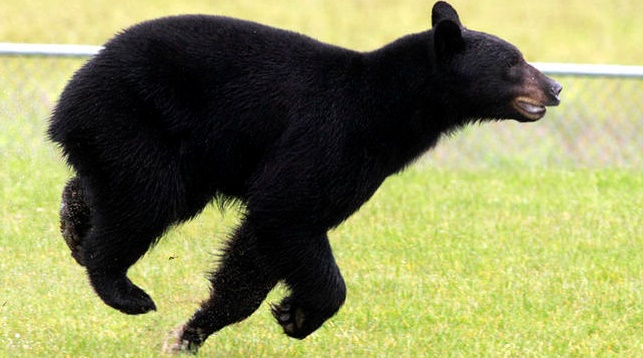
The bear that thrives

running bear

All over the world, we hear the story of bears. The polar bear may die out due to climate change. The grizzly bear lives only in tiny pockets of its former range in the Lower 48. The spectacled bear is not long for this world, and the giant panda is an avatar of the movement to save endangered species.

American black bears are not among the endangered or threatened, though.  They are doing well in such densely populated states as New Jersey.

They are also doing quite well in the wild and wonderful land of West Virginia. When I was a boy, my grandpa loathed bears. If anyone mentioned a bear popping up near his land, he would always go “There isn’t room enough for me and bear in these woods.”

I don’t know where this bear hatred came from, but his ancestors were small farmers who may have lost hogs or sheep to the odd roving bear.

I remember one year that something knocked over his 200-pound deer feeder. It obviously had to have been a black bear. At that time of year, a bear would have been in hyperphagic mode, and the taste of cracked corn in the deer feeder would have been a pleasant repast on a balmy October day.

He never caught the bear in question, but I knew that he really wanted to. He wanted to shoot it for daring to be in this civilized world.

The reason that bear never got killed is because its kind learned long ago to live with us.

And the best way to do that is to avoid our kind at all costs.

By the time I was born, there were only about 500 bears in the state of West Virginia, and now there are about 10,000. Those 10,000 descend from those 500 survivors, who taught their cubs how to thrive in a land where the guns are loaded.

If you see a bear in West Virginia, well over 9 times out 10, all you’ll see is a black form charging into the timber to get as far from you as possible.

The bear that thrives is the bear that knows that the best thing to do when encountering one of us is to run away.

I know that other black bear populations where they sometimes hunt people or, at the very least, tear up garbage.

But not here, they survive only because they are afraid. Fear makes them good neighbors.

And that is the only way a bear can thrive.


Read Full Post »

Passion

DSC02195

From the time I was child, I knew my passion.

Growing up in the backwoods of West Virginia is a blessing and a curse. It’s a curse because it assumed by those living outside your native district that you are some sort of savage who cannot use the queen’s English properly, makes regular use of the outhouse, and never wears shoes.

And now it’s mixed up with an assumption that you must have a laundry list of right-wing political views, which I obviously don’t.

But the blessing of having been raised in a part of America that has been left to go wild is that I know what living things are.

My grandmother was an ardent photographer, and one of the earliest photos of me that she took is me standing next to a chipping sparrow chick. The photo shows a half- feathered out chick that had experienced the misfortune of falling out of its mother’s nest. Such a bird’s fate is usually sealed once the long veil of the night descends upon the scene and the various denizens of darkness come to prowl.

But the look on my face shows no knowledge of the horror that will soon come. Three-year-old me is enthralled by it.  I guess I had seen so many chipping sparrows fly away from me that I couldn’t help but have my curiosity piqued at this one that simply could not.

I have always been this way.  When I was very young, trips to the North Carolina coast would mean my grandparents would take me to the aquarium several times a day. And when a Hereford cow got loose and had her calf by my swing set,  my parents told me years later that it “made my day.”

I still felt that passion years later when a big coyote followed one of my golden retrievers out of a thicket. The two canids strolled up to within ten feet of me. When the coyote realized that it had foolishly approached me, it stopped and stared for no more than two seconds before bolting off as it had seen the angel of death. I can still remember those wild amber eyes, their intensity, their intelligence, and their terror. It was a dark gray wild dog, the one so despised by all around me, and yet I felt no hatred toward it.

It was more like awe and reverence.

And to be truly honest, I was more amazed at the European brown hares and rooks that I saw in the hayfields around Stonehenge than the famous pile of rocks itself. I’d only ever read of European brown hares, and to see one in the flesh was oddly cathartic.

My teenage and early adulthood trips to the North Carolina coast weren’t so tied to the aquarium. By that time I’d been given the liberty to wander the beach on my own, and walking just beyond the easily accessed parts of the public beach on this Outer Bank, I was able to wander into a world of shorebirds, gulls, pelicans, dolphins, and ghost crabs. One day on my travels I happened upon a dead pygmy sperm whale that had washed up on the beach. Only a few months before I had read all about these small whales, and as I began to marvel at it, someone asked what kind of whale it was.

And I couldn’t stop myself from answering. I explained what it was and what it ate and its relationship to the cachalot. I can’t remember what I said, but I know I had to have been a better marine biologist than George Costanza.

My passion is what has been called “animate creation,” but as someone who accepts evolution, such a term really doesn’t fit.  These are the other beings, our cousins forged just as we were in the long journey of natural selection.

In my secondary education, I forsook my passion to study what was safe. I knew I was never going to be any kind of biologist, so I turned to history and social science.

And did well.

But nothing in the affairs of our own species can bring out my true self in the same way animals can.

Perhaps it is because unlike our kind, they are not sullied with delusions of grandeur or entitlement. They know only to exist and live as their natural history dictates.

And there is something oddly appealing about such an arrangement.

But so outside the grasp of a mere human being.

Our kind truly is cast from the Garden for good, and yet I want to have taste of it, if only for the tiny bit that one can glean from a brief sojourn.

This is what makes me live.

There is a sweetness to it.

If only I could taste more.


Read Full Post »

« Newer Posts - Older Posts »

Follow