Feeds:

Archive for the ‘dog domestication’ Category

MHC variability suggests that dogs were domesticated from a large number of wolves

Dave sent me a link to this study in Heredity that looked a major histocompatibility complex (MHC) variability in domestic dogs.

It found that dogs were so diverse in the MHC in their haplotypes that there had to have been at least 500 wolves in the founding population.

It included 128 Asian dogs in this analysis, and it found that Asian dogs had greater diversity in European dogs, and of course, this leads to people crowing about evidence of an Asian origin for the domestic dog.

Not so fast.

MHC haplotypes have generally been lost as Western dogs have become breeds, and they continue to lose them as popular sire issues stratify the already closed gene pools.

Asian dogs, whether they are construed as breeds or not, have not already undergone this process. Or if they have, they’ve done it for very long.

I am not skeptical of the notion that lots of wolves were used to found the population that became modern domestic dogs.

I am, however, quite skeptical of the hypothesis that dogs originated in East Asia.

It’s much more likely that this was a long process that involved many wolves over a long period of time.

And it happened in many different parts of Eurasia.

Further, it’s also very likely that the dog lineages we have now are but remnants of what once existed. We’ve likely lost y-chromosome and mitochondrial DNA lineages,  as well as MHC haplotypes, and because we’re looking at only what exists now, it is actually something a dubious undertaking to try to divine dog origins in this fashion.

We are trying to read backwards through using living dogs, but what we really need are studies of DNA samples from very old specimens– which are not easily procured.

I think the process is likely much more complex than we might like it to be, and it had to have involved the agency of both certain wolves and humans. Without both species exhibit some sort of agency, there would be no domestication of the wolf.

Black-backed jackals have scavenged off of man for a very long time. They have lived in our cities and camps. And they are no black-backed jackals with floppy ears and spots and all the other features we associate with domestication.

For decades, people have looked for simplistic answers to the question about how wolves became dogs.

They’ve not found them.

We’re talking about two species that have pretty complex behavior, and to try to reduce them into a grand theory of domestication is probably not the best way to proceed.

It’s likely far more complex than we can understand at this time (if we can ever understand it at all).


Read Full Post »

Monogamy and polygyny in canids

Strict social, sexual, and genetic monogamy are the general rule for coyotes living in urban environments. Photo by RC Williams.

Monogamy is pretty rare in mammals. Only 3-5% of mammals are monogamous.

Ethologists generally define monogamy as a social organization in which one male and one female live together. Usually, the male helps the female care for any offspring that are born, though he is not always the father. We usually refer to this as “social monogamy.”

Genetic and sexual monogamy is something else. They actually not that common, even in species that thought of as pairing for life. There are countless studies of female songbirds “cheating” on their mates. In colony breeding birds, like budgies, there is often quite a bit of philandering going on. New World quail are often touted for their monogamy, but the truth is that some captive breeders of bobwhites will put compose breeding colonies that consist of one cockbird for every hen.  Some males will mate with multiple hens, and because the custom is to place the eggs in incubators, it really doesn’t matter if the male cares for the young.

I should note that humans are not considered a monogamous species. This may sound somewhat shocking to Westerners, who have lived under a one man and one woman marriage system for centuries, but humans are not truly monogamous.  Not all human cultures have monogamy as the primary structure of the family, and as a construct, it may have never existed until humans developed widespread agriculture and clearly defined property rights–and the rights to inheritance of that property– became important. Even then, we can’t say that monogamy was the default breeding system of human. “True biblical marriage”– a phrase we hear bandied about quite a bit in the US– was often one man and several wives.

So monogamy really shouldn’t be treated as if it were the natural way for humans to reproduce and organize family units.

It’s just that it’s become the main way many societies have decided to operate.

With canids, social monogamy is unusually common.  Virtually every species of canid has some form of social monogamy. In most species, males and females form a pair bond, and the male helps the female raise the pups or kits.

In the social hunting canids, the pair bond is the basis for the pack. There is always a pair-bonded male and female at the center of the pack, and the pups born to those parents are born in the main den and get most of the care from the other members of the pack.

Pair-bonding in canid likely evolved for a very simple reason. Canids are born in a very underdeveloped state, and because the ancestral canids were small and relatively weak carnivores, it was very hard for a female to get enough meat to feed her offspring. Further, she would probably have to leave her den for extended periods of time, which would open her offspring up to predation.

It may have been that the only way that canids could reproduce is if the male stayed and helped the female raise the young.

Now, this is actually a very inefficient way to spread genes. Male animals produce a lot of sex cells. Sex is very cheap for males, and in most mammal species, the male mates with many females to get his genes spread most efficiently.

But from a gene-centered view of evolution, this works only if the females are likely to give birth to young that will survive into maturity.

It may have been that in the ancestral canid, it was virtually impossible for young to survive without the paternal care.

And this may have placed such as strong selection pressure on canids, that this became the most common way they reproduce and organize their social units.

Because males of any species can spread their genes more efficiently through promiscuity, these selection pressures had to have been very strong. Otherwise, we wouldn’t see so much monogamy in canids.

Now, as I pointed out earlier, social monogamy is different from sexual and genetic monogamy. Cheating is actually pretty common in canids– at least in the species that have been studied the most closely. It is fairly common in red foxes. In one study that examined the DNA of red fox kits to ascertain their parentage, 80 percent were fathered by a different dog fox than the one currently pair-bonded to their mother.

Male foxes and other socially monogamous species that do cheat are operating as sort of “half cuckoos.”  Many species of cuckoo are nest parasites. The female cuckoo comes to another bird’s nest and lays an egg in it. The chick hatches after a very short incubation period, and the chick then throws out the eggs that belong to its surrogate parents. The parents raise the cuckoo chick until maturity. They invest so much time and energy into raising it, but the chick they raise does not carry their genetic material. These cheating foxes give half their DNA to fox kits that will be raised by a father that isn’t their own. The kits will have the mother fox’s genetic material, but her pair-bonded mate will be raising offspring that are not his own.

It’s actually not an inefficient way for a male fox to get his genes spread around. It also increases the likelihood that his genes will be carried on into the next generation.

The foxes are not consciously choosing the way they spread their genes. It’s just that their behavior results in this being the way that their genes get carried into the next generation. Strict monogamy places severe controls upon how efficiently and quickly genetic material is spread. It would only exist if there were strong selection pressures to keep monogamy as the main breeding system.

In some red fox populations, the half cuckoo strategy gets the both of best worlds. Male foxes can spread their genetic material rapidly and efficiently, and the offspring get cared for by a pair-bonded male.

This is sort of middle ground, and it’s probably what most wild dogs actually do. They are only socially monogamous, and there is at least some cheating going on.

But there are exceptions.

Coyotes are very strictly monogamous. A recent study of urban coyotes found that without exception, females gave birth to pups that were fathered by the male with whom she had a pair bonded. Similar rates of monogamy have been suggested for golden and black-backed jackals, though they have not necessarily been confirmed through genetic testing.

Coyotes and golden jackals are very similar to the primitive ancestor of the wolf. Indeed, what may be the oldest extant subspecies of wolf has long been classified with as a subspecies of golden jackal. So it is very likely that the ancestral Canis species was a very strictly monogamous species.

Contrary to popular belief, wolves are not strictly monogamous. As David Mech wrote in The Wolves of Minnesota (2003):  “Wolves have long been considered monogamous. However, in reality, wolves are as monogamous–or non-monogamous–as human beings” (pg. 75). Mech then goes on to describe male wolves mating with multiple females. He points out that no one has seen a female wolf mate with multiple males, but the exact parentage could be determined through DNA testing.

Mech doesn’t point out that wolves actually have two reproductive strategies. The first of these is the most common, and the one that every one knows.  A wolf pack is actually an extended family. It consists of a pair-bonded male and female and their grown offspring. Occasionally, siblings of the pair are included in the pack, but most of the pack is a male and female and their grown offspring.

Now, these grown offspring almost never remain in their natal packs their entire lives. At some point, they’ll want to mate, and in wolves, mating is very strictly controlled within packs. The mated pair get free license to mate with each other, but because wolves have both inbreeding avoidance behavior and social suppression of estrus in the subordinate females, the chances of more than one female getting pregnant from other pack members is pretty low. Female wolves won’t mate with their brothers, and they will only mate with their father if their mother dies. If they try to mate with their father, they are likely to be attacked. If the males try to mate with their mother, she usually won’t let them, and if they try, their father will attack them.

However, virtually all female wolves get pregnant at some point in their lives. This includes subordinate females that are in their natal packs.

How does this happen?

Well, there are wolves that use another strategy for reproduction. These are the so-called “Casanova wolves” or “lone rangers.”  These are male wolves that leave their parents’ territory and then hang out on the margins of the territories of established packs. When the estrus time comes, it is not unusual for a subordinate female to become pregnant by a “ramblin’ man.”

This strategy is more risky for two reasons.  The first is that the chances of Casanova wolf being killed when he shows up on a pack’s territory are pretty high. Wolves believe in “No trespassing: Violators will be eaten.”  Quite a few dogs have figured this out the hard way!

The other is wolf society almost guarantees that his pups won’t be born.

Now, in a wolf pack, only that female that has the pair bond with the male gets preferential access to dens and food. Both of these resources are typically quite scarce, so the female with the pair bond gets these resources first. If they run out, the pups belonging to the subordinates don’t survive. In some cases, it is possible that the main breeding female kills off the offspring of the subordinates– and this has certainly been observed in captive packs. That this one female gets to have preferential access to the dens and to the food is the definition of dominance.

There is some evolutionary advantage here. If all these female wolves have pups and the subordinate females lose them, then they will have a milk supply and strong maternal behavior for the main breeding female’s litter.  These two features would have been present in most female wolves whether they became pregnant or not. The false pregnancy and the subsequent lactation and maternal behavior observed in many domestic dogs is also evident in wolves, but if the females have had puppies, these behaviors will be that much stronger.

However, there have been wolf populations where multiple females have produced pups and raised them to maturity. The main breeding female’s pups are sired by her pair-bonded mate, but those of the subordinates are all sired by Casanovas. Some wolf packs– particularly those in Yellowstone– seem to be more tolerant of multiple breeders. This may be because Yellowstone wolves have access to rather extensive prey resources.

It should be noted that domestic dogs generally use a variant on the Cassanova strategy. Pair-bonding is virtually unknown in domestic dogs, though it should not be considered nonexistent.

In a book that gets trashed mainly because of its somewhat extreme anthropomorphism, Elizabeth Marshall Thomas describes a pair bond that existed between her two Siberian huskies. She unfortunately called their pair bond a marriage, and well-known scholars trashed it. However, the behaviors that existed between those two huskies were not that different than those between two wolves. The male actually vomited up food for his mate, and the female would not allow other males to mate her. The male may have had some women in the side, but Thomas never mentioned this dog mating with any other dogs on his travels. (She also rather infamously let him wander the streets of Cambridge, Massachusetts, and for several years, she followed him on bicycle to see what he was doing on his ramblings.)

But she also describes the other way in which dogs reproduce– the main way. When the male husky is given away because of his excessive roaming, the female reverts to the normal dog mode of reproduction, even trying to mate with one her adult male sons.  Thomas describes what female dogs normally do as “a businesslike sexual encounter, wherein a female who cares little or nothing for the male seeks only to get herself bred.” Thomas goes on to describe street dogs copulating on the streets of San Jose, Costa Rica.  She describes their mating behavior is simply a fleeting affair, though she couldn’t see the entire episode because she was afraid of what sort of attention she might have been drawing to herself by watching such a spectacle.

Dogs generally reproduce this way. Because they have become polygynous, selective breeding is much easier. If a male has  desired trait, he can be bred to multiple females, and if a female produces a trait when mated with one male, one can easily breed her to another.

Wolves are not nearly so willing to have their mates chosen for them. Many wolves want to form pair bonds with their mates, just as some dogs do. And if you’re forming a pair bond, you’re going to be more selective about your mate.

The question of why dogs use this Casanova strategy has not been fully answered.

As I noted earlier, one of the reasons that is suggested as to why Yellowstone wolf packs tolerate multiple breeding females is that Yellowstone wolves have much greater access to prey. Resources are less scarce, and the subordinate females can raise their puppies to maturity. The Casanova strategy works when this is the case.

It is possible that the wolves that became dogs found themselves in a very resource rich environment when they began scavenging off the massive surplus kill sites that ancient humans created when they drove ungulates like horses, red deer, and reindeer off cliffs or into box canyons, where they could be entrapped and easily dispatched with boulders or well aimed spears. Some wolves may have adapted their entire culture to living near humans and the riches of surplus killing. The wolves may have even helped participate in the hunt, which would mean that humans would have left them some booty on purpose.

In that sort of environment, the resources would not be that scarce, and the Casanova strategy would work very well. And because Casanova wolves can sire more puppies over their lifetimes, it wouldn’t take very long before wolves with a lowered tendency to pair bond would swamp the population.

And then, as time went on, humans were much more willing to help the wolves raise their puppies, and the selection pressures that ensured very strong paternal parenting would have been relaxed significantly. Although most male dogs love puppies, only a small percentage will vomit up food for them.

Now, we don’t have direct evidence that increased food supply results in more polygyny in wolves. However, on Round Island in the Bering Sea, red foxes typically are polygynous. They live on an island with vast numbers of breeding seabirds, so the vixens can raise their kits on their own. However, when the Bering Sea experiences El Niño, the seabirds can’t raise offspring. Seabirds often rely upon small fish, which are more easily caught in cooler water. When El Niño hits, the fish can swim faster, and the birds can’t catch them. And some species of fish don’t like the warmer water at all and don’t hang out near the island, which means it is very difficult for the parent birds to raise any chicks. The foxes primarily eat the chicks and the eggs, and if there aren’t a lot of chicks produced every year, then the resources get tighter, and the foxes have to hunt voles and eat walrus carcasses that wash up on the beach. Under those conditions, the vixens that have pair bonded are more likely to raise kits to maturity than those that have had them on their own.

And this has generally been the model for understanding when canids will adopt monogamy or polygyny.

But there is an exception to the rule.

Remember that urban coyote study I mentioned earlier?

Urban coyotes have access to great resources. They can scavenge out of dumps. They raid trash cans. They can hunt cats. They can steal pet food.

But they don’t develop polygyny. They remain monogamous.

I don’t know of any studies in which the paternity of coyote pups living in other enviroments was examined, but it is a fair bet to say that if coyotes in urban environments are highly monogamous, then those living in rural areas probably are, too.

It may be that selection pressures that produced pair-bonding in coyotes is so strong that it is very hard for them to change it.

There may also be something hormonal in what is keeping them so tightly bonded.

In recent years, there has been a lot of research on prairie voles. Prairie voles are unusual in that they are monogamous. All other voles in North America are polygynous.

So this set up an interesting research question:

Why were prairie voles so willing to form pair bonds while the others were not?

It turns out that prairie voles have more receptors in their brains for particular hormone called oxytocin than other voles. In particular, prairie voles have a large numbers of these receptor in a part of their brain called the nucleus accumbens, which plays a vital role in the pleasure and reward system. When these voles get together, oxytocin, which is associated with sexual attraction, is released, and this oxytocin actually stimulates the reward and pleasure function of this part of the brain, which means that the being together becomes an even more pleasurable experience than it would be for a polygynous vole.

I wonder if something like this is going on with coyotes. I wonder if there is a difference in the number of oxytocin receptors in the brains of coyotes, wolves, red foxes, and dogs.  It could explain why monogamy is so rare in domestic dogs and why it is almost the rule in coyotes.

It is likely that monogamy in coyotes is one factor keeping this species distinct. Although there is plenty of evidence that many populations of coyote are mixed with dogs, they all still remain primarily coyote in ancestry. The distinctness of the coyote species may be that they have such a strong tendency toward monogamy. Wolf and dog genes may enter the population at times, but they may happen only before a coyote bitch forms a pair bond with a member of her own species. Or maybe male wolves and large male dogs are powerful enough to be able  to drive her mate off and to force her into copulation. (All wolf and coyote hybrids that have been detected have been male wolf and female coyote crossed. The same is generally assumed for coyotes and domestic dogs, but there is evidence of dog mtDNA sequences in some coyote populations, which means there must have been some way that female dogs could have worked their way into the coyote gene pool.  I think the intentional release of coydogs as game animals is a possibility. It seems unlikely that a domestic bitch would be able raise her hybrid pups in the wild.)

It may have been that the wolf’s flexible social and mating systems made them much more easy to domesticate than other related species. It also may have been that the wolf is naturally a very social species, but it is not as intensely social as African wild dogs or dholes are.

At the base of canid mating and social systems is the mated pair. All living canids have some version of a monogamous social system, but only a handful have been found to be genetically and sexually monogamous. Most of them will cheat, and most of them will adjust their mating and social system to fit the relative abundance of food resources.

But monogamy is rare in mammals.

For it to have ever been used by creatures as successful as those in the dog family, there had to have been intense selection pressures for that behavior.

And it had to have worked very well.

We really don’t know when canids started being monogamous, but it was probably very early on. Otherwise, it wouldn’t be such a common feature for this family.

Monogamy in canids is one reason why we like them.

They are like us– with husbands and wives and little kids.

That’s how we anthropomorphize.

Farley Mowat once extolled the wolf for its supposed monogamy, and he then half jokingly excoriated the dog for picking up too many of many of man’s promiscuous happens.

That’s not really an accurate picture, but it is certain true that when some species of wild dog form a pair bond, it is very tight.

It is something like modern Western marriage.

But it has a much stronger evolutionary reason for its existence than our institution.

The truth is dog species probably would not have been able to survive without forming pair bonds.

It always took two parents to raise the kits or pups to maturity.

Domestic dogs don’t need pair bonds anymore. They have humans to take care of their offspring.

In a weird way, we’ve become like the host bird to the parasitic cuckoo. The dogs whelp their puppies and nurse them for eight weeks.

Then we take over the raising of them.

They don’t have any of our genes, but they are our kin.

And I don’t think we’d have it any other way.

Read Full Post »

Can you tell a wolf hybrid by looking at it?

These two photos depict two wolf hybrids.

The animal on the left, with its floppy ears and black-and-tan coat, is an F1 wolfdog from Wildlife Park Kadzidlowo in Poland. He was intentionally bred from a “Polish spaniel” dog and a European wolf bitch. I am not sure what breed of spaniel the father was, but this hybrid reminds me very much of the Gråwachtel, a German spaniel (“wachtelhund”)/Norwegian gray elkhound cross. The dog features predominate. It looks like nothing more than a really feral-looking retriever type dog.

The animal on the right is a first generation cross between a West Siberian laika dog and a female wolf. Breeding West Siberian laikas to wolves is really nothing new, and the practice continues in Russia to this day. Knowing the politics of wolf hybrids in the United States, it might not be wise to discuss this feature in the West Siberian laika. There is a certain politically correct movement that views any sort of wolf hybrid as a skittish, dangerous animal, when in reality, the animals vary quite a bit. Having been around a West Siberian laika, I can attest that they are less wild and skittish than many other Nordic breeds.

The truth is you can’t tell a wolf hybrid by just looking at it. If the dog in the cross has floppy ears, it’s not going to look like a wolf at all. It may act more like a wolf.

Or maybe not.

The differences between wolves and dogs are more complex than you might think.

Unfortunately, this problem gets worse when certain people make absolute claims about wolves, dogs, and wolf hybrids.

The one absolute claim one should follow is always be leery of absolutes!

When someone says “never” or “always,” they are setting themselves up for error. All it takes is one example that goes counter to the claim to make it false.

And that’s what happens.

There are pure wolves that are as docile as golden retrievers when they are brought up imprinted upon people.

There are also dogs that are very reactive and nervous and only bond to a few people– just as most captive wolves do. There are pure wolves that have made decent hunting and working dogs.

There are wolf hybrids that have killed people, and there are wolf hybrids that have been the perfect pets.

Because of the complexity of the wolf and dog question, I cannot consider dogs and wolves distinct species.  There is just too much overlap between dog and wolf to make such absolute distinctions.

I will use Canis lupus familiaris to describe the dog.

I think one of the biggest obstacles to getting people to understand why wolves are dogs is that the only wolves people seem to know about are the big wolves from northern ranges. What they don’t realize is that these wolves are not the totality of their species. They are actually a fairly specialized variant that evolved in the northern parts of Eurasia and North America to hunt things like moose, caribou, elk/wapiti, bison, aurochs, and muskoxen.

There are also wolves that are much smaller in the Middle East, South Asia, and yes, Africa, that are much more dog-like, and at least one study points to Middle Eastern wolves as being the primary source for most of the genetic diversity in the dogs we have today.

Wolves are actually a very diverse species, and historically, they were even more so.  Dogs are just a reflection of their ancestral species diversity. Once removed from the rigors of natural selection, humans can play with that ancestral wolf genome to produce what is really the most morphologically diverse population in the world.

One cannot tell a wolf hybrid just by its appearance.

And one cannot always tell a wolf by its appearance either.

This white wolf-like animal was captured in Los Angeles:

The facility that bred it actually said it was actually 1/8 Great Pyrenees!

Wolves and dogs are wild and domestic populations of the same species.

The wolf itself is really a vestige of what was once a very diverse species.

Wolves managed to range over almost all of Eurasia and all of North America from the Valley of Mexico to Greenland. Their range in Africa has only recently been revealed through genetic studies.

And this species became successful because it could adapt its morphology– perhaps rather rapidy— to fit new ecosystems and prey sources.

To live in the same places, humans adapted new technologies. Wolves adapted their bodies through evolution.

A domestic dog is just a wolf that has evolved to live with humans. It’s a different niche, and humans did quite a bit of selective breeding to produce unusual body types.

But the body template and the vast majority of the genome are still those of a wolf.

Dogs are wolves in terms of their phylogeny and genes.

They may look very different now.

And dogs may be much better adapted to living with people.

But dogs and wolves haven’t diverged that much.

And when a floppy-eared dog mates with a wolf, the results can be somewhat disconcerting.

We expect the wolf dogs that result from the mating to look like wolves and not Labrador crosses.

It takes us aback.

And it makes us wonder.

***

The top image comes from this recent study that confirmed hybridization between male wolves and female dogs in the Baltic states.

Previous “naturally occuring” wolf dogs in Europe have all been between male dogs and female wolves, which is one reason why the studies that one cannot use mtDNA studies on European wolves to confirm or deny the introgression of dog genes into the wolf population.

There will be more  on this study in a future post.

Read Full Post »

Why are we trying to domesticate fennec foxes?

There are two basic reasons:

The first is that fennec foxes don’t have the same musk glands as other vulpine foxes.

That’s actually quite a plus.  Other foxes– especially red foxes– are known for producing an odor that smells something like that of a skunk.

Fennecs don’t produce that odor.

The other is that fennecs live in packs.

They don’t live in packs to hunt larger prey, but their family groups have essentially the same dynamics as a wolf pack.

A wolf pack is based upon a mated pair that have an intense pair bond, and virtually all the other animals in the pack are their grown offspring, which stay behind to take care of their younger brothers and sisters.

This same dynamic exists with fennec foxes.

With more than two adults to forage over the desert, the young fennec kits get more attention and more food than they would get if only their mother and father were caring for them.

Humans have already domesticated one dog species that has this particularly social arrangement.

It’s actually been suggested that reason why humans domesticated wolves so easily is that both humans and wolves have similar social arrangements. Both wolves and humans may have recognized as similarity in this regard, and the two species were able to form very close relationships.

Maybe something similar could happen with fennecs.

It’s certainly true that most fennecs in captivity today are derived from ancestors that were dug out of dens.

In North Africa, people have kept pet fennecs for centuries, but it’s been only in the past few decades that anyone thought of keeping them in the West.

They are still wild animals. Not all individuals have docile temperaments, even when bottle-raised.

But it seems to me that as these animals become a bit more established in the pet trade, there will be attempts to breed them with more docile temperaments.

Although we have domesticated populations of red and arctic fox, these animals are not widely available on the pet market (for the reasons I mentioned earlier).

But fennecs could become the second canid species to become established as a domestic animals.

All it will take is a large enough gene pool of captive individuals and a concerted effort to selectively breed them to be suitable pets.

This may sound a bit far-fetched, but when I was a child, it was impossible to buy golden hamsters– even those with fancy colorations and coat lengths– that were naturally disposed to be tame.

All of the hamsters I owned bit me at least once, and most bit at least once a month.

Today, you can go to a pet store and buy hamsters that have been selected for “low reactivity.”

Hamsters have been bred away from the grumpy little things that they are in the wild.

And what’s more, pet golden hamsters derive from only a single litter that was captured near Aleppo, Syria, in 1930.

They are perhaps the most inbred of all domestic animals, but even though they are inbred, they have been able to produce just enough genetic variation to produce unique coat lengths and colors and just enough variation in temperament to produce very gentle strains.

Captive fennec foxes have a broader genetic base than golden hamsters, so it may be possible to begin another canid domestication process.

We’ve done it before.

We can do it again.


Read Full Post »

Hunting wolves with wolf hybrid hounds in Brittany

Chien gris de St. Louis. A type of large French griffon hound from the sixteenth century.

I came across this interesting account of a French noble using wolf blood to improve the hunting instinct of his wolf hounds.  The following text comes from Wolf-hunting and wild sport in lower Brittany (1875) by Edward William Lewis Davies :

I was fortunate enough that night to sit next to the Count de Kergoorlas at dinner; and hearing he was a master of wolfhounds in Upper Brittany, I gleaned from him some interesting information with respect to the style of hound he considered best adapted for his particular sport.

“A big, bold, broken-haired hound is what I keep for the work; and occasionally I invigorate the race,” said he, “with a strain of wolf-blood.”

“And how, pray,” I inquired, “do you manage that?”

“Nothing is more simple. The dog and the wolf being congeners they breed readily together; nor does the law affecting mules affect the hybrid race, as the offspring of the first cross reproduce their litters with the same facility. I keep a dog-wolf brought up by hand; and he, suckled in infancy by a hound dam, lives in perfect concord with any hounds I think fit to enclose with him in his kennel; while a day or two reconciles a strange hound to his company.”

“And do you find the first cross,” I asked, “as manageable in chase as your ordinary hounds?”

“Far from it,” he replied; “insomuch that I only keep that produce to breed from. They usually run mute or all but mute, and are so self-willed in chase and so fierce in kennel, that I merely use them as stud hounds, and enter the second cross. These, the grand-offspring of the wolf, become rare wolf-hounds, fierce, fine-nosed, desperate in chase, and never tiring during the longest day. But, to be candid, they have one great fault: they are too shy of their tongue; nor can this defect be bred out for several generations, although tonguey hounds are especially chosen for the purpose of every cross. The old nature of the wolf appears and reappears, and no device of human ingenuity can pitchfork it away.”

I have since learned in my own country, from that keen and experienced sportsman, Mr. Waldron Hill, who brought over several couples of these hybrid hounds from the Department of Eure, and whose object it was to enter them as otter-hounds, that they had at least one other fault, which he found utterly ineradicable, in fact, the old wolf coming out again in them. They would kill sheep; and, as he justly remarked, that to hunt the sheep was a far more expensive amusement than hunting the otter, he hanged the whole of them. In the Count’s country, however, this vice would not be observable, as there flocks of sheep are not found depastured abroad and roaming at will on a thousand hills, as in this more favoured land (pg. 25-26).

This is not the first time I’ve encountered stories of people crossing wolves and dogs to produce a superior hunting animal.  Henry Wharton Shoemaker described the exact same thing happening in Pennsylvania, and it has always been claimed that the various types of cur, particularly the Catahoula and Lacy dog, have a bit of wolf ancestry.  Several reindeer-herding and hunting spitz breeds from Finland and Scandinavia have also been found to have some wolf blood.

The hound described in the text is some sort of griffon, which is why someone tried to pass some of them off as otterhounds. Otterhounds do have some blood from the French griffon hounds, especially the Griffon Nivernais.

It’s not entirely clear if any modern hounds that derive from these French hybrid wolf hound packs.

It’s certainly possible, but one should not necessarily assume that all of these are wolf dogs in the same way as the Saarlooswolfhond.

However, this account is yet another example of humans using wolf blood to improve working dog stock.

And it’s also one of the reasons why I don’t use Canis familiaris as the scientific name for domestic dogs. That name assumes that it is a true species.

But the truth is it is nothing more than a very successful subspecies of Canis lupus.

And there have always been relatively significant amounts of gene flow between both wild and domestic Canis lupus populations.

Whether we want to admit it or not.


Read Full Post »

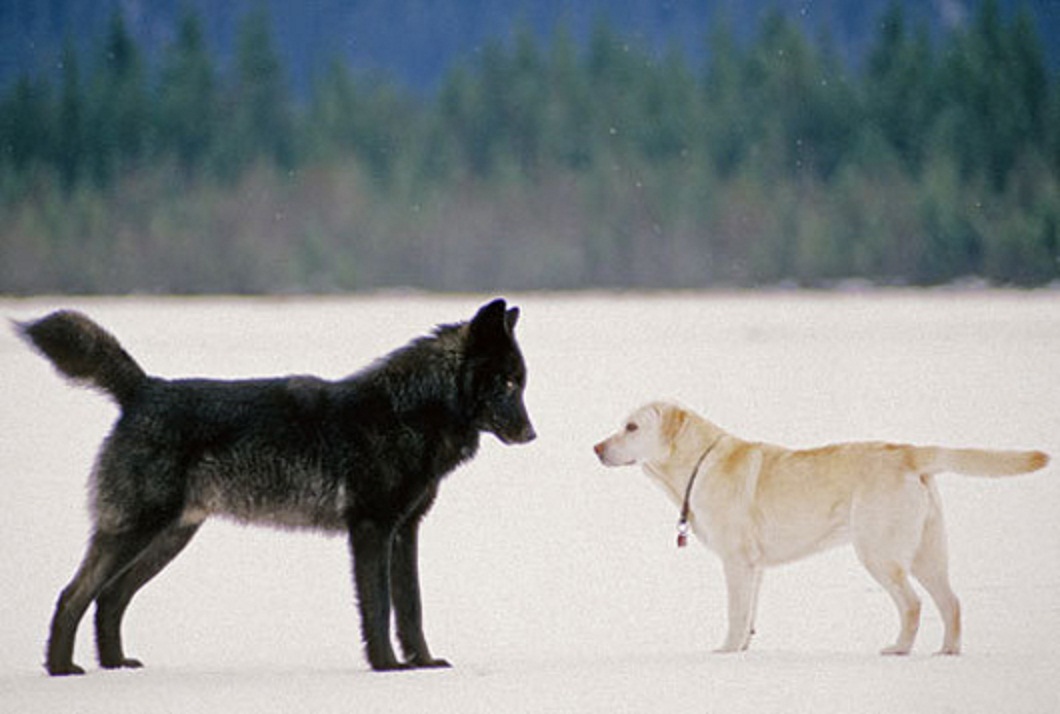
Romeo and a yellow Lab

Not all wolf and dog interactions are adversarial.

Take the story of Romeo.

Romeo was a black wolf who liked to hang out at the Mendenhall Lake near Juneau, Alaska.

Lots of people walked their dogs there, and Romeo joined up with them.

According to most stories, Romeo lost his mate, and then he tried to bond with a female Labrador retriever that was brought to the lake on a regular basis.

He eventually extended his friendship toward virtually all dogs that were walked there.

In 2010, Romeo went missing.

Although his exact fate has never been confirmed, it has been claimed that a hunter killed Romeo.

But while he was alive, Romeo’s interaction with many different domestic dogs became something of an internet sensation.

A simple Google Image search for “Romeo the wolf” will reveal dozens of photos of a striking black wolf standing next to an assortment of common domestic dog breeds.

The juxtaposition of a Northern-type wolf with mostly Western dog breeds is quite striking.

One can see how much more robust this sort of wolf is.

One can tell that his kid of Canis lupus evolved to hunt the big game. Their massive teeth and jaws help them drop moose and bison.  Their massive heads anchor enormous jaw muscles that allow them to deliver punishing bites and break thick bones.

If the latest genomic data is correct, the modern strains of domestic dog are derived from an entirely different sort of wolf, the more primitive and slightly-built “Southern” wolves of South Asia and the Middle East.

Romeo is the sort of wolf who would have contributed his genes to domestic dogs.

In the thousands of years that existed before humans regularly spayed and neutered and confined dogs, wild genes had a way of working their way into the population.

Unattached wolves like Romeo would sometimes mate with the domestic bitches they encountered.

Dog and wolf initially started out as a cultural distinction.

Humans regarded the wolf as wild and the dog as tame.

They are still the same species, but now each has adapted to its niche.

Just as the Romeo’s subspecies has adapted to hunting large game in frigid environments,  the wolves who became dogs adapted to living in the human world.

Here are two types of wolf that have specialized and adapted to very different environments.

One of them has hitched its evolutionary wagon to the Homo sapiens star.

And it has thrived beyond any reasonable expectations for a relatively large carnivoran.

The other subspecies is doing okay.

But it will never have the success or the range of the human-adapted one.


Read Full Post »

An argument based upon a false analogy

I’ve actually run into this statement quite a bit:

We can’t know much about dogs by studying wolves. It’s about as much as we could find out about human behavior while studying chimps and bonobos.

That’s a cute one!

Unfortunately, it’s a bad analogy.

Dogs are not to wolves as humans are to chimps and bonobos.

Dogs are to wolves what modern humans are to archaic Homo sapiens.

It’s also not dogs are to wolves as humans are to Neanderthals. That analogy would be dogs are to coyotes, golden jackals, or Ethiopian wolves as humans are to Neanderthals (and maybe Denisovans and other descendants of Homo erectus). Same genus. Chemically interfertile.  Not the same species.

We can actually learn quite a bit about ourselves by studying humans who were around until 30,000 years ago but were much more robust than any living person.

The line that divides modern humans from archaic Homo sapiens is quite fuzzy, just as it is with defining the difference between dogs and wolves.

Contrary to what you may have read, the line separating dog and wolf is very, very fuzzy. There are doggish wolves and wolfish dogs, and the only physical features separating them are that wolves (at least  of the northern subspecies) lack sweat glands on the feet and dogs don’t have an active supracaudal gland. There are dogs that have brains that are proportionally the same size as those of southern wolves, which are the main source for modern domestic dogs.

There have been wolves  that were tamed at 6 weeks, and even fully grown adults have been tamed.

And there are dogs that are so nervous and hard to handle that they might as well be wild animals.

Humans are not chimpanzees or bonobos.

We’re actually much more different from them than dogs are from wolves.

For example, most people would never want to breed with a chimp, and humans, unlike male chimps, typically only attempt to devour the faces of other humans while high on bath salts.

However, there are plenty of cases of dogs and wolves interbreeding. Studies of free-roaming dogs and wolves in Italy found that female wolves that had not yet found a mate, would often solicit the attention of male dogs while in estrus.

Most single women don’t want to go on a date with a chimpanzee!

(Though bonobos, well, they are the doctors of love.)

When I see someone using this analogy, it makes me wince.

I know people are trying hard to fight the Cesar Millan-malarkey out there.

But too often, I see these anti-lupomorph or dominance theorists making claims that are just as bad as anything you’d hear from the Dog Whisperer.

Let’s try to get our analogies right.

Let’s understand what we’re actually opposing.

It’s not the entire phylogeny of Canis lupus familiaris.

Just because idiots use that Canis lupus part of the scientific name to make stupid arguments doesn’t mean that you should reflexively reject it.

We’re not exactly the same thing we were 30,000 years ago.

Neither are dogs. (And really, neither are wolves).

Evolution is about change. It’s almost the entire definition of the phenomenon.

But just because things change doesn’t mean analogies don’t work.

It just means they have to be correct.

You can learn more about us by looking at our more immediate ancestors than from animals that derive from more distant ones.

You can know more about your potential health problems by looking at your parents and grandparents than you great-great-great-great-great grandpa.

In terms of its phylogeny, a dog is a wolf.

It’s not anything else.

One cannot evolve out of one’s phylogeny.  One can only evolve from it.

Dogs and modern wolves evolved from ancient wolves.

If we saw these animals today, we’d call them wolves, though they’d likely be much more willing to approach us than modern wolves are. They might even be readily tamed and actively seek us out as social partners.

Dogs underwent selection pressures to become more and more incorporated into human society. Most wolves experienced selection pressures that selected for extreme fear and reactivity– the result of all those centuries of persecution by our species.

I doubt that archaic Homo sapiens would have ever fit into urban life. Some of them might, but most would not.

It doesn’t mean that they were a different species from us.

It just means that there were lineages of our species that were adapted to an entirely different lifestyle and potential future.

That’s the difference between wolves and dogs.

They aren’t as different from each other as humans and other great ape species are.

But there are differences.

Nuanced, fuzzy differences.

Read Full Post »

« Newer Posts - Older Posts »

Follow