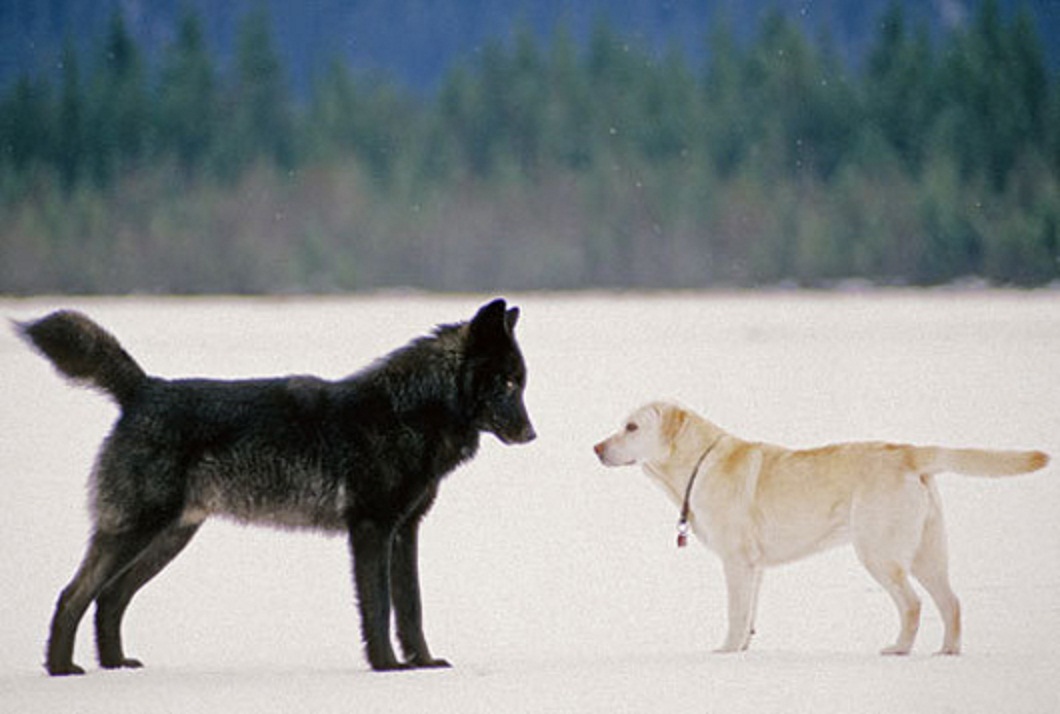
Not all wolf and dog interactions are adversarial.
Take the story of Romeo.
Romeo was a black wolf who liked to hang out at the Mendenhall Lake near Juneau, Alaska.
Lots of people walked their dogs there, and Romeo joined up with them.
According to most stories, Romeo lost his mate, and then he tried to bond with a female Labrador retriever that was brought to the lake on a regular basis.
He eventually extended his friendship toward virtually all dogs that were walked there.
In 2010, Romeo went missing.
Although his exact fate has never been confirmed, it has been claimed that a hunter killed Romeo.
But while he was alive, Romeo’s interaction with many different domestic dogs became something of an internet sensation.
A simple Google Image search for “Romeo the wolf” will reveal dozens of photos of a striking black wolf standing next to an assortment of common domestic dog breeds.
The juxtaposition of a Northern-type wolf with mostly Western dog breeds is quite striking.
One can see how much more robust this sort of wolf is.
One can tell that his kid of Canis lupus evolved to hunt the big game. Their massive teeth and jaws help them drop moose and bison. Their massive heads anchor enormous jaw muscles that allow them to deliver punishing bites and break thick bones.
If the latest genomic data is correct, the modern strains of domestic dog are derived from an entirely different sort of wolf, the more primitive and slightly-built “Southern” wolves of South Asia and the Middle East.
Romeo is the sort of wolf who would have contributed his genes to domestic dogs.
In the thousands of years that existed before humans regularly spayed and neutered and confined dogs, wild genes had a way of working their way into the population.
Unattached wolves like Romeo would sometimes mate with the domestic bitches they encountered.
Dog and wolf initially started out as a cultural distinction.
Humans regarded the wolf as wild and the dog as tame.
They are still the same species, but now each has adapted to its niche.
Just as the Romeo’s subspecies has adapted to hunting large game in frigid environments, the wolves who became dogs adapted to living in the human world.
Here are two types of wolf that have specialized and adapted to very different environments.
One of them has hitched its evolutionary wagon to the Homo sapiens star.
And it has thrived beyond any reasonable expectations for a relatively large carnivoran.
The other subspecies is doing okay.
But it will never have the success or the range of the human-adapted one.




I think I read something somewhere about Romeo finally breaking his pattern and attacking and killing a dog. I don’t recall the details.
He did kill a dog, but that was early-on and he played w/ others peacefully well after that event. Do you think the dog he killed was neurotic or psychotic and, recognizing something wasn’t right, he destroyed it?
BTW: he also apparently played w/ Pugs as though they were balls or stuffed toys–picking them up and running around w/ them, then dropping them.
From what I’ve read, it was never confirmed if Romeo killed a dog or not. A beagle went missing at that lake. Whether Romeo killed it or not, it’s all speculation.
Romeo was also famous for playing scary game with pugs. He would run in and pick them up and run off with them– and then drop them at full speed.
I think he thought they were puppies, and when wolves see puppies, the want to pick them up.
http://www.npr.org/templates/story/story.php?storyId=18292655
Apparently he did kill a Pomeranian.
But that’s even smaller than a fox.
And wolves eat foxes.
That pug has no marks on him. If the wolf had wanted to eat that pug, he would have killed it first.
What I find striking in that photo is the great similarity of form/proportions between Romeo and the Lab. The biggest differences seem to be size and coat . . . and if there were ever strains of wolves that evolved to work niches that entailed swimming, I’ll bet their coats would look Lab-like. In the post on Newfoundland origins, you mention that Richardson thought they were wolf-dogs . . . but that no genetic evidence supported that view. Does genetic evidence specifically exclude the possibility?
As for wolves killing dogs . . . if dogs are allowed to run free and forced to be self-provisioning, a lot of them would kill other dogs.
Without reading the description, I would have assumed that Romeo was just a really big, neat-looking dog – he looks like the “Alaska noble companion dog” that you featured several weeks ago.
I think you nailed it, the difference between dog and northern wolf, that is. Do you happen to know when northern gray wolf split from the southern ones for the first time? (Must have happened more than once, as ice ages waxed and waned.)
“One can tell that his kind of Canis lupus evolved to hunt the big game. Their massive teeth and jaws help them drop moose and bison. Their massive heads anchor enormous jaw muscles that allow them to deliver punishing bites and break thick bones.”
It occurs to me that if our “giant” breeds had derived from this strain of wolf vice the southern strains that they might not have all the giantism-associated problems they have today.
Actually, that’s not what the genetic data shows.
Dogs like mastiffs share a larger number of SNP’s with Middle Eastern wolves:
http://www.nature.com/nature/journal/v464/n7290/full/nature08837.html
It’s likely that the larger size came from breeding them larger.
It’s certainly true that mastiff-type dogs were around 14,000 years ago, but it’s unlikely that they all derive from the same root source.
Yes, I agree, they came from the same base stocks as all the Western breeds. What I was proposing was that if, they had descended from the NeoArctic wolves instead, they might not now have all those nasty side-effects of gigantism. It was a what if.
Has the the topic of giantism gene been sought after in research of neo-Arctic wolves?
If not, remember, the selfish gene only cares about producing copies of itself,, even at the dismal of the organism:
http://dogbehaviorscience.wordpress.com/2012/09/07/wolves-start-getting-old-at-2/
The large size gene or genes in wolves hasn’t been studied or discovered, unlike the small gene in Middle Eastern wolves and small dogs.
Those are interesting figures as a Saint doesn’t reach its full growth until approximately the age of 2.
Did Romeo sire any offspring with any dogs?
Not with any dogs.
He may have sired a litter with his initial wolf mate.
Another thing that makes Romeo look dog-like is that, in all the photos I’ve pulled up, he appears well fed. That may also make him more dog friendly. I wonder if people left food out for him . . . or he was self-provisioning.
[…] The Retriever, Dog, & Wildlife Blog Posted in Pet Health Articles | Tagged Romeo, yellow | Leave a comment […]
[…] El lobo Romeo y un labrador […]
Reblogged this on Snoopy's Collars and commented:
I love this story and they have finally released a book about Romeo!