Feeds:

This image comes from the Isle of Skye and dates to about 1900.

The dogs on the right are Patterdale/Fell types, but the ones on the left are far more interesting.

On the Isle of Skye,  two terrier breeds were developed– probably from the same landrace.

One of these is called the Skye terrier today, and it’s quite rare. It has a soft coat, and the dog on the far left appears to have something like this coat, although it could be an unstripped wire-coated dog. But wire-coats were never that extreme in actual working terriers, so I think it is that of a soft-coated terrier on Skye.

The other terrier that was endemic to Skye was called the “Short-haired Skye terrier,” but we now call it the Cairn terrier. It was very similar to what was called the Highland terrier, which is why Cairns and Westies are so similar. (I’ve always thought Westies and Cairns were more similar than Westies and Scotties.)

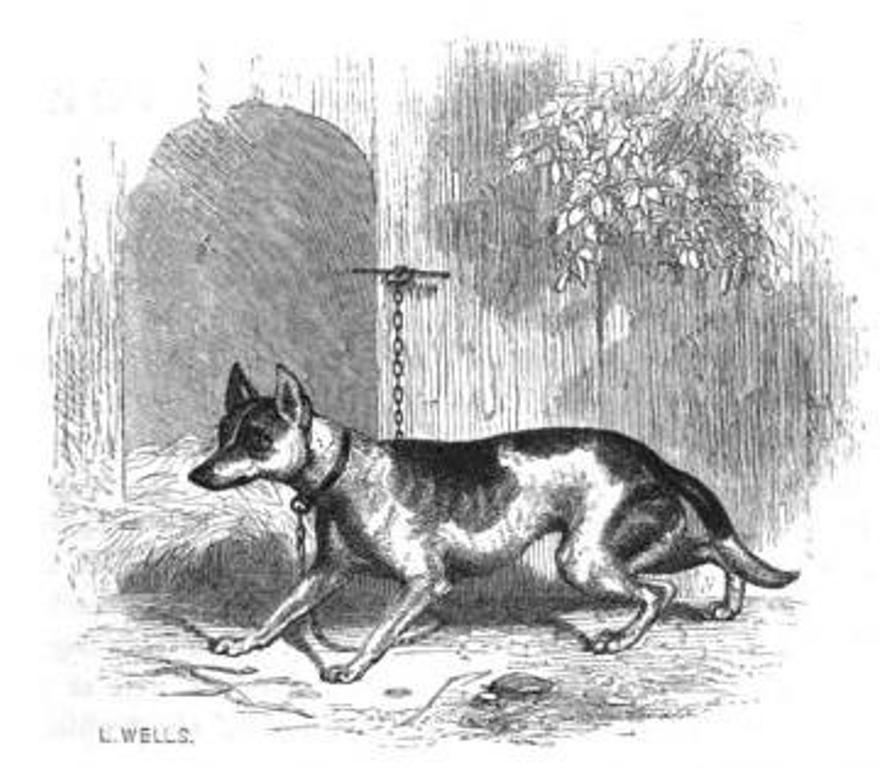
These working Skye terriers have a mixture of features we’d associate with both Cairns and Skyes. One dog, as I mentioned, appears to have a soft coat, but two of the wire-coated dogs appear to have drop ears and are larger in size– features that have historically been associated with Skye terriers. (There still are drop-eared Skyes, but they are quite rare.  It is a bad situation to be rare in a very rare breed!)

The soft-coated Skye became a popular pet among the nobility relatively early on. Many nobles from the Scottish lowlands and town kept them as pets, as Caius wrote that the Scottish nobles took these dogs from “barbarous borders from the uttermost countryes northward” as lap dogs.

So it is very likely that there were actually two types of Skye terrier:   the landrace that gave us modern Skye and cairn terriers and the pet Skye terrier that always had a soft-coat. The people around the Clyde Valley in Scotland also developed a version of the Skye that was a bit smaller, which is sometimes referred to as a Clydesdale or Paisley terrier. That breed is the ancestor of the Yorkshire terrier and its kin.

Rawdon Lee notes that there was some  intense debate as to which coat was correct in Skye terrier. One school believed that the soft-coated dogs were Paisleys and the wire-coated dogs were the “true Skyes.”

I think the dog on the far left is a working soft-coated Skye terrier. They may have never been popular on the island as actual working dog. It is likely that the actual terriermen of Skye, who used their larger terriers on otters, wanted to get rid of these soft-coated dogs and readily sold them to those people with money on the Scottish mainland. Over time, these soft-coated dogs disappeared from the island almost entirely, but when it came to set a “Skye terrier” standard, the vast majority of these dogs were hard-coated– and many had more of what we’d consider cairn terrier features.

And that is a good way to get a hell of a fight going about what the “true Skye terrier” was.

It is likely a very similar situation to the commonly held assumption that all St. John’s water dogs were smooth-coated, when the simple laws of population genetics and the images of English retrievers derived from the water dog clearly suggest that at least some of the dogs imported to England were feathered. (And we have good historical evidence that the Newfoundlanders exported them to England in the nineteenth century. The smooth-coated dogs were more useful in their native land. The golden retriever and the flat-coat are derived from these long-haired dogs).

But because there is always an assumption that remote islands tend to have very little evolution in type and that they likely retain anachronistic forms, it is often assumed that dogs or other domestic animals from those islands are exactly the same as they were hundreds of years before.

It may be true. It may not.

The view that the wire-haired Skye terrier was the only true terrier native to Skye is likely based upon this assumption.

And it’s quite faulty.
From The Dog in Health and Disease (1859). Stonehenge uses some correspondence between a Mr. Tomlin, who makes the claim about this hybrid. The image is supposedly of a creature that is 3/4 dog and one quarter fox that was derived from the original supposed F1 hybrid that wound up in the hands of Mr. Hewer of Reading.

Mr. Tomlin write of the supposed F1 crosses in an 1855 issue of  a publication called Bell’s Life:

I venture to forward you one respecting the fox and dog cross, and, although somewhat out of season, it may, perhaps, prove interesting to the sportsman and the naturalist. In 1853 various accounts appeared in ‘Bell’s Life in London’ of the fox and dog cross, the fact being established by a gentleman of Kent, who then possessed a vulpo-canine bitch which had produce by a dog (vide ‘ Bell’s Life,’ Dec. 1853 and Feb. 1854). This bitch (half fox, half dog), now in my possession, had produce in the month of February last by a terrier dog. The produce are two dog-whelps and three bitches, some of which were (to ease the dam) suckled by a cur bitch. Two of the litter prove in nature shy as a fox; three of them dog-like in appearance, colour, and perfectly quiet, and follow well at heel. Still, they have the real fox muzzle and ‘fox action,’ about which (to those who have well studied it in the hunting-field) there exists but little mistake. Many there are who doubt the existence of any such animal as that between fox and dog. I am, however, in perfect condition to prove (by the living articles themselves) that the fox is merely a separate species of the genus dog, and intercopulates With the bitch, producing not a hybrid or mule animal, but one which will propagate its species to the very end of the chapter (pg. 166).

Mr. Tomblin describes the supposed hybrid bitch giving birth to a litter with a terrier:

In 1855 you were good enough to describe in ‘Bell’s Life’ some history of a vulpo-canine bitch in my possession at Peterborough which had bred whelps, and as you are at this period of the year ‘for the fox and nothing but the fox,’ perhaps you can spare a niche in your ‘fancy columns’ for a subject that may not be considered out of season. The vulpo-canine vixen is now, like all the fox genus, in full coat, and a beautiful-looking animal, higher on the leg than our common foxes, with more frame and size, and looks like going a slapping pace, and carries that unmistakable odour which accompanies ‘the beast of stinking flight.’ She bred a litter of whelps in the spring of the years 1855 and 1856 (got by a * lion-tawny-‘ coloured terrier dog), and goes ‘on heat’ only at one regular period. Her produce are endued more or less with the natural shyness and timidity of the vulpine species, and which it appears somewhat difficult to remove. The formation of their heads is faultless—long, and punishing—in fact, the appearance of these animals resembles terrier dogs, with the perfect head and countenance, back, body, and feet of the fox. The vulpo-canine bitch is now suckling four whelps (got by a good white terrier dog), and as their colours are likewise good — white ‘with black and pied ear-patches ‘ — it is likely to prove a better cross of its sort than the two former litters of whelps which the bitch reared, they being all of foxy, wild, dark-looking colours; and, as the terrier dog which got them was somewhat wicked and crafty in nature, I am now inclined to think that, ‘as like begets like,’ he was not altogether a suitable partner for the vulpo-canine bitch—an animal but one remove from the ‘veritable fox itself,’ as wild, too, as the wildest fox which ever broke away in a state of nature from any ‘ evergreen gorse covert,’ with a pack of hounds in pursuit, all eager for the fray (pg. 167).

Of course, this whole story is one giant flight of fancy. Red foxes can no more cross with dogs than they can with cats. There are plenty of domestic dogs that look like foxes. Virtually all of the smaller spitzes could be mistaken for a fox and could have easily “lined” a terrier.

But such an animal could be claimed to be part fox as a time-tested way of getting rid of a mongrel puppy. Many supposed “wolfdog” are just husky crosses that some unscrupulous person has claimed to be part wolf in order to get rid of them more quickly.

Of course, now that one of these supposed dog-fox hybrids has whelped a litter, Stonehenge is willing to thunder about how dogs and foxes are so similar. It is in this sort of intellectual milieu that Darwin postulated that some dogs were derived from foxes– as well as wolves and jackals.

Source.

Posted in Absolute Piffle | Tagged Osama bin Laden | 2 Comments »

Not an empty threat

(And we did!)

Posted in Uncategorized | 1 Comment »

Is this a photo of Nous and Belle?

I have seen this particular photograph many times in golden retriever history publications and website. It is always pointed out that the yellow retriever on the far left is Nous, the foundational sire of the yellow wavy-coated retriever strain at Guisachan. He looks almost exactly like a golden retriever of today, and at the time, he would have been considered a very typical wavy-coated retriever that had a lot of St. John’s water dog ancestry. He may have been entirely of this ancestry. His breeder, Lord Chichester, left no record of Nous’s ancestry. He was a “sport” in a litter of black wavy-coat pups, and he was given to cobbler at Brighton in lieu of a debt. (I don’t know what sort of debt a landed gentleman would owe a cobbler, but that is the story.) Dudley Marjoribanks, 1st Baron Tweedmouth, encountered the yellow retriever at Brighton in 1864.  We all know his story fairly well.

The dog at the far right is the dog that now Scottish nobleman could be without– a Scottish deerhound or “Highland deer greyhound.” This particular dog appears to be a fawn– a color that has since disappeared in modern deerhounds. Every Scottish sportsman tried his hand a deer-stalking or deer coursing.  In both activities, a wiry deerhound would be necessary. With coursing, it is self-explanatory, you have to have a sight hound for that activity. In deer-stalking, if the hunter merely wounded the deer, he would sent forth a brace of deerhounds to bring down the wounded stag– an action somewhat reminiscent of retrievers. (Stonehenge would classify retrievers and deerhounds together for this reason).

I think it is likely that the second dog from the right is a black and tan wavy-coated retriever. It could be a Gordon setter, but I am a bit skeptical for another reason. The Marjoribanks family used their retrievers to hunt deer. The dogs generally tracked the wounded ones, but there is a least one account of a retriever named Mars jumping into a bog to “retrieve” a wounded stag. Because of their use in deer-stalking, it would make sense that the family’s retrievers would be displayed with the deerhound.

The final dog in this photo is a bit nebulous. From a distance, the second dog from the left looks like a young golden retriever or a maybe a smaller individual. However, at this time, the majority of all wavy-coated retrievers were on the larger, more heavily boned side. Most looked like Nous and the black-and-tan dog– except that the vast majority of these dogs were solid black in color. Most of these dogs were broad-headed and very “Newfoundlandly” or perhaps very much like  the “English Labradors” of today, just with long hair.

This dog’s head is all wrong to be a typical wavy-coat of the day. Its ears are more low-set, and the head is almost conical in shape.

When I first saw this photo, I thought nothing of it, except that this dog looked like a different type of yellow wavy-coat than Nous.

A well-known golden retriever historian pointed out to me today that this dog could have been a “Tweed water spaniel.” Then I remembered a description of the Tweed water spaniel’s head, and I realize that this dog has something like the conical shape that was ascribed to this extinct breed from the Scottish Borders and Northumberland.

Every description of this breed I’ve come across points to the similarity between this breed and other retrievers, so wouldn’t one expect a Tweed water spaniel to look something like a golden retriever?

If this dog is a TWS, then it might be Belle. Belle was born at Ladykirk in the Scottish Borders country, which near the Nothumbrian town of Berwick-upon-Tweed, where the 1st Baron Tweedmouth had been the MP. The Marjoribanks family had roots in the Scottish Borders, and the family had an estate in the region. It would have made sense that the 1st Baron Tweedmouth would have been familiar with this yellow or liver water dog.

By the way, I do not know when this photo was taken. It could have been before 1868, when Nous and Belle were bred together to produce the foundational litter for the strain. If so, then Nous would have had the golden retriever trait of developing a white muzzle in middle age. Perhaps he is the source for the premature graying that is so common in the breed!

Nous also has something in his mouth.I have no idea what it is. He was very much a retriever, and this trait was defintely passed on to his offspring, as this painting of Mary Marjoribanks and either Cowslip or Primrose, bitches that Nous and Belle litter, would suggest.

Judging from the appearance of either Cowslip or Primrose  in that painting and that of Ada, another bitch pup from that litter and the foundational bitch of the Ilchester strain of these yellow retrievers, the Tweed water spaniel used in that cross had to have strongly resembled a golden retriever or a “yellow wavy-coat.”  The golden retriever phenotype was established early on in the breeding program. Indeed, Nous himself could easily have passed for a modern golden retriever.

The Tweed water spaniel or Tweed water dog didn’t closely resemble McCarthy’s strain of Southern Irish water spaniel at all. And this confusion, I think has led more than a few people astray. Everyone has scoured the old paintings and photographs looking for something like a yellow version of that breed, but they should have been looking at those of small yellow retrievers instead.

I don’t know if this dog is Belle or even a Tweed water spaniel. It could be, judging from the fact that it doesn’t resemble the typical early wavy-coat of that day.

But one would expect that this bitch would have not been radically different from Nous or the modern golden retriever.

Posted in golden retriever, golden retriever history, Retriever history | Tagged golden retriever, golden retriever history, Tweed water dog, tweed water spaniel | 36 Comments »

Ice-fishing American water spaniel

Posted in Wisconsin, working dogs, working retrievers | Tagged American water spaniel | 1 Comment »

Captain O’Grady’s Irish water spaniel

This Irish water spaniel appears in Stonehenge’s The Dogs of the British Islands, Being a Series of Articles and Letters by Various Contributors, Reprinted from the “Field” Newspaper (1872).

In the text, this particular dog is said to have been a superior specimen. His coat is less profuse and more tightly curled than one might expect from a modern example of his breed, and his topknot looks somewhat like a glorified Mohawk.

Irish water spaniels of this type were very commonly used as retrievers throughout the British Isles, and they were even quite popular in the United States for a time.   The 1870’s and 1880’s were the zenith of their popularity, which also corresponds to the rise of the institutionalized fancy. The dogs now have largely been replaced by the St. John’s water dog-derived retrievers, and the English springer is now the main working breed of land spaniel– which can also moonlight as a water retriever.

But at one time, the Irish water spaniel was greatly sought after for its retrieving prowess.

It’s just a very different dog from the typical Labrador retriever!

Posted in dog breeds, working retrievers | Tagged Irish water spaniel | 6 Comments »

Follow