Advertisements
Feeds:

Archive for May, 2011

Most interesting quote of the day

In this article about Ryan Bokyo collecting DNA samples from village dogs throughout the world,  I found this amazing quote:

“It was also a good thing this collaborator was used to dealing with large mammals since the shepherds’ dogs near the [Lebanese] border with Syria were very large and not used to handling,” he adds. “There were also enormous guard dogs in that area. After the DNA was analyzed, we found out one of these dogs was actually a full-blooded wolf.”

In Lebanon, the wolf sometimes guards the sheep.

This wolf was probably raised from a pup to live with the livestock guardian dogs, and it adopted their mores and “culture,” which involves considering sheep as part of the family group and doing the utmost to protect them from predation.

I’d like to see how Coppinger would handle that one. In his theory, only dogs that have been bred to have no predatory behavior can ever be livestock guardian dogs. Exactly how many wolves have undergone that selection pressure?

There are no dogs that will never exhibit predatory behavior. There are only dogs that have a lowered tendency to exhibit it  and that have also learned from other dogs what the proper behavior is.  And those same dogs have to have bonded with the stock at some point. Otherwise, why would any dog consider a sheep part of its family group?


Advertisements

Read Full Post »

Golden retriever hog dog

Looks like a catch dog to me.

Read Full Post »

Foxy love

Apparently a lot of this happened around here last winter, because now everyone seems to be seeing lots of vixens with kits.

Read Full Post »

Something no golden retriever breeder wants to see

A bitch licking one of her black puppies:

“It’s just a unique mutation that made this puppy black– and all 9 of his littermates!”

Only correct if  by “unique mutation,” one means fence-jumping Labrador.

Read Full Post »

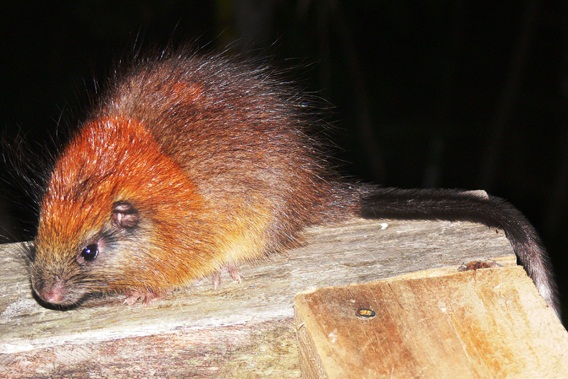
Red-crested tree rat rediscovered

Or maybe this post should read “Red-crested tree rat rediscovers humans.”

From Mongabay.com:

The red-crested tree rat (Santamartamys rufodorsalis) had not been recorded since 1898 and was thought possibly extinct—that is until one showed up at 9:30 PM on May 4th at a lodge in El Dorado Nature Reserve in northern Colombia.

“He just shuffled up the handrail near where we were sitting and seemed totally unperturbed by all the excitement he was causing,” said Lizzie Noble, a British volunteer with Fundación ProAves a conservation group in Colombia focusing on birds.

The nocturnal rodent hung out for a couple hours, allowing Noble and another volunteer, Simon McKeown, to take photos. Noble and McKeown were there to monitor endangered amphibians, but on this night, at least, they found themselves captivated by a long-lost rodent.

Described as about the size of a guinea pig, the red-crested tree rat—or if that’s not long enough for you: the red crested soft-furred spiny-rat—had only been known from two skins previously. But the species was odd enough to be given its own genus, Santamartamys.

With its long absence it’s almost certain the species is quite rare, and researchers say they expect it will be listed by the IUCN Red List as is Critically Endangered. Already, the species is believed to be imperiled by feral cats.

Located in the Santa Marta mountain range, the 2,000 acre (809 hectare) El Dorado Nature Reserve, which was established by ProAves and other groups, has been the site of a number of remarkable incidents recently. In 2007 the Santa Marta screech owl (Otus gilesi) was discovered in the reserve—still undescribed by researchers—while last year the first ever photo of a living Santa Marta Sabrewing (Campylopterus phainopeplus), a hummingbird, was taken in the park. But the red-crested tree rat may be the biggest surprise yet.

“We are so proud that our El Dorado Nature Reserve has provided a safe haven for this enigmatic little guy to survive,” said Lina Daza, Executive Director of ProAves. “The discovery exemplifies why we buy forested properties known to be important for endangered wildlife yet at imminent risk of being destroyed.”

The reserve is home to a high number of endemic birds and amphibians, some globally threatened with extinction.

“The El Dorado Nature Reserve represents the ultimate Noah’s Ark, protecting the last populations of many critically endangered and endemic flora and fauna; a living treasure trove like no other on earth,” said Dr. Paul Salaman, a scientist with World Land Trust-US who confirmed the identity of the species.

ProAves established the El Dorado Nature Resevere in 2005 with support from American Bird Conservancy, World Land Trust-US, Fundación Loro Parque and Conservation International, and the US’s Neotropical Migratory Bird Conservation Act.

“Had we not worked with our partners to establish this reserve, it is reasonable to believe this species would still remain something that was only talked about in science journals,” said George Fenwick, President of American Bird Conservancy. “Now we need to work with our partners to take steps to see that this species continues to be a part of our world.”

These researchers were in search of new species of amphibian.

But I’m sure rediscovering a species of rat will do.


Read Full Post »

Xoloitzcuintli in LIFE magazine, 28 January 1957

Several photos of Xoloitzcuintli appear in a LIFE  article entitled “Hairless Dogs Revived.”

The first of these is of a “mongrel” xolo, which the article contends possesses a “squat, awkward figure” :

By contrast, the “purebred” xolo “has graceful lines”:

The “mongrel” dog does remind me of Stitch, but from my understanding, the Mexicans now allow so-called mongrel dogs to be part of the xolo breed. After all, these dogs represented a landrace breed that continued to exist after the conquest. It just bred into the typical village-type dog– which is all that a xolo is. It is a natural, very rustic village-type dog. It just doesn’t have much of a pelt.

By the 1950’s, these dogs were national symbols of the Mexican identity and were being improved as a standardized breed. This seven-month-old puppy belonged to the Countess Lascelles de Premio Real, who was a prominent breeder of xoloitzcuintli. The article states the ears will become erect after the dog is a year old. Maybe.

And then no article about a breed would be complete without a photo of a bitch with puppies, here is Lampi with her ten-day- old puppies. I think this litter would have had to have had some coated individuals, but they are not featured– either they were removed so the photo could be taken or they were culled.

Read Full Post »

Black and red eastern gray squirrel

As I have written earlier, many melanistic Eastern gray squirrels have red tails, which leads to bizarre conclusions that these squirrel are hybrid with fox squirrels. Melanistic eastern gray squirrels are generally found in the northern parts of their range, where the native fox squirrel subspecies isn’t black at all.

I’ve never heard of the two hybridizing. Eastern grays don’t even like fox squirrels, and although a single fox squirrel can easily beat a gray up, the grays often gang up the fox squirrels. I’ve seen this many times at bird feeders.

This paticular melanistic gray does have an unusual amount of red on it. I’ve never seen one like this before

The vast array of color phases that can be found in the Eastern gray squirrels is really quite remarkable. They come in normal gray. They come in albino, and they have the aforementioned melanistic form.  But there are other colors that are not often mentioned– probably because they aren’t all that widespread.


Read Full Post »

« Newer Posts - Older Posts »

%d bloggers like this: