Feeds:

Archive for the ‘evolution’ Category

What the wall lizards of Pod Mrcaru tell us about dogs and wolves

Changes in diet lead to changes in morphology and behavior:

Source.

These are precisely the same changes that have happened between wild and domestic Canis lupus populations.

Domestic variants are called Canis lupus familiaris.

In the same way that these lizards have evolved to eat vegetation, domestic dogs have new digestive adaptations to consume carbohydrates.

But these does not mean that new species have been created.

In the case of dogs and wolves, there has continued to be a small but not insignificant gene flow between wild and domestic populations. Black wolves in North America obtain their melanism from a mutation that was introduced into their population through breeding with domestic dogs, and now melanistic Italian wolves have been found to have exactly the same mutation that was also introduced in exactly the same way.

I don’t think dogs and wolves will ever become divergent enough to become distinct species, but I do think that smaller dogs, which are genetically isolated from the larger ones, could eventually evolve into a new species.

If there is no gene flow between the lizards on these two islands, they will also eventually become so genetically distinct as to lose chemical infertility.

I should also note that Dawkins hits the nail right on the head when he makes the caveat that we should not automatically assume that the lizards of Pod Kopiste haven’t also experienced rapid evolution as the ones on Pod Mrcaru. They could have indeed experienced similar rapid evolution, but the two would have derived from a common ancestor.

I think some of the problems in doing comparison research on dogs and wolves is that people are unwilling or unable to understand that this possibility exists.

There is an assumption that the wolves we are studying in captive situations are truly reflective of the ancestral population that gave rise to domestic dogs.

Most of these wolves are large wolves from northern Eurasia or northern North America.

It’s very unlikely that any of these wolves has contributed much genetic material to  modern dog populations.  North American wolves haven’t contributed much at all.

Further, most wolves in captivity descend from ancestors that were heavily persecuted by man.

What we’ve done is something like the Belyaev experiment in reverse. Whereas Belyaev selected for lack of fear in foxes, man has selected for something akin to paranoia in wolves.

We’ve trapped and poisoned them across the northern hemisphere.

The only ones that have survived, with the exception of some populations in the high arctic, have been those that have been most overly cautious. It’s well-known that many wolves won’t even cross highways, which stymies their recolonization of much of their former range, and in Yellowstone, at least one “Casanova wolf,” a bachelor wolf that mated only with the non pair-bonded wolves in established packs, used the highway as a buffer zone to keep from being killed by the main breeding male  in the pack.

The wolf that once ranged over the northern hemisphere couldn’t be like these animals. It had to have been much more adaptable and less timorous than these very reactive and fearful animals.

The ancient wolf had to have been an animal that was very easy to domesticate.

I’ve occasionally stolen from an insurance company’s advertisements when I’ve written about these issues, but I do think that dog domestication had to have been so easy a caveman could do it.

Modern wolves, in general, are difficult animals to tame. There are exceptions, and I’ve written about them at length on this blog.

But they are exceptions.

And just because some modern wolves have proven to be quite like dogs when socialized to humans doesn’t mean they are all appropriate pets.

It just means that the analogy that says dogs and wolves are as different as chimps and humans is false one.

You’ll never find a chimp that can do all the things that a human can do, but occasionally, you’ll find a wolf that is as tractable as any retriever or a dog that is as obstinate and reactive as any wolf.

Because some wolves are quite like dogs when they are imprinted and socialized with humans, I think it’s actually much more important to tell people not to keep them as pets.

Just because one tame wolf is as nice as a golden retriever doesn’t mean they all are. In fact, most are not.

But it’s not like the difference between humans and chimps.

It’s really the difference between wild and domestic.

I don’t know why it is that with this one domestic species very intelligent species spend hour after hour trying to deny the proper classification with its wild ancestor.

It’s almost creationist in a way.

***

I should also note the wall lizards have been introduced to southwestern Ohio. One of the members of the Lazarus department store family introduced a few lizards to the Cincinnati suburbs from Italy, and the wall lizards have expanded their range into adjacent Kentucky and Indiana.

Because they were introduced by a member of the Lazarus family, they are called “Lazarus lizards.”

I wonder if these lizards have any unique adaptations that separate them from the ones in Italy.


Read Full Post »

Did kangaroos ever live in the Middle East?

OMG:

Source.

The only fossils of kangaroos that have ever been found are in Australia and New Guinea and the islands near there.

They have never been in the Middle East.

EVER!

Seriously.

They don’t give you any evidence here. They just say that they have to have been in the Middle East because that’s where the ark landed.

If you want to know the real story of kangaroo evolution, check out Tim Flannery’s Chasing Kangaroos.

This is the worst I’ve ever seen it.

Read Full Post »

What really is meant by a living fossil

Also a great take-down of Harun Yahya:

Source.

Read Full Post »

Science vs. Pseudoscience at Glenville State College

My parents are both alums, and this is something that is needed.

Source.

Read Full Post »

An historical legacy revealed in Antarctic fur seals when they prey upon king penguins

From the BBC’s Planet Earth series:

Source.

This is pretty famous footage, but I noticed in the sequence something that is worth exploring from evolutionary perspective.

Notice that when the fur seal catches the penguin, it uses a vigorous shaking motion to complete the dispatch.

It doesn’t kill the penguin quickly. In fact, the seal had tried to rip out its throat, that would be a much quicker way to kill the prey.

However, its very likely that the seal cannot make a choice as to the best way to kill the penguin.

Its killing motor pattern is likely inherited, and anyone who has a dog can recognize the sequence. Give a dog a toy to play with, and they very often exhibit a vigorous shaking pattern as they play with the object.

It’s a motor pattern that has to be trained out of most retrievers, but as a type, they tend to exhibit this motor pattern less often than other dogs, though there is quite a bit of variation within individuals.

In my short time with Pavel, the West Siberian laika, I noticed that his shaking motor pattern was quite vigorous compared to Miley’s. That’s because Pavel’s ancestors have never really been expected to bring prey to hand alive, while Miley’s certainly were. Indeed, Pavel’s ancestors had to kill sable and other fur-bearers and fight off bears and wolverines. Miley’s most immediate ancestors came from genteel shooting estates from Great Britain, where the biggest predatory mammal is the Eurasian badger.

This motor pattern is instinctive in dogs. It does serve a purpose whenever one sees a dog catch a smaller mammal or a bird. A few vigorous shakes usually breaks the neck of the quarry, and it then can be eaten.

This same motor pattern also exists in bears, and when one reads of a grizzly bear attack, the victims often experience violent shaking in the bear’s jaws.

Because this behavior exists in dogs and bears, one can see why the Antarctic fur seals engage in it.

Within Carnivora, there are two major suborders– Feliformia and Caniformia. Bears, dogs, and seals (including true seals, the walrus, and the fur seal and seal lion family) form a clade.

That means they all share a common ancestor about 40 million years ago.

At that time, the dog and bear lineages diverged.

And then about 23 million years ago, the bear and seal, sea lion and fur seal, and walrus lineages diverged. Bears as we know them now didn’t evolve until about 20 million years ago, and the ancestor of the seals and other marine Carnivorans was actually something like an otter.

Fur seals are actually sea lion species, and Antarctic fur seals live almost exclusively on krill. They’ve likely been living on krill for thousands of years, and their ancestors have been living a marine existence for millions of years.

If this shaking motor pattern in Antarctic fur seals is inherited, as I think it likely is, then dog breeders who want to breed it out might have a task on their hands.

For thousands and thousands of generations, these seals have not needed this shaking behavior in order to survive, but when they engage in something similar to the predation of their terrestrial ancestors, they engage it.

I would like to see some comparative studies of this shaking  motor pattern in different fur seal and sea lion population in order to see if this behavior actually is inherited.

But if it is, it is a wonderful example of an historical legacy.

A wonderful little piece of evidence for evolution.

Read Full Post »

Eucyon and the wolf

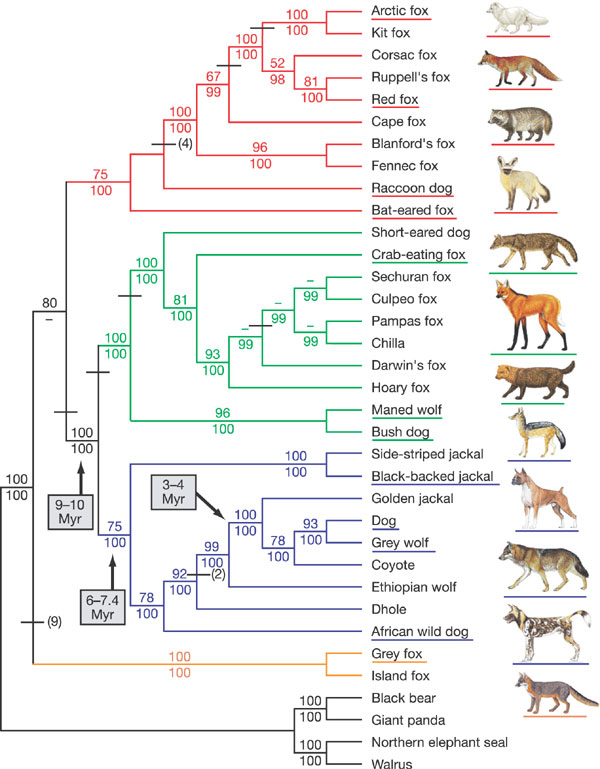
The likely ancestor of all extant species of Canis and probably the dhole and African wild dog is featured in this print.

The smaller canid featured here is Eucyon, a type of canid that lived in North America during the Late Miocene (10-5 million years ago). Eucyon is  both the genus and common name for these canids, which weighed about 20 pounds.

Eucyon means “original dog,” and it believed that all the extant Canis and possible Canis species evolved from some sort Eucyon species around 6 million years ago.

The oldest extant Canis species is the black-backed jackal (C. meslmelas) of Southern and East Africa. Mitochondrial DNA studies suggest that it split off the Canis lineage between 2.5 and 4.5 million years ago.

I have seen depictions of Eucyons that show them looking a lot like black-backed jackals.

However, black-backed jackals are still quite derived from this ancestor, and from my reading of the literature, this depiction is more accurate.  The morphology of this animal is believed to have been very similar to a crab-eating fox, which isn’t actually a fox.

For most of the dog family’s history on this planet,North America was the main center for their evolution. Canis came from North America and then spread throughout Eurasia and Africa.  The dire wolf eventually colonized South America, and then through the domestic dog, the genus eventually spread virtually every else.

Yes. Dogs are much more American than any of us African great apes!


Read Full Post »

Herman Cain meets Bill Nye

And he puts it on his Facebook status. His followers are not amused:

Read Full Post »

« Newer Posts - Older Posts »

Follow