Of all the somewhat reasonable theories about the origin of the domestic dog that have been posited, the one that lingers on is the theory that domestic dogs are derived from jackals. Charles Darwin thought this was a great idea, and he thought that all the different species of Jackal played some role in the development of the domestic dog.
Of course, only the golden jackal can interbreed with the domestic dog or other forms of Canis lupus. The coyote can do the same thing and has done so in the wild. The Ethiopian wolf, which was once thought to be a jackal, has also been known to interbreed with domestic dogs.
Side-striped and black-backed jackals cannot interbreed with dogs. They both represent the oldest extant forms of the genus Canis. It has been suggested that they be moved back to Thous, the old genus for jackals, for their real taxonomic status is like that of the Dhole and the Lycaon species. They have the same number of chromosomes as the interfertile Canis species but are currently recognized to be in their own respective genera, because they are very different from those Canis species.
Now, Darwin’s theory on the supposed jackal origin of the domestic dog grew new legs with the work of Konrad Lorenz, one of the founders of ethology. His theory on dog origins was posited in Man Meets Dog, which is an exploration of the natural history and ethology of man and dog.
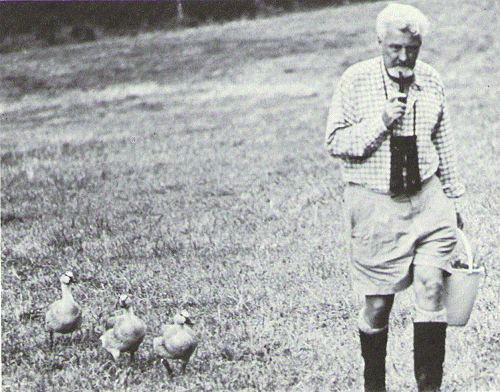
Before I explain the particulars of Mr. Lorenz’s theory on dogs, I must point out two things about this man. He is credited with discovering the phenomenon of imprinting. (However, Douglas Spaulding is person who actually discovered this aspect of animal behavior in the nineteenth century). He is often remembered for his work on graylag geese, which imprinted onto Lorenz as little goslings. He’s really better known for this part of his work, which is why that linked photo depicts him with a goose.
Now, the other you have to know about him are his politics. We all talk about Germans and Austrians who lived at the time of Third Reich and the Second World War. Many had to make compromises with that odious regime just to survive. Konrad Lorenz, I must say wasn’t one of those guys. He actually willingly joined the National Socialists in 1938. Lorenz was an Austrian, and after the Anschluss, he qualified to join Hitler’s party as a citizen of the Reich. He was given a university chair, and to thank the regime for his position Lorenz wrote: “I’m able to say that my whole scientific work is devoted to the ideas of the National Socialists.” He had also had a positon in the infamous Office for Race Policy.
Now, I’m sure all of you think that this is an ad hominem attack on the man. I don’t think so, because even though he did recant on some of his racist scientific beliefs. He was also active in the Austrian Green Party in his later years, and much of his later work was of a humanitarian nature. (Although I have to say his quasi-sociobiological theory on human aggression was less than convincing.)
As for his theory on the origin of the domestic dog, he believed that some dogs were derived from wolves and some are derived from jackals. The wolf-derived dog was like a chow, very loyal to one person, undemonstrative, and somewhat aggressive toward stangers. The jackal-derived dog was like spaniel, very friendly to everyone and always fawning over people just to get attention. The wolf-derived dog is capable of loyalty and great love, while the jackal dog is just in it to get some food (because Lorenz incorrectly believed jackals were mostly solitary animals.)
Lorenze eventually recanted on this theory when the evidence became overwhelming that all dogs–including the fawning variety– are derived from wolves, not jackals. But from the reading of the text, one gets the impression that Lorenz preferred a wolf-derived dog. He was lover of chow crosses, which in their original temperament were very similar to Lorenz’s description of the wolf-derived dog.
It has been speculated that Lorenz developed this theory in part from his close association with Nazism. In this scenario, Lorenz created a dichotomy between the wolf of northern Eurasia and the golden jackal of Mesopotamia, which is very similar to the Aryan versus Jew dichotomy created in official Nazi policy. The golden jackal-derived dogs are the inferior “Jewish dogs,” while wolf represents the Aryans. Perhaps it was subconscious that Lorenz created this bizarre theory, but it does strangely mimic Nazi racist science.
***
You should find this somewhat disconcerting, because I have noticed that a lot early wolf research seems to have a sort of Nazi influence. Rudolf Schenkel was studying wolves in Basel, Switzerland when the Nazis came to power. Although not a German, he was a German-speaker, and much of the German literature at the time was focused on survival of the fittest. Within that line of thinking is the view that domestication causes animals, including people, to degenerate. The aggression and strict heirarchy of Schenkel saw in a wolf pact was natural for a social animal that had no degenerated through the niceties of domestication.
I am not saying that Schenkel was a Nazi, but his ideas were being developed in a German-speaking academic culture that was very much focused on racial hygiene and purging society of the degeneration that had occurred through civilization. It is a kind of bizarre nature-cult that sees the natural form as being good, and the domesticated form as being inferior. The Nazi regime did not grow out of a vacuum. It grew out of a political and academic culture that was openly discussing things from this nature cult perspective, both consciously and subconsciously.
Because these studies from the German-speaking world of that time were at the base of the literature on wolf and dog behavior, there was tendency to see the dog as degenerate wolf. This legacy still exists within certain sectors of academia, but it is fading, largely because of those new studies on dog social cognition.
Not only have these sorts of paradigms set back our understanding of dog origins and their cognitive abilities, we are still holding onto some rather antiquated concepts about dogs and wolves and the supposed strict heirarchy in which they live. It has only been recently that L. David Mech began to question that pardigm.
We are right now about to experience a paradigm shift on how we think about dogs and wolves. I don’t think many people are going to like it at first, because it is very different from what we’ve been taught.
*Note: I’m not making a case that dogs cannot be punished. I’m just saying that all this leader of the pack business might be nonsense. The reason why dogs are tractable is not because they are wolf-pack members. They are tractable because they are capable of learning from us what certain rules and expectations are. That’s something that wolves and other wild dogs are really unable to do, which is why wolves are so hard to housebreak and train.
***
Now, there is a dog that has golden jackal in it. It is called the Sulimov dog. The average domestic dog is C. Lupus with very little or no C. aureus in it.




The ‘natural form as superior to domesticated/lesser/easier form’ bugaboo persists today. Look at folks repeatedly creating ‘new’ breeds of wolf/dog crosses and insisting ont heir utter perfection and ‘ancient’ history (usually linked with lots of dreamcatcher and generic Native-ish imagery, claims of ancient utility by whatever tribe the creator idolizes, etc.)