Feeds:

Archive for October, 2009

Why you should never believe everything you read on the internet

Wrong on the internet

It’s going to be one of those posts. Don’t say I didn’t warn you.

I was perusing this site on Native American dogs, when I came across something very, very wrong:

All of these primitive dogs are probably, to one extent or another, related or have very similar ancestors. The only difference is that Native Americans also developed their dogs from crossing in coyotes thousands of years ago. Where as the dogs from Africa, India and Asia used jackals and small Asian wolves that are more Jackal-like than wolf-like. With modern DNA and logical research, it’s now known that the wolf was not the ancestor of the modern dog, but coyote and jackals were the modern dog’s ancestors. Outdated research said all people and dogs migrated into the American continents across the Baring [sic] Straits [also not true– for both people and dogs!]. New, more recent research shows they also came up from the south [not a single study suggests this].

Very little of this paragraph is true. Dogs are derived from some form of Eurasian wolf, including the native dogs of North and South America. In fact, the big contention right now is where in Eurasia. Right now, the big debate is whether Savolainen’s finding that dogs come from southern China or whether the dog comes from some other part of Eurasia.

Coyotes and golden jackals played a negligible role in developing the domestic dog. The fact that many Native American dogs in North America looked a lot like coyotes is mostly circumstantial. These dogs have had their MtDNA and nuclear DNA analyzed, and they are also derived from Eurasian wolves. The only dogs that have been known to have jackal in them are the Sulimov dogs. Dogs are wolves. That case has been settled long ago.

I found a few other things that were wrong with this site. One of them is the suggestion that the largest Native American dogs (other than those of the Arctic hauling spitz variety) were the size of a Carolina dog or dingo.

I’ve read too many accounts of large wolf-like dogs in North America during the colonial period and the era of exploration to accept this theory.

The truth is that Native Americans were expert dog breeders. They produced all sorts of different forms of domestic dog.  Wool-producing dogs in the Northwest, little bear dogs that resembled chihuahuas, and the hairless dogs of Latin America are but a few varieties that the original inhabitants of the Americas were able to create.

I don’t know why people keep repeating that dogs are derived from jackals or coyotes. It’s the one theory about the origins of domestic dogs we know for sure is false.

Research into dog and coyote hybrids suggests that there is decreased fertility and embryo survival when hybrids are bred to each other over several generation.  While we have found fertile coyotes with dog MtDNA and the Eastern North American wolf and red wolf have coyote MtDNA, the fact that hybrid coydogs cannot carry remain fertile or produce many offspring through successive generations of back-crossing suggests that coyotes played a very small role in development of the domestic dog.  It is also one reason why the coydog population remains relatively low.

When Sulimov created his golden jackal hybrid sniffer dog. He had to have husky bitches nurse jackal pups because male jackals won’t mate with a domestic dog. This is the opposite of the behavior one sees naturally occurring dog and wolf crosses. In those crosses, the male wolf readily mates with the dog bitch. The fact that Sulimov had to go to these lengths to get the animals to crossbreed suggests that they aren’t that closely related, even if they can produce hybrids that are very often fertile.

I don’t know why people hold onto these tired old theories. Konrad Lorenz was wrong. Get over it.

It’s not as bad as believing chihuahuas are derived from fennec foxes, but this theory has been thoroughly disproved.

***

If you want to read the truth about Pre-Columbian Native American dogs,  check out Marion Schwartz’s A History of Dogs in the Early Americas.

Also worth reading is Mary Elizabeth Thurston’s The Lost History of the Canine Race, which has a wonderful chapter on the various types of Native American dogs.

Read Full Post »

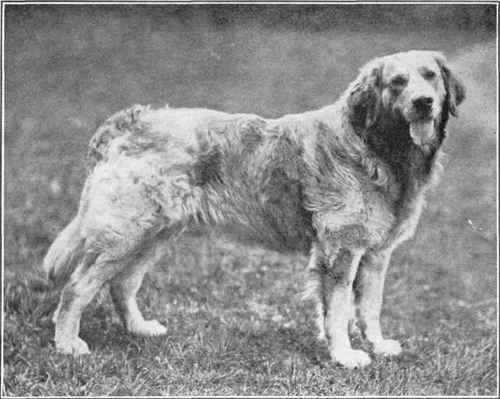
I think I can guess something about this dog’s parentage

mongrel

The wikimedia description of this photograph says:

 “A hybrid mixed-breed dog. A real mongrel in which not a single contributing breed is recognisable.”

I’m thinking that this dog has some working strain golden retriever in it.

Read Full Post »

Petition to make the AKC stop registering puppy mill dogs

Most factory hog farms are more sanitary than this puppy mill.


I no longer agree with the content of this post.

Read Full Post »

Golden retrievers and “Yellow Russian Retrievers”

I found something rather interesting in W.E. Mason’s Dogs of All Nations.

The entry for the flat-coated retriever has this description for its color:

“Color : Rich black,  free from rustiness and from white. There is also a Golden Retriever so named because of the golden or yellow color of his coat.”

 While it is interesting that liver isn’t even mentioned as a color for the flat-coat, Mason places the golden retriever as a color variety of the flat-coat. That means, in his eyes, the golden is basically a golden or yellow flat-coat.

This is the photo Mason includes with the flat-coat entry:

W.E. Mason's Flat-coat

Now, this book was published in 1915, when the golden was in the process of separating from the flat-coat.  During this same time period, the Russian origins myth about the golden was being bandied about. Mrs. Charlesworth, who is basically the founder of the golden retriever as a separate breed, was a firm believer in this story. In 1915, the dogs were considered separate breeds, but you could breed black flat-coats to goldens and then register the offspring as separate breeds depending upon color.

Apparently Mr. Mason was not a believer in the Russian origins of the golden. Or maybe he didn’t get that memo.

However, when one goes a bit deeper into his text in the section about Russian dogs, one comes across this dog:

Russian yellow retriever

The entry that includes this dog is called a “Russian yellow retriever.” The dog has this description:

Color: Yellow or rich red sable. Height: 28 in. Weight: 90 lbs.

This dog is similar in all essentials to the English [flat-coated] Retriever, except that he is a size bigger and heavier in coat, and of course different in color, as his name implies. He is used principally for tracking wounded deer.

Now, this dog is not Russian at all.

This is Col. William le Poer Trench’s strain that came from culls from the Tweedmouth strain. The culls he had were of the larger, Newfoundlandy- type of golden that appeared in some the dogs in the strain in the late 1880’s and early 1890’s. He firmly believed his dogs were Russian, and he managed to get the Kennel Club to let him show his dogs as a different strain. However, they had to be shown within flat-coat breed, which means they didn’t do so well.

He was a noted liar. He got a former keeper from Guisachan to write a letter verifying the Russian origins of the dog. He then went to Russia (supposedly in the Caucasus) in search of new stock. New stock from the Ovtcharka lines that were supposedly in this strain. Of course he found no dogs. He claimed that all the dogs were in the mountains with the sheep, and he couldn’t find any. However, it is more likely that he found some dogs of the Ovtcharka type, and after dealing with the dogs for a few minutes, very quickly realized they were entirely unsuitable as an outcross to a line of retrievers. (This video explains why).

These dogs look a lot like the big pet goldens that are offered today.

It is interesting that their job description was tracking wounded deer. There are accounts of the Tweedmouth strain dogs doing a lot of deer tracking at Guisachan. This is usually where someone says that bloodhound was crossed in, but the evidence isn’t that good. And my main complaint with it is that I have found no records of short-haired dogs with heavy ears in the entire strain.

But it is very interesting that the Tweedmouth strain of wavy or flat-coat was exhibited in two different breeds at one point. I should note that Trench’s Russian dogs played no role in the founding of the golden retriever as a separate breed. His strain became defunct after he died in 1920.

And if you look at the early goldens from the Ingestre, Noranby, and Culham lines, you can see that they are very clearly of the flat-coat/wavy-coat type, and not of the giant yellow dogs that supposedly came from Mother Russia.


Read Full Post »

Yorkies look different with tails

Source.

Yorkies are normally docked over here, but this was filmed in Sweden where it is illegal.


Read Full Post »

A Famous West Virginian

Traveller and Robert E. Lee

No, not Robert E. Lee.

His horse!

This horse is probably the most famous horse in American history. His name was Traveller.

And he was from West Virginia.

He was born at Blue Sulphur Springs, Greenbrier County, Virginia in 1857.

Somewhere in his pedigree is the famous racehorse named Grey Eagle, a thoroughbred. I have seen this horse listed as his sire, but that horse was being run in the late 1830’s and  early 1840’s. Now, horses do live a long time,  but I wonder how long they lived in the nineteenth century.  Where ever Grey Eagle fit into Traveller’s pedigree, this horse was considered the top of the line for his time.

In those days Greenbrier County was known for its fine horses, and Traveller took first prize at the Lewisburg fairs in 1859 and 1860.

At the outbreak of the war, a quartermaster for the 3rd Virginia Infantry purchased Traveller, because he was of the Greenbrier stock and could be of some use during the war. He named the horse “Greenbrier.”

Greenbrier proved to be as sturdy horse that could be ridden hard over the terrain of the Allegheny mountain roads. Lee was stationed in that part of Virginia during those early months of the war, and he was smitten with the young colt.

When Lee got transferred to South Carolina in 1862, the quartermaster sold him the colt, which Lee then renamed Traveller, perhaps because of his ability to traverse the rugged mountain roads with such ease. He could also go long and hard, a trait that was essential for any officer’s horse.

Traveller was also very easy to handle and not easily spooked, but during the Second Battle of Bull Run, Traveller became frightened by the advancing enemy and ran. That wouldn’t have been such a bad thing, but Lee had dismounted and was holding the horse’s bridle. When Traveller bolted, the horse dragged Lee down on a stump, breaking both of his hands. Lee spent the rest of the campaign in an ambulance.

After the war, Traveller accompanied Lee to Lexington, Virginia, where Lee was president of Washington College (now Washington and Lee University). During his tenure at Lexington, Traveller’s tail was often ragged and moth-eaten from people plucking hairs from his tail. They were collecting his hairs as souvenirs. It was as if they were collecting the hairs of Alexander’s Bucephalus. (Lexington, incidentally, isn’t that far from Traveller’s birthplace.)

Lee died in 1870, and Traveller followed the caisson carrying the casket.

Then Traveller stepped on a nail in 1871 and caught tetanus. He had to be euthanized.

He was buried on the campus of Washington College, but in 1875, his bones were exhumed and taken to Rochester, New York, where they were bleached and put on display.  Then in 1907, the bones were returned to Washington and Lee, where they were displayed at the school’s museum.

However, those bones were not preserved. Students often carved their initials in the bones for good luck. As it became obvious that the bones were in trouble, they were moved to the basement of the Lee Chapel, but they still continued to detiorate.

In 1971, the bones were buried near the Lee family crypt, where Traveller’s master’s remains are located.

Now, I should mention here that Greenbrier County, Virginia, is now Greenbrier County, West Virginia. Its county seat is Lewisburg, where Traveller won those first prizes as a colt. (This is the same county where the Greenbrier hotel –and former congressional bunker–is located).

So Traveller is technically a famous West Virginian, though of the equine variety. I’m surprised I never read a word about this when we had West Virginia history, and I’m a Knight of the Golden Horseshoe. West Virginia history is taught– at least when I had it– in such a way that tries to show all the famous people who are either from here or grew up here. I’m sure other states that have these required history courses teach them in exactly the same way. I heard all about Pearl S. Buck, Booker T. Washington, Leon Sullivan, Stonewall Jacks, and Barney Fife Don Knotts, but not a single word about Traveller.

***

Richard Adams (of Watership Down fame) wrote a biography of Traveller, which is written entirely from the horse’s perspective. I’ve not read it, but I have read Adams’s other work that uses animals as main characters. And I really liked the those books.

So maybe I need to get this book. From my reading of reviews, Adams tries to give the horse a Southern accent.  I don’t know how that would work, considering Adams is from England, and the English never get American accents right!

Read Full Post »

What is wrong with this picture?

strange thing

The answer.

Read Full Post »

« Newer Posts - Older Posts »

Follow