
Winfred Charlesworth with Ch. Noranby Diana, Ch. Noranby Dutiful, and Ch. Noranby Deirdre
If I hadn’t been for the efforts of Winifred Charlesworth, it is likely that the golden retriever would have remained a minority color variant of the flat-coated retriever. Not only did she write the first proposed standard for the breed in 1910, but she also developed one of the three founding strains of the breed. Her Noranby dogs were part of the bedrock on which this breed is based.
The other two lines, the Earl of Shrewsbury’s Ingestre dogs and the 1st Viscound Harcourt’s Culham line, certainly played a role in the foundational stock of the breed.
However, it is very likely that without Winifred Charlesworth’s constant patronage, the fortune of these dogs would be tied up in the flat-coated retriever. The flat-coat was a celebrated working dog in late nineteenth and early twentieth century Britain. However, not long after the golden had been separated from the flat-coat, the flat-coat’s popularity dissipated,
It is very likely that the strains that gave us the golden would have remained a minority within the flat-coat breed, and when the flat-coat became a minority breed, these dogs would have disappeared.
We’ve seen similar colors and forms disappear in other breeds that have lost their popularity. Good luck finding a drop-eared Skye terrier, and I guarantee you that you won’t find a wheaten Scottish deerhound.
Even relatively common breeds lose their minority colors. Solid red English springer spaniels were not unkown, but these dogs don’t exist all today. The “mouse” color in the French bulldog is probably gone, but some claim that blue Frenchies are the mouse dogs. Black mastiffs were once relatively common in the breed, but today, all so-called black mastiffs are actually very dark black brindles.
It is likely that the very dark colors in the golden retriever will disappear. The FCI and KC standards don’t want red or mahogany dogs, even though red and mahogany dogs were part of the breed from the beginning (and were the majority of the breed). The tendency now is to breed for a dog with the recessive chincilla factor that produces lighter colored dogs. The net result of such selective breeding will mean that the dark colors will simply disappear. It is possible to produce light-colored puppies from dark-colored parents. It is impossible to produce dark-colored puppies from light-colored parents.
I just want to give you an idea of what the color range was for the Noranby dogs, including one of the dogs featured above.
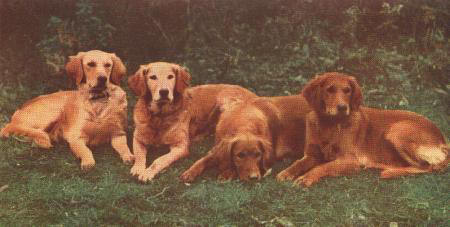
The second dog from the right is Ch. Noranby Diana, which is the same dog featured at her mistress’s side in the top photo.
***
The first champion in the breed was a Noranby, Ch. Noranby Campfire.

Ch. Noranby Campfire, b. 1912. First champion golden retriever.
***
Yes, a lot of these early dogs were quite dark-colored, and here I need to make something clear.
The dark color of these dogs did not exist because these three foundational strains were interbred with black flat-coat. Black (EE or Ee) is a dominant color over yellow t0 red (ee). However, an entirely different gene determines the extent of the yellow to red coloration (C or c). Black versus liver is determined by another set of genes (B or b). It is possible for a yellow or red dog to have the alleles for dominant black coloration (BB o Bb). That’s because the (ee) prevents the black coloration from being expressed on the coat. If you have a golden, it is most likely a black dog with with the ee. That’s one reason why it is very easy to get black puppies if you breed a golden retriever to virtually anything, including brindle boxers and sable collies.
And yes, I’m aware the the recessive c alleles has several different versions, but I can’t type them here. (Source)
***
I should also point out that Winifred Charlesworth was a firm believer in the Russian circus dog theory of the golden origins. It has long since been debunked, but I think there are plenty of good reasons why someone would continue to promote something so bizarre. After all, it doesn’t take a genus to see how similar golden retrievers are to flat-coats, and the Noranby dogs really do look a lot like red flat-coated retrievers.
However, I don’t think the move to separate the golden from the flat-coat would have been so strong in 1910 if it was assumed that this was nothing more than a color variety of the usually black flat-coat. If the dogs had an exotic and very different origin from the flat-coats, it would be easier to justify separating them.
It is very likely that this is all the Russian circus dog story was. It was an origin myth that legitimated separation.
I’m not saying that these people were all liars, but they were all believing Grade A bull-plop.
And although it is obvious that these dogs are very similar to comtemporary flat-coats in every respect except for color, this story had power to shape the distiny of two breeds.
The flat-coat became quite rare in the succeeding decades, while the separated golden retriever would become unbelievably popular. It would eventually become the second most popular dog in the United States, if we are to use AKC recognition statistics as a guide to popularity. Today, the breed is the fourth most registered dog with the AKC. It has lost its second-place ranking to the Yorkshire terrier.
And both breeds have diverged into different dogs, although I won’t go as far as to say that they are very different. The tendency is breed goldens with more bone and coat, and the tendency in flat-coats is to breed for less bone and for less profuse feathering. But whenever you see a yellow flat-coat or a lightly built golden, you can tell that their history is connected.
And goldens aren’t from Russia.




There’s a lot to be said about human perception and the value of a name. Once the word “Golden” was added to the name of the color variant, there was a perceived value added to the notion of owning one. Conformation was after all a fancy founded by the elitist culture of the time. Ironically the fancy still has that air of elitism about it even today.
The naming of our hybrids required some thought. In which case the name now has sort of a viral momentum. Its actually very interesting. I suppose if the “doodle” craze had put more thought into putting a proper name on the mix it could have proven to be as infectious as stamping the word “Golden” on a previous variant of the dog over a century ago.
I’ll add, that the Chestnut and Mahogany Goldens we know are beautiful and sport a luster in their coat you don’t find in the lighter show Goldens. Similar to the shiny coat seen on the dark colored Black and Liver FCR.
Winifred Maud Charlesworth was indeed the person behind KC recognition of the Retriever (Yellow or Golden) as they were originally registered. Retriever (Golden) became official around 1920.
The original breed standard called for any shade of golden, but neither “mahogany or cream”. During the 1920s the fashion was for deeply colored dogs without any light shadings, although those had always been a breed trait. About 1936 the British standard was altered to allow “golden or cream”, although failing to state that this was in order to permit the light shadings. So opened the door for paler and paler dogs, although it wasn’t until the 1970s or so that wholly “cream” dogs became popular.
North America and Australia still have plenty of dogs with truly “golden” coloring.
North America certainly does.
The 1936 standard was the one that allowed for cream and for a slightly shorter height at the whithers.
Mahogany was common enough in the early days of the breed, for the first dual champion (Balcombe Boy, bred by Viscount Harcourt, meaning the dog was of Culham breeding) was of this color.
It seems to me that the Tweedmouth strain was important to the founding of the breed, but that these dogs were fedback with black flat-coats that had been outcrossed with Irish setters or Red Gordon setters. The Culham and Ingestre lines had black flat-coat relatives.
I’ve also found that the famous flat-coat Moonstone was bred back to his dam. This mating produced a red bitch puppy named Foxcote. Moonstone’s litter brother Tracer (I believe) was bred into the strain at Guisachan– probably in hopes that that this would have produced some red or golden colored puppies.
I have also found a retriever in a Landseer painting named Breeze that is clearly a wavy-coat, but he looks like a golden retriever:
http://www.dogpainting.com/art_detail.cfm?Reference_Number=EL00_40
This dog lived in the 1840’s.
Sampson (a red setter) was bred into two different litters early on. One was with Cowslip.
I don’t see mention of that here… Also, nobody really knows what Belle looked like and what exactly her color was…
Very interesting article!
My guess is that Sampson looked like the photo that you posted here: https://retrieverman.wordpress.com/2009/11/24/old-fashioned-irish-setters-early-goldens-and-some-modern-dogs/
I often think about the following article whenever anyone talks about color and Golden Retrievers. http://www.grca.org/pdf/health/cancer.pdf
If you look a few pages in, you can see a study that was done with Golden mice where they fed the pregnant mice differently. Those fed soy were darker and slimmer and less prone to certain diseases. I often wonder if any Golden breeders have checked out this theory with their litters. At any rate, I was surprised to see that diet during pregnancy could affect major attributes… This post is a little off topic but I was wondering if anyone who reads this knows of a GR breeder who has checked out this theory.
The genes for color inheritance in Goldens are not the same as in viable yellow Ay mice. There is absolutely no reason to think that coat color in Goldens is actually linked to cancer incidence. “Mice that carry the lethal yellow (Ay) or viable yellow (Avy) mutation, two dominant mutations of the agouti (a) gene in mouse chromosome 2, exhibit a phenotype that includes yellow fur, marked obesity, a form of type II diabetes associated with insulin resistance, and an increased susceptibility to tumor development.”
http://www.ncbi.nlm.nih.gov/pmc/articles/PMC1440782/?tool=pubmed
Effects of diet on cancer are nothing new, specifically antioxidants. There are a lot of studies out there on specific foods or constituents of foods.
http://www.ncbi.nlm.nih.gov/pubmed/21158707
http://www.ncbi.nlm.nih.gov/pubmed/21119663
http://www.ncbi.nlm.nih.gov/pubmed/21098631
http://www.ncbi.nlm.nih.gov/pubmed/21067630
Anyone who has a cancer prone breed would do well to read the research on diet and cancer. Adding some veggies to the diet will certainly not hurt the dog, and may do some good.
After reading that PDF, though, this needs to be said (and I’m sure Scottie is waiting for it, and I don’t want to disappoint him.) OMFG OMFG OMFG OMFG OMFG OMFG OMFG COULD HOVAN ACTUALLY GET MORE DISGUSTING?
Let’s get an entire room full of pet Golden owners who have lost dogs young to cancer, and let Ms. Hovan tell them that purity matters so very much, and crossing in something else would make Goldens not be Goldens any more (selective breeding, people, look it up! How do you think Goldens were developed in the first place?) and so they should just suck it up, because ‘being’ a Golden might mean ‘having cancer.’ Therefore we shouldn’t be doing any experiments involving breeding dogs together that have different MHC genes, or cross-breeding to increase heterozygosity. You know, just to see what would happen.
Good freaking grief, she even misuses the Dalmatian Backcross project. Here’s the truth:
http://www.showdays.info/LUA.php
And here’s some LUA Dals, with spotting patterns well within the norm for Dals, and how did they get that? Oh yeah, that pesky selective breeding again:
http://www.luadalmatians.com/Meet.html
And gee whiz, the UK KC has accepted a couple of LUA Dals for registration.
I am probably going to have to blog this, because the first time around wasn’t enough:
http://desertwindhounds.blogspot.com/2010/07/dear-closed-registry-proponent-shut-up.html
These people just piss me off to no end.
“Is it possible that we could ever face similar choices in Goldens? Could some part of “what it means to be a Golden” be linked
with the risk of cancer? Unfortunately, this is a very real possibility.
Remember the theories presented above that deleterious genes
from early founder dogs have concentrated over time, to the point
now where it has resulted in an elevated risk of cancer and a compromised immune system? So what makes genes concentrate like
that? Well, with every generation that goes by, breeders are constantly selecting desirable genes to keep in the gene pool, and less
desirable genes to reduce or eliminate. So in essence, the gene
pool is always under selection pressure to shrink, and as a closed
gene pool, it can never get larger. And one of the reasons that we
may have inadvertently kept and concentrated genes associated
with cancer risk and immune dysfunction is that those genes may
very well be linked to genes that we have selected as part of what
it means to be a Golden.”
I’ve heard that same line about Scottish terriers, Boston terriers, boxers, and rottweilers.
Cancer was just selected for when we bred them.
None of those dogs look alike, behave alike, or are anything alike. (Bostons and Boxers are bulldogs but on different parts of the family tree.)
What they have in common is they are closed registry breeds.
Wow Jess, that was a lot of emotion!
I thank you for the reading materials.
Lord Tweedmouth bred together a yellow flatcoat, a Tweed Water Spaniel, a champion Labrador Retriever, a Red Setter… all those dogs went into creating the Golden Retriever breed. You could say that Lord Tweedmouth was a fan of open registry.
I always cringe when I see these pedigrees with the same champion dog listed 6 or 7 times in 5 generations… Looking at the dogs at the Westminster, yes, they are gorgeous but their pedigrees all look the same and they all are very closely related. It would not be acceptable for humans to pair up like that.
While it is true that 1st Lord Tweedmouth combined several sorts of gundogs in the development of his yellow retrievers, there was no “champion Labrador”. He died in 1894, and Labradors didn’t achieve champion status until after 1903. The notable cross of British FTCh Hayler’s Defender (yellow Labrador) didn’t happen until the late 1920s, when the Haulstone kennels (Golden Retrievers) used him.
However, 19th century retriever pedigrees show considerable intermingling of the retriever varieties, as they were at that time all considered a single breed with coat and color variations. The ‘first yellow Labrador’, Ben of Hyde, shows several dogs in his pedigree that also appear in Golden (and probably Flat-Coat) pedigrees.
I thought that CH. Wisdom was a lab. Was Wisdom a Flat coat?